





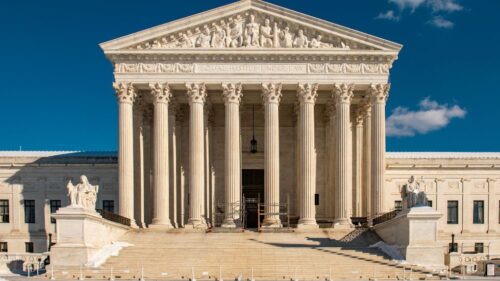
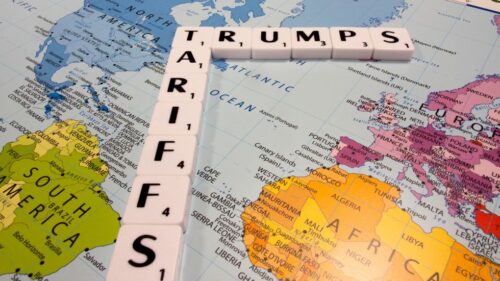
Editor-in-Chief Atul Singh and FOI Senior Partner Glenn Carle, a retired CIA officer who now advises companies, governments and organizations on geopolitical risk, examine a 6–3 US Supreme Court ruling that struck down most of US President Donald Trump’s recent tariffs as illegal. The decision, issued on February 20, found that the administration exceeded its authority under the International Emergency Economic Powers Act (IEEPA), which Trump had used to declare a national emergency over the US trade deficit. Within hours, the president signaled defiance, promising to rebuild tariff barriers using “methods, practices, statutes and authorities that are even stronger than the IEEPA tariffs.” What follows now is deeper constitutional and economic uncertainty.
The constitutional fault line
Glenn frames the ruling as part of a “tectonic” struggle over the nature of American democracy. The US system, he argues, “was by design to be inefficient,” built on separation of powers and checks and balances precisely to prevent “unfettered executive authority.” For decades, however, a dominant strain within the Republican Party has embraced the theory of the unitary executive. They assert that the president must be empowered to act decisively in the national interest, even in the face of congressional or judicial resistance.
The Court’s ruling reinforces a basic constitutional principle: Taxation and tariff powers rest with Congress. Drawing on the major questions doctrine, which was previously used by the conservative majority to curb federal bureaucratic agencies, the justices now turn that reasoning against the executive itself. For Atul, this demonstrates that the Court is “not entirely a handmaiden of the executive yet,” and that checks and balances still function.
But a deeper crisis lurks. If the executive resists implementation, the judiciary has no enforcement arm of its own. The president controls the Department of Justice and the machinery that executes court orders. In theory, impeachment could discipline open defiance. In practice, however, with Congress divided and midterms looming, that appears unlikely. The ruling thus exposes both the resilience and fragility of constitutional governance.
Legal workarounds and fiscal fallout
The economic implications are immediate and complex. The IEEPA tariffs, imposed after Trump’s declaration of a national emergency on April 2, 2025, had already generated an estimated $200 billion in import duties. Those funds must now be refunded, but repayment could take years of litigation. Companies are lining up for reimbursement; class-action lawyers are preparing to argue that any refunds should flow to consumers rather than remain with corporations. Trump himself has noted that the Court did not explicitly address repayment, leaving the issue unresolved.
Meanwhile, the administration is far from out of options. Supreme Court Justice John Kavanaugh’s dissent emphasizes that “numerous other federal statutes authorize the President to impose tariffs.” Section 122 of the 1974 Trade Act allows temporary tariffs of up to 150 days to address balance-of-payments difficulties. Invoking this authority, Trump announced a 10% global tariff, raised to 15% on February 21. Other provisions permit duties of up to 50% against countries deemed to discriminate against US commerce, as well as restrictions justified on national security grounds.
More dramatically, Trump could simply delay dismantling the IEEPA tariffs. With control of the executive branch, the administration might slow compliance indefinitely, using prosecutorial discretion and presidential pardons to shield officials. Such a move would deepen the constitutional clash and compound uncertainty.
Trade deficits and inflation reality
Atul and Glenn stress that the tariffs’ original objective, reducing the US trade deficit, has not been met. The overall deficit declined marginally from $903.5 billion in 2024 to $901.5 billion in 2025, a mere $2 billion shift. In some cases, deficits widened. For instance, the US goods deficit with India rose from $45.8 billion in 2024 to $58.2 billion in 2025. A small US services surplus may turn into a roughly $4 billion deficit.
Simultaneously, tariffs have proven inflationary. Although price pressures have not surged as dramatically as some predicted, Glenn underscores the lag effect: It can take a year for the full impact of trade barriers to filter through supply chains and consumer prices. Markets can adjust to higher or lower tariffs, and even to different constitutional arrangements. What they cannot easily manage is instability. The White House’s determination to maintain and extend tariffs, even after judicial rebuke, amplifies policy unpredictability.
Uncertainty as policy
Capitol Hill sources, including Republicans, privately welcome the ruling. They believe the White House had wrested excessive authority from Congress and that the decision restores some institutional balance. In the long term, they argue, this may prove beneficial for both governance and the economy.
Yet in the short term, FOI expects the opposite of clarity. Businesses and investors should anticipate product-, sector- and country-specific duties proliferating under alternative statutes. Existing tariffs may persist while litigation unfolds. Rather than reducing uncertainty, the Court’s decision may intensify it.
Atul calls the moment a “mini crisis,” constitutional and economic at once. Despite judicial intervention, the administration remains committed to tariffs as both principle and instrument. So despite the Supreme Court ruling, the Trump administration is poised to maintain and extend its already extensive use of tariffs as a central trade policy tool.
[Lee Thompson-Kolar edited this piece.]
The views expressed in this article/video are the author’s own and do not necessarily reflect Fair Observer’s editorial policy.






































Comment