




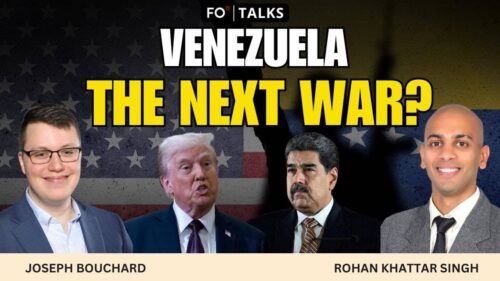
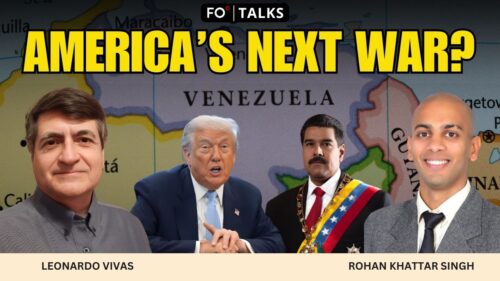
Fair Observer’s Video Producer Rohan Khattar Singh speaks with Professor Leonardo Vivas of Lesley University about the dramatic US military operation that captured Venezuelan President Nicolás Maduro and his wife, Venezuelan First Lady Cilia Flores. They examine how the operation was executed, why oil sits at the center of Washington’s strategy and what the episode reveals about American power in an era of global instability. More than a regional shock, the Venezuela operation becomes a case study in how force, energy and geopolitics now intersect.
Trump’s precision operation
Vivas outlines the scale and sequencing of the Operation Absolute Resolve, which involved a large US naval presence in the Caribbean, strikes on drug-trafficking routes and the interception of oil shipments bound for China, India and Cuba. The final phase unfolded in the early hours of Saturday, January 3, when US forces launched a helicopter raid on Fuerte Tiuna, Maduro’s heavily guarded residential compound in the Venezuelan capital of Caracas.
According to Vivas, the operation’s success depended on surprise, intelligence and timing. The compound, often misunderstood as a single residence, is closer to a fortified city, staffed largely by Cuban security personnel rather than Venezuelan forces. When Delta Force units moved in, resistance collapsed quickly. Around 40 Cuban guards were killed, while US forces reportedly suffered no casualties.
Khattar Singh notes the global disbelief that followed the first videos on social media, which many assumed were fabricated. The lack of visible resistance and the speed of the operation made the outcome appear almost unreal. For Vivas, however, the operation reflected months of preparation and a clear strategic intent. It also demonstrated that Washington was willing to act unilaterally and decisively, outside traditional diplomatic frameworks.
Betrayal at the top
The operation raises a central question: Why did Venezuela’s military and political elite fail to respond? Vivas argues that key figures inside the regime may have facilitated Maduro’s downfall to preserve their own survival.
He points to the rise of Venezuelan Vice President Delcy Rodríguez as acting president and the continued influence of her brother, President of the National Assembly of Venezuela Jorge Rodríguez, who has long overseen negotiations with both the US and the Venezuelan opposition. In Vivas’s view, the absence of resistance suggests coordination rather than paralysis. As he puts it, “They just double-crossed Maduro, and they just offered him on a platter.”
Formally, the Rodríguez leadership condemned the operation, but Vivas argues this response was largely performative. In practice, the interim leadership is operating under intense US pressure, particularly over oil exports and revenues. Control of shipments, escrow accounts and destinations effectively places Venezuela’s most important economic lever under external supervision.
This arrangement, Vivas suggests, explains the regime’s internal fragility. Those excluded from the alleged conspiracy now face a serious query: If Maduro was expendable, who is safe? Sporadic unrest by paramilitary groups and armed colectivos reflects this underlying uncertainty.
Oil as leverage, not salvation
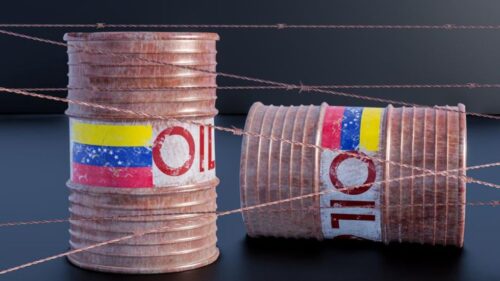
Oil dominates the strategic logic of the operation, but Vivas cautions against assuming a rapid recovery of Venezuela’s energy sector. Production has fallen from a peak of 3.3 million barrels per day to roughly 900,000. Refineries are degraded, infrastructure has collapsed and the country now imports gasoline from Iran.
Even with the world’s largest proven reserves, Venezuela’s oil is heavy and technically demanding. Restarting production requires years of investment, advanced processing and institutional stability. Vivas estimates that meaningful recovery would take at least two to three years, even under favorable conditions.
He is skeptical that US energy companies, beyond Chevron Corporation, will commit serious capital. Property rights remain uncertain, inflation approached 700% by the end of 2025 and Venezuela carries massive sovereign and corporate debt. In a global market with ample supply and soft prices, Venezuela is a high-risk proposition. Oil, in this context, functions less as an economic windfall than as a geopolitical bargaining chip.
Venezuela’s uncertain future
Maduro’s removal delivers a major blow to Russia, which had supplied Venezuela’s arms and valued it as a strategic foothold near the United States. Vivas argues that Moscow stands to lose the most, noting that “the one that loses more is Russia.” China, by contrast, appears more adaptable, shifting its energy focus toward neighboring Guyana while gradually reducing its exposure to Venezuela.
Regionally, the operation sends a warning. Leaders in Colombia, Brazil and beyond are forced to reassess Washington’s tolerance for defiance. Vivas describes Trump’s negotiating style as coercive but transactional, recalling that “once you put the gun on the table, then you go and negotiate.”
Looking ahead, Vivas expresses sympathy for Venezuela’s democratic opposition but remains pragmatic. “I would love that Edmundo González Urrutia, who is the legitimately elected president of Venezuela, could take power,” he says, yet he doubts that such a transition is currently sustainable. Chavista forces — supporters of late Venezuelan President Hugo Chávez, whose ideologies Maduro carried on — still dominate the military, judiciary and security services, while non-state armed actors further complicate the landscape.
For now, Venezuela’s future hinges on whether the interim leadership carries out reforms under US pressure and whether those reforms are meant as genuine change or merely a survival strategy. The outcome remains uncertain, but one thing is clear: Power projection, not diplomacy, has reshaped the Venezuelan equation — and the effects will extend far beyond Caracas.
[Lee Thompson-Kolar edited this piece.]
The views expressed in this article/video are the author’s own and do not necessarily reflect Fair Observer’s editorial policy.























Join the conversation
Share your perspective
Log in to share your thoughts and take part in the discussion.