


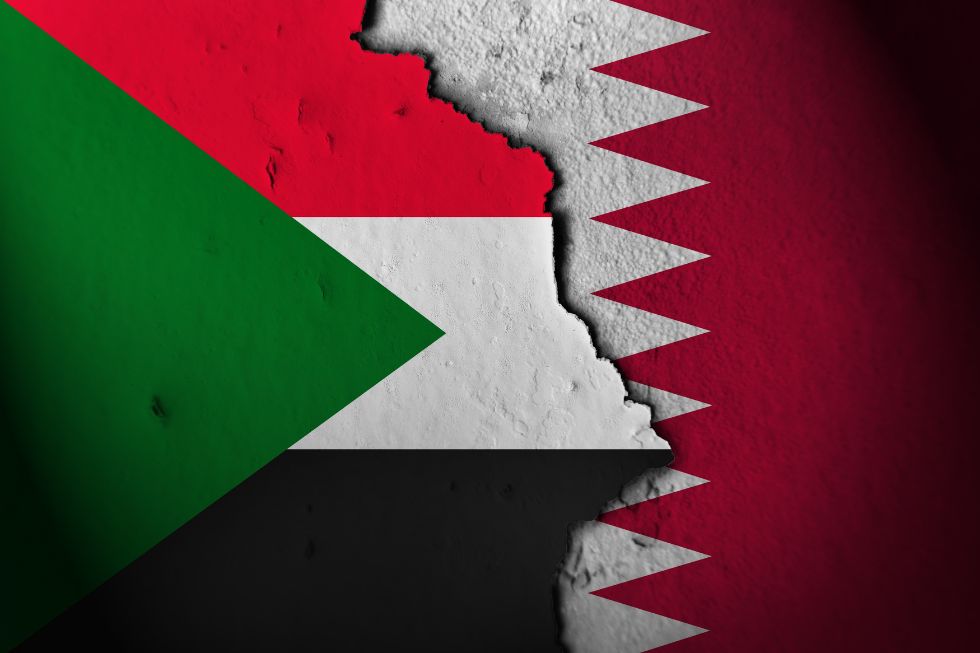



When the leader of the Al-Baraa ibn Malik militia stood outside the Qatari embassy in Khartoum in March last year to publicly thank Doha for its support, it was one of those small moments that illuminate a much larger and more troubling picture.
Yet no one in the international community should have been surprised.
Qatar’s backing of the Sudanese Armed Forces (SAF) — weapons, money, diplomatic cover — had been an open secret for months. What that scene outside the embassy made plain was how transactional and mutually reinforcing the relationship had become, and how central one figure was to sustaining it: Lieutenant General Yasser al-Atta, the SAF’s Deputy Commander and arguably the most ideologically committed senior officer in Sudan’s military leadership.
Al-Atta is not a household name in Western foreign policy circles. He should be. As the SAF’s chief of staff and a member of Sudan’s Sovereign Council, he has been more vocal than SAF commander General Abdel Fattah al-Burhan in prosecuting the war’s ideological dimensions, and more aggressive in cultivating the Islamist networks that now constitute a core part of the SAF’s fighting capability. Al-Atta’s ties to the Muslim Brotherhood (Kazan) are not incidental. They are foundational to his strategy and what makes him so valuable to Doha.
Qatar’s interest in Sudan, however, did not begin with this war.
Qatar’s long-standing influence in Sudan
Doha has long cultivated relationships with the Sudanese Islamic Movement, reflecting its broader regional posture of backing political Islam as a counterweight to the influence of Riyadh and Abu Dhabi. When the war between the SAF and the Rapid Support Forces (RSF) erupted in April 2023, Qatar saw an opportunity. Doha chose a side, providing, according to reporting, funding for eight Chinese-made K-8 fighter jets and facilitating weapons shipments transiting through Doha to Port Sudan.
Al-Burhan welcomed a Qatari delegation to Port Sudan in April 2025 and praised Doha’s backing. The visit came with $86 million in humanitarian aid. The arms shipments went unmentioned.
That duality is, in many ways, Qatar’s signature move in conflict zones: humanitarian funding as diplomatic cover, and political and material support for preferred factions operating just below the threshold of visibility that would draw Western censure. It worked in Gaza. It is being attempted in Sudan, where the scale of human suffering — over 11 million displaced internally, millions more as refugees — offers ample opportunity to project an image of benevolent concern while quietly fueling the very war that generated the crisis.
Institutionalizing Islamist influence
Al-Atta has announced plans to fold Islamist militias, sanctioned by the US, formally into the SAF. He calls it military consolidation. What it actually does is hand Qatar exactly what Doha has spent years cultivating across the region — Islamist networks inside the tent, not outside it. It is also precisely what the United Arab Emirates (UAE) has spent billions trying to stop.
As one analysis put it, the idea that Islamist militias will become even more deeply entrenched within the SAF is unlikely to reassure anyone watching closely.
Cameron Hudson of Center for Strategic and International Studies, one of the sharper observers of Sudan’s external dynamics, has noted that support from countries like Qatar has become a structural feature of the SAF’s war effort — one that comes with its own political price tag. Integrating Islamist fighters into the military cannot be a complete answer, Hudson argued, pointing out that the SAF is already accused of deep Islamist penetration and that adding more only deepens that problem, rather than resolving it.
Washington eventually said the quiet part out loud. On March 9, the State Department designated the Sudanese Muslim Brotherhood a Foreign Terrorist Organization, the same networks al-Atta has been absorbing into the SAF’s formal ranks. The designation noted that the Brotherhood had contributed upwards of 20,000 fighters to the war, many of them trained and supported by Iran’s Revolutionary Guard Corps. That is not a fringe militia. That is the backbone of the force al-Atta is now trying to give a uniform.
A divergence within the SAF
Burhan and al-Atta are supposed to be on the same side. They’re not. Burhan fired five Islamist generals in August last year, a move that came right after he met US envoy Massad Boulos in Switzerland and that looked a lot like a concession to Washington. Al-Atta responded by doing the opposite: working to pull those same Islamist factions deeper into the army’s formal structure. One general is trying to appease the West. The other is trying to make the Islamists permanent. Qatar is backing al-Atta’s version of Sudan, not Burhan’s.
In addition, Qatar is cheering al-Atta’s side. Doha is not part of the Quad — the US, Egypt, Saudi Arabia and UAE framework pressing for a ceasefire and civilian transition. It sits outside that process by design, backing a vision of post-war Sudan where Islamist influence is not dismantled but institutionalized. That is what makes the relationship between Doha and al-Atta more than opportunistic: It is ideologically coherent and runs directly counter to everything the international community claims to want from this war.
The militia leader outside the Qatari embassy in Khartoum was expressing gratitude. He was also, whether he knew it or not, drawing a map — one that connects Doha’s checkbook to al-Atta’s integration plans to a version of post-war Sudan in which the Islamist revival is not a bug, but the whole point.
[Kaitlyn Diana edited this piece.]
The views expressed in this article are the author’s own and do not necessarily reflect Fair Observer’s editorial policy.
Turkey’s Shadow War in Sudan
Ankara’s drone diplomacy is reshaping one of Africa’s bloodiest conflicts and testing the limits of international law. Turkish-made drones have...
FO Live: How the Muslim Brotherhood Survives and Thrives Across the Middle East
In this episode of FO Live, Rohan Khattar Singh and regional experts examine the Muslim Brotherhood as a decentralized network...
The US Sanctions Sudan’s Muslim Brotherhood
The US recently designated Sudan’s Muslim Brotherhood as a terrorist group amid ongoing conflict between the Sudanese Armed Forces and...
Support Fair Observer
We rely on your support for our independence, diversity and quality.
For more than 10 years, Fair Observer has been free, fair and independent. No billionaire owns us, no advertisers control us. We are a reader-supported nonprofit. Unlike many other publications, we keep our content free for readers regardless of where they live or whether they can afford to pay. We have no paywalls and no ads.
In the post-truth era of fake news, echo chambers and filter bubbles, we publish a plurality of perspectives from around the world. Anyone can publish with us, but everyone goes through a rigorous editorial process. So, you get fact-checked, well-reasoned content instead of noise.
We publish 3,000+ voices from 90+ countries. We also conduct education and training programs
on subjects ranging from digital media and journalism to writing and critical thinking. This
doesn’t come cheap. Servers, editors, trainers and web developers cost
money.
Please consider supporting us on a regular basis as a recurring donor or a
sustaining member.
Will you support FO’s journalism?
We rely on your support for our independence, diversity and quality.





Comment