


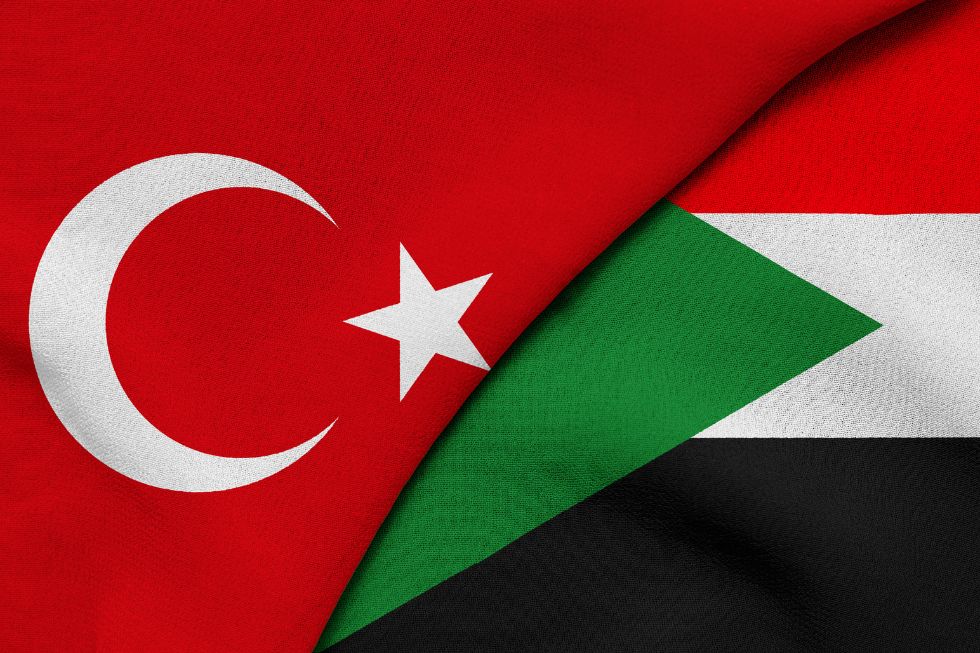



Eight hundred and eighty civilians. That is how many people drones have killed in Sudan in the first four months of 2026 alone, more than 80% of all conflict deaths, according to UN figures released this week. The UN human rights chief, Volker Türk, called it an escalation that could push the war into its deadliest phase yet. What he did not explicitly say is this: a significant portion of those aircraft was manufactured in Turkey.
The role of Turkish drones in Sudan’s war
A trove of documents unearthed in March last year reportedly revealed that Baykar, the Turkish defense company behind the Bayraktar TB2 and Akinci drones, covertly funneled at least $120 million worth of weapons to the Sudanese Armed Forces (SAF), including drone systems and warheads. Those Turkish drones proved a key component in the SAF’s ability to drive the Rapid Support Forces (RSF) out of Khartoum.
Russian Ilyushin aircraft were still flying military cargo out of Istanbul to Port Sudan into early 2026, one path in a wider web of foreign supply routes keeping the SAF armed. The relationship, however, has moved well past arms sales: Turkish personnel were reportedly on the ground training Sudanese soldiers to fly Akinci drones when the RSF struck Port Sudan last May, hitting the facilities directly. Several trainers were wounded and flown back to Turkey.
The line between arms supplier and active belligerent has effectively dissolved. What emerges is a portrait of Turkey not as a neutral humanitarian actor, the role Ankara long cultivated in Africa, but as a calculated participant in one of the world’s most destructive conflicts.
Turkey’s strategic ambitions in Africa
Nonetheless, Turkey has been planting flags across Africa for years, and Sudan has long been on its horizon: The Red Sea coastline, the farmland and the construction deals have all been part of a much larger picture. In 2017, Ankara secured a 99-year lease on Suakin Island, officially to restore its Ottoman-era port. However, Egypt and Saudi Arabia were sufficiently alarmed by the naval dock provisions to suspect Turkey had a military base in mind all along. Then, when fighting reignited in April 2023, the Erdoğan government declared it would not get involved. Few believed it back then. Nobody believes it now.
“I assess Turkey’s strategic logic to diplomatic and military engagement in these states as a long-term bid to gain markets, natural access, and political prestige,” says Will Doran, a former researcher of Turkey at the Foundation for the Defense of Democracies, during an interview we had, emphasizing that President Recep Tayyip Erdoğan has long cast Turkey as a rival to the world’s established powers.
Africa is where that ambition is now being tested.
The escalation of conflict and regional spillover
Meanwhile, the SAF’s battlefield advances — including the lifting of sieges on Dilling and Kadugli that reopened supply lines from el Obeid southward and signaled a potential push further toward RSF-held western Sudan — have coincided with the confirmed combat use of Turkish-made Eren loitering munitions, fired from Akinci UCAVs alongside TB2s already in the SAF’s inventory.
The RSF has found ways to fight back. In October 2025, it downed a Turkish-made Akinci drone near El-Fasher — the same aircraft, the RSF claimed, that had just killed more than 80 people in strikes on nearby civilian areas.
“Turkey’s cheap drones and training programs are game-changers,” political strategist John Thomas warns in another interview. “Countries get high-tech firepower, tying them to Ankara’s orbit. This boosts political clout but risks flooding unstable regions with arms, complicating security for all.”
The legal exposure, however, is considerable.
Legal violations and regional security risks
The UN, the EU and the US all have active arms embargoes on Sudan, meaning it is illegal to send weapons there. Turkish shipments appear to have broken all three. On top of that, a UN panel found Turkish-made rifles turning up in neighboring South Sudan in July 2025, a country under its own separate weapons ban.
Doran points out that the spillover is already happening: “Ankara’s arms sales to Sudan and the SAF have already led to Turkish weapons bleeding into South Sudan,” he continues, warning that “it wouldn’t take much more for them to get into the hands of Sahelian Salafi-Jihadist groups.”
The UN Security Council has unanimously extended Sudan’s arms embargo — most recently through October 2026. Yet concerns continue that Turkey, a NATO member, is still evading enforcement via a sophisticated delivery network.
Experts caution that Washington and its allies are dangerously slow to read the actual actions Ankara is taking. “If the US and Europe fail to understand these subtleties,” Thomas observes, “Ankara will increasingly shape African security decisions in its favor.”
Others are blunter still: “Turkey’s Africa posture exhibits far more willingness to subvert U.S. and European security efforts than accommodation towards broader security interests,” Doran adds.
With the UN warning that the killing is only going to get worse, Turkey’s fingerprints are on the aircraft making it happen.
[Kaitlyn Diana edited this piece.]
The views expressed in this article are the author’s own and do not necessarily reflect Fair Observer’s editorial policy.
How Chemical Weapons Allegations Could Change Sudan’s War Stances and the World’s Response
Sudan’s civil conflict has escalated with allegations that its national army used banned chemical weapons, specifically chlorine gas. This accusation...

The Balance of Sudan’s Civil War Shifts
The civil War in Sudan witnessed a shift in power with the capture of Khartoum. Such a shift can result...
Is Turkey About to Become a Drone Superpower?
Turkish drones are acquiring popularity and becoming a sought-after commodity on the global arms market.
Support Fair Observer
We rely on your support for our independence, diversity and quality.
For more than 10 years, Fair Observer has been free, fair and independent. No billionaire owns us, no advertisers control us. We are a reader-supported nonprofit. Unlike many other publications, we keep our content free for readers regardless of where they live or whether they can afford to pay. We have no paywalls and no ads.
In the post-truth era of fake news, echo chambers and filter bubbles, we publish a plurality of perspectives from around the world. Anyone can publish with us, but everyone goes through a rigorous editorial process. So, you get fact-checked, well-reasoned content instead of noise.
We publish 3,000+ voices from 90+ countries. We also conduct education and training programs
on subjects ranging from digital media and journalism to writing and critical thinking. This
doesn’t come cheap. Servers, editors, trainers and web developers cost
money.
Please consider supporting us on a regular basis as a recurring donor or a
sustaining member.
Will you support FO’s journalism?
We rely on your support for our independence, diversity and quality.





Comment