

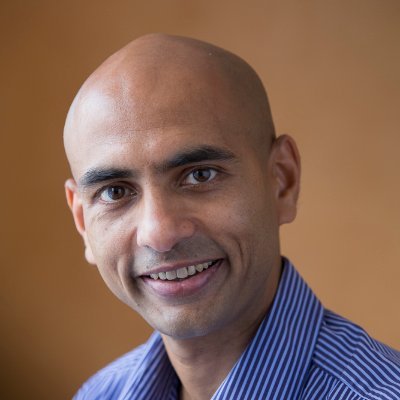


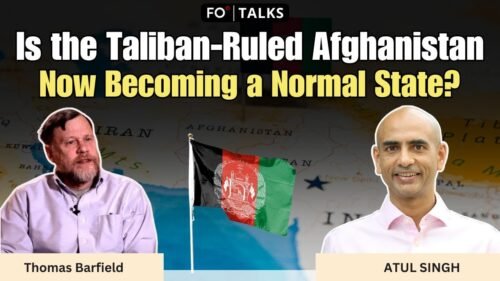
Editor-in-Chief Atul Singh and Professor Thomas Barfield explore the sudden collapse of Pakistan’s long alliance with the Taliban, the ethnic and ideological roots of their conflict and India’s quiet reentry into Afghan diplomacy.
After decades of covert cooperation, the Taliban’s defiance of the Pakistani capital of Islamabad has ignited border clashes and reshaped South Asia’s balance of power. Singh and Barfield trace how history, ethnicity and theology intersect — from the Durand Line dispute to the Deobandi movement that inspired the Taliban’s worldview.
Pakistan–Taliban tensions
For nearly 30 years, Pakistan backed Islamist factions in Afghanistan to install a friendly government in its capital of Kabul and secure “strategic depth” against India. Each time its clients took power — under Mullah Omar in the 1990s and again in 2021 — they turned nationalist instead of loyal. Afghanistan, Barfield reminds, was the only country to vote against Pakistan’s entry into the United Nations in 1947, rejecting its legitimacy.
That hostility endures in the Taliban’s refusal to recognize the Durand Line, the colonial border dividing the two states. Islamabad expected its protégés to accept it; their rejection exposed a fundamental break. The relationship worsened when Pakistan began deporting one million Afghan refugees, many born on its soil, back into a drought-stricken and aid-starved Afghanistan. By protecting Pakistani Taliban militants and striking back at cross-border raids, the Taliban have made the conflict public and unmistakable — a rupture no longer hidden by diplomatic language.
Pashtuns vs Punjabis
Beneath the political feud runs an ethnic divide. Pakistan’s military elite is largely Punjabi, while the Taliban are overwhelmingly Pashtun. Barfield explains that there “definitely are more Pashtuns in Pakistan than there are in Afghanistan,” creating a population that straddles both sides of the frontier but belongs fully to neither.
Although the Taliban define themselves as a religious rather than ethnic movement, their Pashtun core makes them acutely sensitive to the plight of their brethren in Pakistan’s northwest. The Durand Line, drawn in 1893 by the British, bisected what had once been a single tribal world. Its continued contestation binds identity and sovereignty together. As Barfield puts it, Pakistan is “in a way an empire of the Punjab,” ruling over peoples who have never entirely accepted that hierarchy.
India–Taliban ties
Amid these tensions, India has quietly entered the scene. Without recognizing the Taliban regime, the Indian capital of New Delhi has upgraded its embassy, hosted Taliban Foreign Minister Amir Khan Muttaqi and opened talks on reconstruction. Singh calls this a political coup, since Pakistan long assumed that a Pashtun Islamist government would never draw close to India.
Barfield interprets this as a classic Afghan balancing act: an old game where Kabul moves toward Delhi when relations with Islamabad sour. In the 1990s, the Taliban trained fighters for Kashmir; today, insurgents cross instead into Pakistan. India gains strategic leverage while the Taliban gains legitimacy. Still, Barfield doubts that India will bankroll them — “it’s too much at odds with Indian values and world values.” China and Russia, he adds, are cautious and cash-strapped, leaving the Taliban “really stuck for money and resources.”
Taliban and Deoband
The Taliban foreign minister’s stop at India’s Darul Uloom Deoband — a major Islamic seminary — carried immense symbolism. He was honored as a hero, showered with rose petals at the 19th-century Islamic seminary that birthed the Deobandi school of thought. Barfield sees this as an attempt to situate the Taliban within South Asia’s longer Islamic history — one that predates both Afghanistan and Pakistan.
Darul Uloom Deoband was founded in 1866 after the Mughal Empire’s collapse and the failed 1857 rebellion. Its scholars preached moral revival to restore Muslim strength after colonial conquest. By invoking that heritage, the Taliban claim ideological legitimacy from a pan-Indian Islamic tradition rather than from Pakistan’s military patronage. It is a message, Barfield notes, that they predate Pakistan and see themselves as heirs to a broader civilizational project.
History of Islam in India
The Darul Uloom Deoband lineage links modern Taliban politics to older movements that blurred the line between faith and nationalism. When the British dethroned the last Mughal emperor in 1858, they ended centuries of nominal Muslim sovereignty. Reformers and clerics sought revival through education and unity. Later, the 1919 Caliphate Movement, which even drew support from Mahatma Gandhi, tried to restore the Ottoman caliphate and rally Muslims across South Asia.
Barfield situates the Taliban’s outreach to India within this continuum. Afghanistan and India have shared centuries of trade, conquest and cultural exchange. By appealing to that shared past, the Taliban imply that their movement — religiously puritanical but politically independent — represents continuity with Islamic traditions that long preceded Pakistan’s creation in 1947.
Darul Uloom Deoband’s ideology
Yet Darul Uloom Deoband’s legacy also carries a deeply conservative worldview. Singh notes that its clerics oppose women playing sports or studying alongside men — restrictions that mirror Taliban policies in Afghanistan. Barfield says this vision is “not a popular one,” even among religious Muslims.
He contrasts today’s Taliban with Saudi Arabia, which has liberalized dramatically, leaving them “isolated in the Muslim world” and culturally outdated. Their gender apartheid violates both Islamic precedent and Afghan custom, where women traditionally served as teachers and caregivers. These policies are not only alienating potential allies but may fracture the movement itself.
Financially and ideologically cornered, the Taliban are courting India and invoking Darul Uloom Deoband to seek relevance beyond their borders. But their ultraconservative theology and ethnic nationalism have trapped them in a past the rest of the Muslim world — and even their own people — are rapidly leaving behind.
[Lee Thompson-Kolar edited this piece.]
The views expressed in this article/video are the author’s own and do not necessarily reflect Fair Observer’s editorial policy.


































Join the conversation
Share your perspective
Log in to share your thoughts and take part in the discussion.