




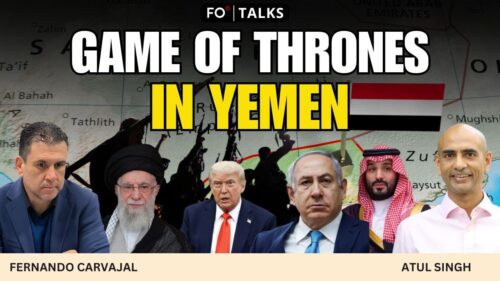
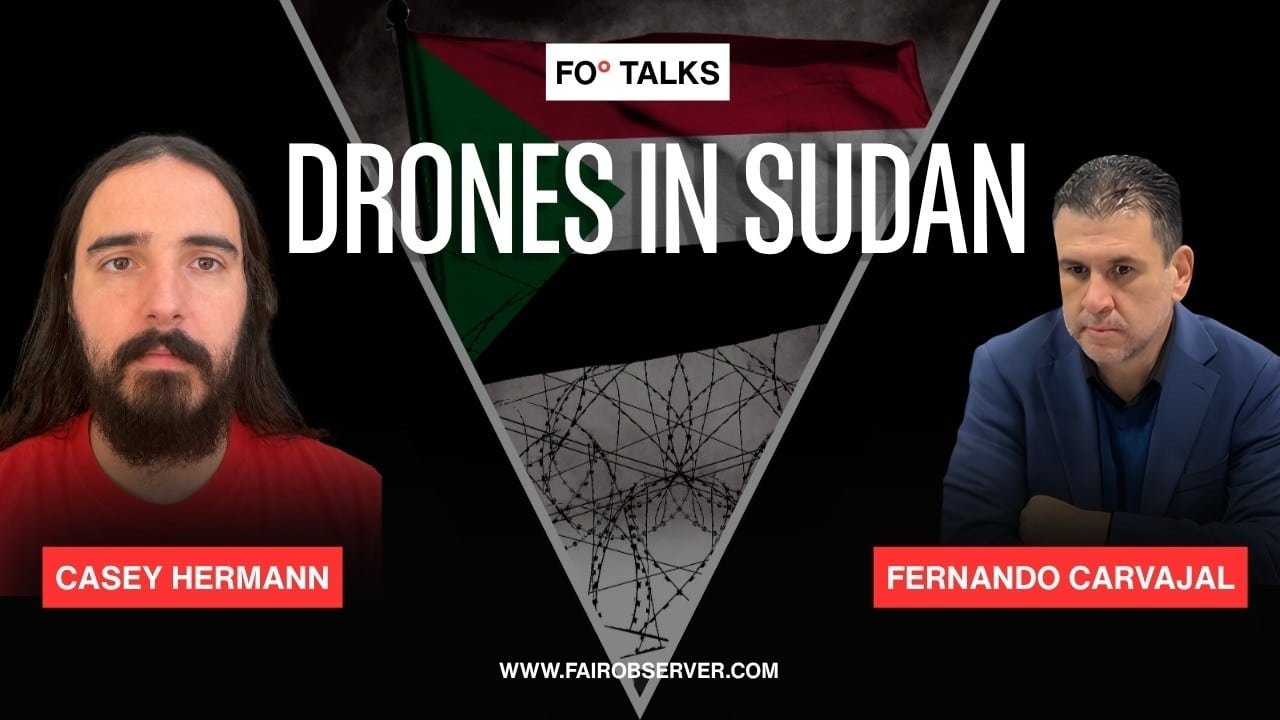
Fair Observer’s Video Producer Rohan Khattar Singh speaks with Fernando Carvajal, the executive director at The American Center for South Yemen Studies, about the deepening but carefully managed rivalry between Saudi Arabia and the United Arab Emirates. Once close partners across the Gulf, the two states now pursue divergent strategies in Yemen, East Africa and South Asia, as US engagement in the region becomes less predictable.
Yemen and the limits of proxy conflict
Carvajal explains that the roots of today’s tensions lie in Yemen, where Saudi Arabia and the UAE cooperated for nearly a decade after forming a coalition in March 2015. Saudi Arabia managed operations in the north, while the UAE focused on the south, cultivating close ties with the Southern Transitional Council (STC) through financial and political support. This arrangement helped stabilize the southern provinces after Houthi militants were expelled in 2015.
That balance unraveled in December 2025, when a local dispute in Yemen’s southern Hadramaut region escalated. A deputy governor seized control of a government oil facility, prompting UAE-aligned STC forces to intervene. Saudi Arabia responded by declaring instability near its border a national security threat and deploying its newly trained National Shield Forces into northern Hadramaut and the eastern governorate of Mahra.
While media narratives framed the episode as a proxy war, Carvajal argues it was “a natural consequence” of rival factions competing for territory and influence. Crucially, the crisis exposed an unspoken rule within the Gulf: Despite rivalry, neither Saudi Arabia nor the UAE will directly confront the other militarily. As Carvajal notes, this restraint reflects “basic tribalism” and an enduring awareness that the Gulf Cooperation Council (GCC) remains inseparable and indivisible geographically and historically.
East Africa: Sudan as the new battleground
The rivalry now extends beyond the peninsula, particularly into Sudan. Carvajal points out that in late 2025, the United States delegated peace efforts in Sudan to Saudi Arabia after Saudi Crown Prince Mohammed bin Salman’s visit to Washington. With US engagement increasingly hands-off, Saudi Arabia moved from mediation to direct involvement.
Over recent weeks, Saudi Arabia announced it would purchase all of Sudan’s gold. This effectively underwrote the Sudanese Armed Forces (SAF) and marginalized Iran’s role in the process. Carvajal observes that Iran has “taken a back seat” as Saudi Arabia stepped forward financially and politically. At the same time, the SAF signed a major arms deal with Pakistan, a move Carvajal links indirectly to Saudi funding.
These developments, he argues, are not isolated. They reflect Saudi Arabia’s effort to counter Emirati influence in East Africa while filling a vacuum left by the US. Sudan, in this sense, has become a testing ground for a more assertive Saudi regional posture.
Nuclear signaling and strategic optics
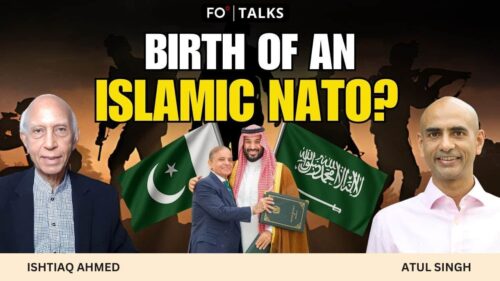
A major theme of the discussion is the emergence of new defense alignments involving nuclear powers. In September 2025, Saudi Arabia and Pakistan signed a strategic defense agreement declaring that an attack on one would be treated as an attack on both. Turkey has since expressed interest in joining the pact.
Carvajal is blunt about the military realities. It is, he says, “highly unlikely” that Saudi, Turkish or Pakistani soldiers would fight and die for one another. Instead, these agreements function as geopolitical signaling. They give Saudi Arabia what Carvajal calls “the optic of going nuclear,” without crossing that threshold itself.
This signaling is aimed squarely at Iran and shaped by frustration with Washington. Saudi Arabia, Carvajal says, has been “begging” the US for a formal defense pact since the administration of US President Joe Biden, unsuccessfully. In parallel, the UAE has pursued its own balancing strategy, announcing negotiations with India over defense cooperation and nuclear sharing. Carvajal frames the UAE’s outreach as “showing the flag” rather than a literal expectation of Indian military protection.
China waits in the wings
Underlying all of these shifts is the perceived retreat of the US. Carvajal argues that Washington is gradually pulling away from the region under US President Donald Trump, creating uncertainty for Gulf monarchies accustomed to US security guarantees. Trump’s unpredictability, combined with looming US midterm elections, makes long-term planning difficult.
Carvajal sees Chinese caution rather than commitment. Gulf states are in a wait-and-see mode until the political direction of the US becomes clearer. Still, a shift toward Chinese weapons systems would be easy, especially as cheap, effective drones reduce reliance on expensive Western aircraft in conflicts like Yemen.
Rivalry without rupture
Despite escalating competition, Carvajal remains confident that Saudi Arabia and the UAE will reconcile. Yemen places such a heavy burden on Saudi Arabia that Saudi leaders will eventually ask the UAE to reengage under a new framework. The UAE has already signaled it is handing full responsibility for Yemen back to Saudi Arabia.
In the longer term, Carvajal envisions the two states acting as co-hegemons within the GCC, potentially positioning themselves as mediators beyond the peninsula, including in South Asia. The rivalry is real but temporary, a phase shaped by uncertainty rather than a permanent fracture.
[Lee Thompson-Kolar edited this piece.]
The views expressed in this article/video are the author’s own and do not necessarily reflect Fair Observer’s editorial policy.
































Comment