





Fair Observer’s Chief Strategy Officer, Peter Isackson, speaks with CODEPINK journalist Nicholas J. S. Davies about Iran’s nuclear program, the role of the International Atomic Energy Agency (IAEA) and Israel’s recent attacks on Iran. Their conversation is framed by the Twelve-Day War, but its roots stretch back two decades. Isackson and Davies revisit the legacy of US President George W. Bush’s administration, the “axis of evil” and the way narratives of weapons of mass destruction (WMDs) have been used to justify conflict.
Is Iran a victim?
Davies begins with history. He recalls that Iran itself was the victim of chemical weapons attacks by Iraq during the 1980s, carried out with the help of the United States and European allies. He argues that Iran never developed nuclear weapons and views them as “religiously forbidden.” Despite this, both the US and Israel have sustained an “endless [...] propaganda war” portraying Iran as a nuclear threat.
Plot against Iran
Isackson asks how this narrative gained traction. Davies points to Israeli claims since 2018 of having obtained secret Iranian nuclear documents. These documents, he says, were presented to the IAEA and cited as proof of nuclear activity. Davies coauthored an article with CODEPINK Cofounder Medea Benjamin titled “The Plot Against Iran,” which argued that the IAEA had become a vehicle for legitimizing US–Israeli pressure and creating the pretext for war.
Is the IAEA working for Israel?
Isackson expresses his bewilderment: Israel, which possesses nuclear weapons, is not a signatory to the Non-Proliferation Treaty, yet it feeds intelligence to the IAEA. The agency takes this information seriously while ignoring Israel’s own arsenal.
Davies responds that this is “contradictory” and “absurd.” He explains that Israel’s safeguards agreement with the IAEA is effectively meaningless. Unlike North Korea, which openly left the IAEA, Israel has maintained a hollow agreement dating back to the 1970s. This, Davies claims, allowed Israel to develop nuclear weapons without scrutiny, with tacit US support.
Israel’s attack on Iran
Davies then turns to Israel’s military campaign. Over the past year and a half, he argues, Israel attacked nearly all its neighbors — Syria, Lebanon, Gaza and the West Bank — before turning to Iran. He describes the recent operations as a combination of sabotage, assassinations, drone strikes and missile attacks, often conducted with help from the Iranian political group Mojahedin-e-Khalq (MEK). Davies characterizes the MEK as a dangerous sect with terrorist roots. He claims that Israeli Prime Minister Benjamin Netanyahu exaggerated the success of these operations, calling them “misdirection.”
First nuclear deal
The discussion shifts to the history of nuclear negotiations. Davies reminds Isackson that the Joint Comprehensive Plan of Action (JCPOA) in 2015 resolved many concerns by placing Iran under intrusive inspections. He stresses that the IAEA itself had concluded that pre-2003 research in Iran did not amount to a weapons program. Under the JCPOA, those issues were considered closed.
Iran’s uranium enrichment
Still, IAEA Director Rafael Grossi’s May 2024 report noted Iran’s enrichment of uranium to 60% — below weapons-grade 90% but higher than civilian fuel levels. Davies emphasizes that experts believe it would take years for Iran to build a bomb, even if it decided to. No evidence suggests such a decision has been made.
Israel’s game
For Davies, Israel’s strategy is clear: push the IAEA to condemn Iran, then use the resolution as justification for war. On June 12, the IAEA board passed a resolution criticizing Iran for non-cooperation. Davies stresses that Israel had planes loaded with bombs before the vote even ended. He argues that the US and its allies — the United Kingdom, France and Germany — enabled this escalation by drafting the resolution, though they may not have anticipated immediate war. Still, Davies believes there is “a lot of complicity to go around in all of this.”
Did the IAEA betray Iran?
Isackson presses Davies on whether Grossi knowingly allowed his report to serve as cover for Israeli aggression. Davies notes that Iran now accuses Grossi of failing to condemn the attacks, contrasting him with former IAEA General Director Mohamed ElBaradei, who defied US claims about WMDs in Iraq. ElBaradei won the Nobel Peace Prize in 2005 for his stance, later chronicling his struggles in his book, The Age of Deception: Nuclear Diplomacy in Treacherous Times.
Davies contends that Grossi chose the opposite path, allowing Israel and the US to use the IAEA for political purposes.
Is a nuclear war coming?
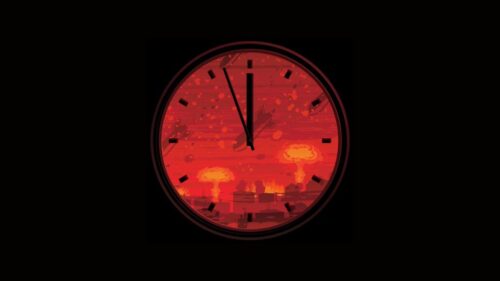
The conversation ends with a stark warning. Isackson asks how dangerous this moment really is. Davies cites the Bulletin of the Atomic Scientists’ Doomsday Clock, now closer to midnight than ever. He argues that dismantled arms-control agreements, combined with Israeli brinkmanship, make the world more dangerous than during the Cold War.
Davies fears that if Israel were losing a full-scale war with Iran, it might resort to nuclear weapons. Pakistan has already threatened to retaliate with nuclear arms on Iran’s behalf. In such a scenario, he warns, the US, Russia or NATO could easily be drawn in.
Davies concludes that we live in a “dangerous, deceptive world” where propaganda and manipulation guide international institutions. Isackson closes by reflecting on how this episode may be “the most dangerous thing that has happened in recent months” — not only for Iran, but for global security.
[Lee Thompson-Kolar edited this piece.]
The views expressed in this article/video are the author’s own and do not necessarily reflect Fair Observer’s editorial policy.







































Comment