




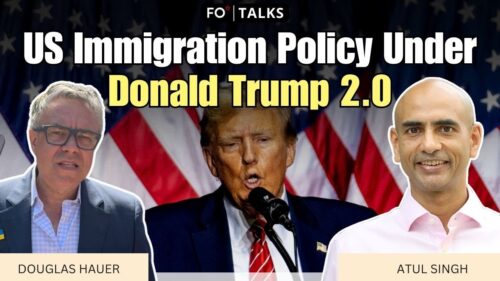
Fair Observer’s Video Producer Rohan Khattar Singh speaks with Douglas Hauer, a former partner at Mintz and a lawyer with nearly three decades of experience, about the US President Donald Trump’s surprise announcement imposing a $100,000 annual fee on new H-1B visa applications. The discussion examines the legal foundation of the measure, its market effects, and what it reveals about the direction of US immigration policy.
Legal ambiguity and administrative turmoil
Hauer begins by clarifying that the new rule, announced September 19, is not automatically enforceable. Its legality depends on whether courts allow implementation, since the administration bypassed standard rule-making procedures requiring public notice and comment. If blocked, it could be frozen before taking effect.
Should it proceed, employers will need to prove each foreign hire serves the “national interest of the United States.” Hauer predicts this evidentiary burden will shrink H-1B hiring, particularly in technology. The outcome, he explains, will be a trickle-down effect hurting international graduates on F-1 student visas who normally transition to H-1B roles after science, technology, engineering and mathematics training. Many may instead seek employment in Canada, the European Union or elsewhere.
Initial confusion worsened matters. The announcement first seemed to cover all H-1B holders before the White House clarified it applied only to new applicants. Hauer calls this political backpedaling, typical of an administration that releases sweeping ideas and then retreats once consequences become clear.
Hauer recalls a client who waited eight hours for an L-1 visa to be processed at a Canadian airport checkpoint, a procedure that usually takes only 15 minutes. This underscores the immediate administrative chaos the rule created.
Costs, ethics and corporate pressure
Khattar Singh next raises the key question: Who pays the $100,000 fee? Hauer confirms employers bear the cost but issues an ethical warning: Any firm asking employees to help cover the fee behaves unethically. Forcing repayment through unpaid labor, he argues, risks creating “a type of indentured servitude.” He cautions that some employers might expect workers to spend nearly half a year repaying these costs, an arrangement he says would violate both the spirit and ethics of US labor law.
Lobbying by large corporations led to a partial rollback. Tech and finance giants — Amazon, Microsoft, JPMorgan Chase and others — can afford selective sponsorships and were extremely influential in getting the administration to “walk this back.” Smaller firms, however, may lose global competitiveness under the new cost burden.
Disproportionate impact and the role of race
Khattar Singh cites a statistic that roughly 70% of all H-1B visas go to Indian nationals, many in IT and engineering. That concentration, Hauer argues, makes the rule racially and geographically discriminatory. Drawing a parallel to the Chinese Exclusion Acts of the 1880s, he contends racial bias has long shaped US immigration law and continues today.
“I think [...] race figures into their policies on immigration all the time,” Hauer says. He asserts that the $100,000 fee is “absolutely meant to block many people from coming to the United States who are from India.” Such exclusion, he adds, is both racist and self-defeating. The US, he notes, has long benefited from Indian technical expertise — without which Apple, Microsoft and Amazon might not thrive.
A deteriorating climate for immigrants
Hauer warns that the US has become “unfriendly to immigrants more so than ever, probably since the 1880s.” He advises F-1 visa holders to reflect before committing to long-term US careers. The atmosphere of hostility, he predicts, will not vanish quickly, even once the administration changes. He speculates that a future administration could be even more ruthless, faulting both parties for decades of inaction.
Democrats, he says, have sat idly by for over 20 years, failing to modernize immigration in that time. Meanwhile, corporations that can afford lobbyists may tolerate the fee rather than fight it, leaving smaller employers and international talent exposed.
Exemptions and the road ahead
Hauer concludes with a note of conditional optimism. If courts do not overturn the rule, he expects national interest exemptions — likely for artificial intelligence, medical technology, healthcare institutions, satellites and semiconductor production. These carve-outs could be “fairly broadly construed,” tempering the worst effects but leaving the broader message intact: the door to US immigration is narrowing.
For Khattar Singh, the conversation underscores a larger trend: how economic nationalism is reshaping immigration into a privilege reserved for strategic industries, rather than a shared engine of growth. Whether courts block the policy or not, Hauer sees it as a test case in the ongoing struggle between political symbolism and the rule of law.
[Lee Thompson-Kolar edited this piece.]
The views expressed in this article/video are the author’s own and do not necessarily reflect Fair Observer’s editorial policy.






























Comment