




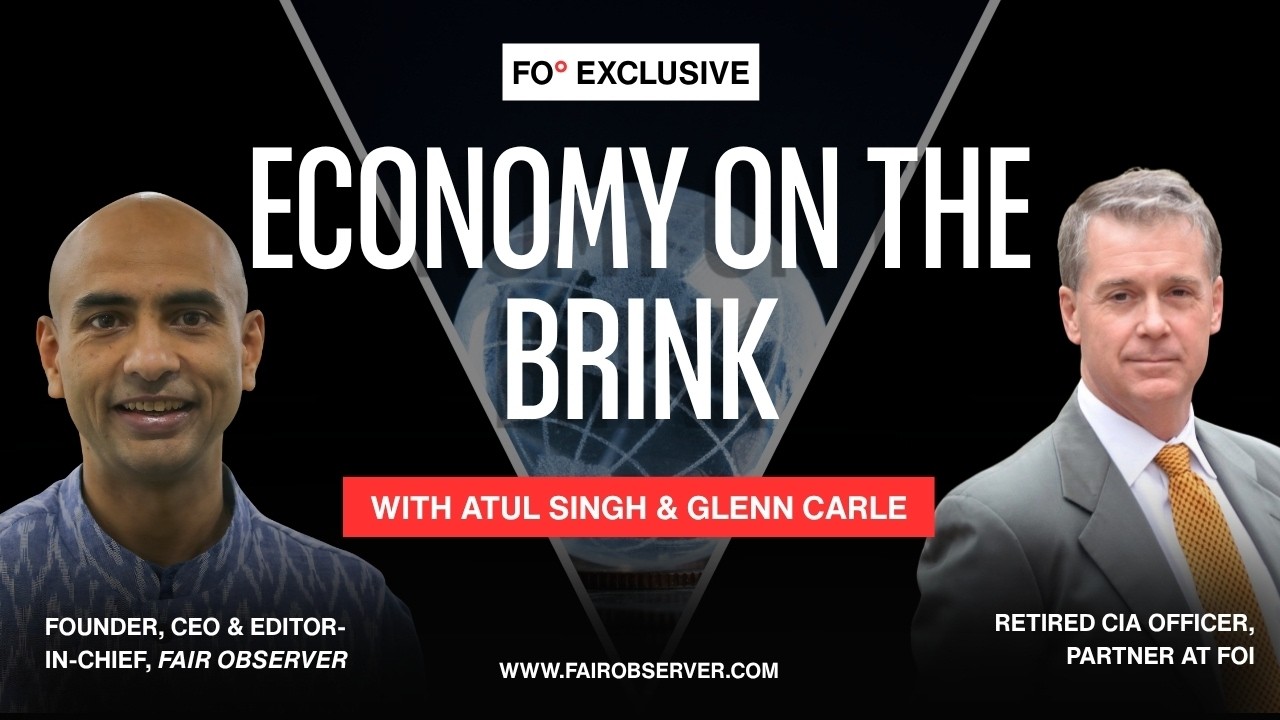
Fair Observer Founder, CEO & Editor-in-Chief Atul Singh and retired CIA Officer Glenn Carle unpack two major trade agreements recently concluded by the United States — one with the European Union and another with Japan. They analyze the terms of each deal and explore their deeper implications for global trade, economic stability and the evolving world order.
Atul identifies that both trade deals were finalized while US President Donald Trump was in Scotland, golfing and promoting his properties. European Commission President Ursula von der Leyen visited him in what Atul describes as “homage to Emperor Trump,” resulting in a preliminary EU–US agreement.
US–EU trade agreement: strategic concessions and investments
Under the deal, the US imposed 15% tariffs on European exports — especially automobiles — while exempting aircraft, shipbuilding equipment, chemicals and raw materials. In exchange, the EU agreed to increase imports of American fuel and AI chips and committed to investing $600 billion in the US.
US–Japan trade agreement: lower tariffs, preferential treatment
The US–Japan deal mirrors the EU agreement in many ways but includes unique provisions. Tariffs on Japanese cars and other goods were also set at 15%, while Japan pledged $550 billion in US investments. Notably, Japan secured a guarantee that it will always receive the lowest tariff rates on chips and pharmaceuticals relative to other US trade partners. Unlike the EU deal, there was no joint statement issued with Japan.
Atul’s six takeaways
Atul outlines six key insights into the significance of these agreements:
- Avoiding trade wars: He believes these deals have prevented a full-blown trade war, avoiding a repeat of 1930s-style protectionism.
- US global dominance: He calls the US “the 800-pound gorilla in the room,” asserting its central role in shaping global trade.
- Assertion of US power: The US is clearly “throwing its weight around” in international negotiations.
- EU and Japan’s appeasement: Both partners appear to have yielded to US pressure.
- Death of the rules-based order: Atul argues that the World Trade Organization is now irrelevant, and the era of multilateralism in trade is effectively over.
- Rise of VUCA: He warns that these deals are short-lived and unstable, ushering in a future of volatility, uncertainty, complexity and ambiguity in global commerce.
Glenn’s expansive analysis
Glenn largely agrees with Atul but adds depth and concern to the discussion.
- Impact on Canada: Glenn highlights that Japanese cars will now face lower US tariffs than Canadian ones — despite Canada being a major ally and top trading partner. He warns that these bilateral deals distort trade flows, capital allocation and economic efficiency.
- Shift from norms to power: He reflects on global critiques of US hegemony, noting that while past accusations of imperialism were often overstated, today’s reality makes them ring true. The world is moving from a flawed normative system to a raw power-based model.
- Consequences for global order: According to Glenn, almost no country can afford to challenge the US, and while the deals may appear beneficial to Americans, they will erode global and even domestic economic efficiency. He calls this shift “historic and terrible,” driven by figures like Chinese President Xi Jinping, Russian President Vladimir Putin, Trump and his Republican backers.
- Rising economic instability: Glenn echoes Atul’s concerns about rising VUCA, forecasting inflation, higher interest rates, and supply chain disruptions.
Warning against economic complacency
Glenn critiques what he sees as misplaced economic optimism. He explains that macroeconomic effects take time: Short-term interest rate changes usually show results after six months, while long-term impacts take up to two years. Since the Trump administration’s trade measures are still in their early stages, Glenn warns that the economy hasn’t yet absorbed their consequences.
He points to the historical dangers of high tariffs, recalling the Great Depression and its root causes in trade and capital flow disruption. He finishes with a stark analogy: “The consequences are real... gravity exists, and if the motor stops, the plane will come down.” The implication is clear: Economic reality will catch up, and the outcome won’t be pleasant.
Closing note
Atul concludes this section by highlighting Fair Observer’s broader economic coverage, with insights from economists like Alex Gloy from Germany, Masaaki Yoshimori from Japan and Manu Sharma from India.
[Lee Thompson-Kolar edited this piece.]
The views expressed in this article/video are the author’s own and do not necessarily reflect Fair Observer’s editorial policy.































Join the conversation
Share your perspective
Log in to share your thoughts and take part in the discussion.