



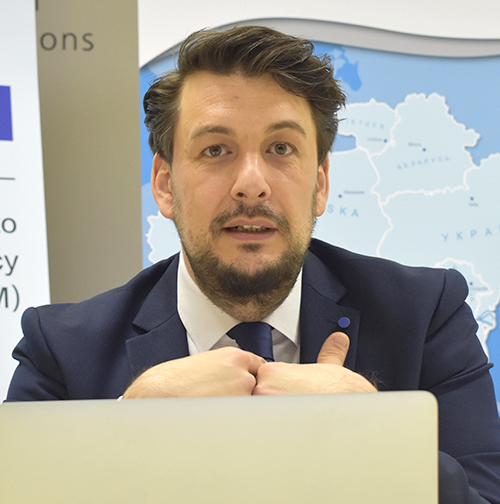

Editor-in-Chief Atul Singh and Sebastian Schäffer, Director of the Institute for the Danube Region and Central Europe, discuss the Alternative for Germany’s (or Alternative for Deutschland, abbreviated AfD) historic electoral victory in Saxony-Anhalt. They examine the economic stagnation, political disillusionment and enduring East–West divide fueling the far right’s rise. They also assess German Chancellor Friedrich Merz’s leadership, Germany’s increasingly fragmented political system and the future of the country’s firewall against the AfD.
East Germany’s discontent fuels the AfD
Saxony-Anhalt is one of Germany’s 16 federal states and has roughly two million inhabitants. Located in the former German Democratic Republic (GDR), the state was established in its current form during German reunification. It contains areas once sustained by industry but now marked by economic decline and outward migration. Singh describes the state as part of Germany’s rust belt.
Despite having relatively few foreign residents, Saxony-Anhalt has become a center of support for the anti-immigration AfD. Schäffer identifies three underlying causes: the persistent belief among East Germans that they remain second-class citizens, dissatisfaction with established parties and frustration over the handling of migration and the economy.
The AfD’s victory follows its 2024 success in Thuringia. Schäffer argues, however, that the most consequential result was the Christian Democratic Union of Germany’s (CDU) collapse rather than the AfD’s expected first-place finish. The outcome reveals how sharply traditional parties have lost voters’ confidence. Many voters appear less committed to the AfD’s detailed program than determined to reject a political establishment they believe has ignored them.
Merz has overpromised and underdelivered
Merz presented himself as a business-minded alternative to conventional career politicians. After serving in politics during the 1980s and 1990s, he worked as a corporate lawyer and investment manager at BlackRock before returning to lead the CDU. His experience encouraged expectations that he could restore growth and modernize Germany’s economy.
Parliament gave Merz exceptional room to act by approving €500 billion in borrowing for infrastructure, defense and economic modernization. He also promised to halve the AfD’s support and pledged to supply Taurus cruise missiles to Ukraine if Russia continued attacking civilians. Schäffer argues that visible progress has not followed.
“He has overpromised and underdelivered drastically,” Schäffer says. Merz has also alienated citizens by telling them to work harder while appearing unable to fulfill his own commitments. His communication problems compound the impression that his government lacks empathy, direction and urgency. By adopting some of the AfD’s rhetoric without delivering the change voters expected, he may have strengthened the party he intended to weaken.
Germany hasn’t prepared for industrial change
Germany’s economic malaise predates Merz. Its automotive industry, long built around mastery of the internal combustion engine, now faces severe pressure from Chinese electric vehicle manufacturers. Political and corporate leaders failed to anticipate the transition early enough, leaving Germany without a convincing strategy for industrial renewal.
Former Chancellor Gerhard Schröder confronted an earlier period of stagnation with the controversial Hartz labor reforms. No comparable structural program has emerged today. Global crises have also raised energy costs and weakened growth, but Schäffer argues that German governments could have done more to prepare the country and protect citizens from economic disruption.
Many Germans no longer believe that the next generation will enjoy greater prosperity than the last. This loss of optimism strengthens parties offering a return to an idealized past. The nostalgia hits particularly hard in former East Germany, where some voters romanticize aspects of the GDR despite its authoritarian system and Soviet domination.
Schäffer believes the AfD does not truly want responsibility for governing. Opposition allows it to promise sweeping change, reject compromises and blame other parties when those promises prove impossible.
Fragmentation tests Germany’s coalition model
Germany uses a mixed electoral system combining constituency contests with proportional party representation. Parties generally must receive at least 5% of the vote to enter parliament. The system usually produces coalition governments and makes negotiation essential.
Critics argue that the proliferation of parties, including the AfD and Bündnis Sahra Wagenknecht, has transformed compromise into paralysis. The previous coalition of the Social Democrats, Greens and Free Democrats became associated with indecision and internal conflict. Germany’s postwar consensus worked when the social fabric was stronger, but growing fragmentation now makes agreement more difficult.
Schäffer nevertheless defends coalition-building as one of democracy’s fundamental rules. “We need coalition governments, we need compromise,” he says. The deeper problem is not proportional representation itself but parties’ failure to use compromise to produce coherent policies. Political leaders must debate which policies work rather than reducing every question to a contest between left and right.
Migration intensifies a broader crisis of confidence
More than a quarter of Germany’s population has an immigration background. Migration and integration have consequently become central political issues, but Schäffer warns that politicians repeatedly exploit border rhetoric during elections instead of developing workable European solutions.
He maintains that “basic humanism requires us to help if people are seeking refuge.” Germany must nevertheless demand more from those unwilling to integrate while creating better opportunities for those who want to participate in society. Schäffer argues that the country needs migration because of its demographic decline, but its leaders have communicated poorly and failed to balance obligations with expectations.
The AfD’s strongest results in areas with relatively few migrants suggest that its appeal reflects broader political alienation as much as direct experience of immigration. Economic insecurity, distrust of institutions and resentment toward governing elites give simplified anti-immigration arguments greater force.
Since Singh and Schäffer held this interview, the CDU has lost the September 20 Berlin election and couldn’t garner enough votes in the September 20 Mecklenburg-Western Pomerania state election to enter parliament — the latter is a historic failure. A CDU defeat in North Rhine-Westphalia next year could make his position untenable. Merz’s fate depends on whether his government can restore economic confidence, answer public concerns and prove that democratic compromise can still deliver meaningful change. If it cannot, the political firewall excluding the AfD from the government will become increasingly difficult to maintain.
[Lee Thompson-Kolar edited this piece.]
The views expressed in this article/video are the author’s own and do not necessarily reflect Fair Observer’s editorial policy.










































Comment