



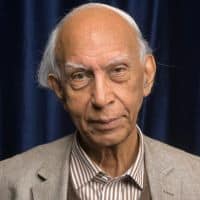

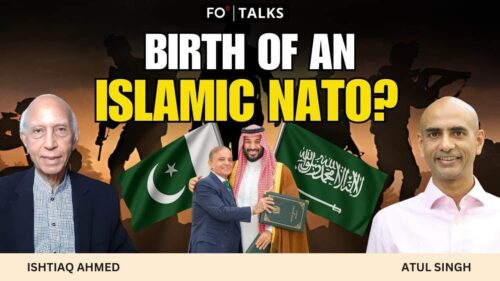
Editor-in-Chief Atul Singh and Professor Ishtiaq Ahmed examine why Pakistan evolved into a military-dominated garrison state while India became a bureaucracy-dominated “babu state,” as Atul calls it. Drawing on history, political theory and institutional development, they compare how each country inherited and transformed colonial structures after independence. Their discussion argues that although the two states followed different paths, both now require major institutional reforms to improve governance and accountability.
Weak institutions created Pakistan’s garrison state
Ahmed begins by explaining communications theorist Harold Lasswell’s concept of the garrison state, in which perceived external threats allow military institutions to dominate politics, the economy and society. He argues that Pakistan adapted this model after independence because it lacked a strong national political party following the deaths of founder Muhammad Ali Jinnah and Prime Minister Liaquat Ali Khan. Instead, the civilian bureaucracy briefly filled the vacuum before the military steadily consolidated power, culminating in General Ayub Khan’s takeover in 1958.
Ahmed describes Pakistan as a “post-colonial garrison state,” saying that the military gradually acquired authority over virtually every important national decision. Singh notes that Pakistan strengthened this system by aligning closely with the United States during the Cold War, presenting itself as a frontline state against communism while simultaneously viewing India as its principal security concern.
Singh and Ahmed then turn to how East Pakistan seceded from Pakistan and emerged as Bangladesh in 1971. They explain how political exclusion, economic grievances and ethnic discrimination destabilized the country after Bangladeshi leader Sheikh Mujibur Rahman’s electoral victory was ignored by elites in Pakistan, then West Pakistan. According to Ahmed, the creation of Bangladesh reinforced the military’s claim that only it could preserve Pakistan's survival.
India’s inherited imperial-era bureaucracy
Singh contrasts Pakistan’s experience with India’s political evolution after independence. Whereas Pakistan’s military became the dominant institution, India retained the colonial administrative system built around the Indian Civil Service (ICS) and Imperial Police. Jawaharlal Nehru preserved these institutions, transforming them into the Indian Administrative Service (IAS) and Indian Police Service (IPS) while expanding the state’s role through socialist economic planning.
This produced a babu state, where bureaucrats, especially the IAS, exercise much of the country’s practical authority rather than elected officials. Elected mayors still have no power in India. The lord of a district is the IAS officer who controls the commanding heights of not only the state but also the local economy. Singh traces this system back to British colonial governance, under which ICS officers collected revenue, administered provinces and maintained imperial control. This was the Eastminster (in stark contrast to Westminster) model that the British operated in the colonies. India still functions according to the Eastminster model.
Ahmed agrees that India’s bureaucracy became the principal pillar of governance while the military remained outside politics. He highlights one important distinction between the two countries: “The political leaders [of India] are compelled to go to the people every four or five years... and that does have a certain virtue.” Elections force Indian politicians to seek public approval, whereas Pakistan’s military establishment can remove civilian governments without facing voters.
Problem producers: colonial bureaucracy and military rule
Both institutional models have generated long-term governance challenges. Singh contends that India’s expanding bureaucracy accumulated authority over specialized sectors without developing the technical expertise needed to manage them effectively. He points to institutions ranging from the Reserve Bank of India to the Archaeological Survey of India as examples where IAS officers with no experience or expertise lord over professionals with domain expertise.
Ahmed notes that Pakistan followed a different trajectory since both countries won their independence in 1947. During Ayub Khan’s rule (1958–1969), the country initially experienced rapid economic growth and industrialization with substantial support from the US and the World Bank. However, Pakistan’s 1965 war with India proved a turning point and the economy suffered, never to recover. Political instability has plagued Pakistan since 1965. The Afghan conflict that kicked off 1979 and the ensuing increasing Islamization prevented Pakistan from sustaining its early economic momentum.
These historical choices continue to shape each country’s political culture. Singh maintains that bureaucratic centralization has created a criminally corrupt and inefficient administration, suppressing business activity, economic growth and investment, while Ahmed emphasizes that Pakistan’s military continues to dominate national decision-making through its institutional influence, manipulating elections and elected governments.
Reform requires local democracy and greater accountability
Singh and Ahmed turn to possible reforms. Singh says both countries should professionalize their bureaucracies by placing experts rather than general administrators of the IAS or the Pakistan Administrative Service (PAS) in specialized positions. Economists should oversee central banks, specialists should lead technical agencies and recruitment should move beyond a single examination system.
Singh also calls for stronger institutions that curb corruption. This would require independent bodies with top-notch investigation, proper prosecution and an efficient judiciary that resolves cases quickly. Currently, the police rely on extrajudicial methods, including executions of criminals in cold blood. Instead, Singh contends that effective law enforcement requires functioning legal institutions based on investigation, prosecution and conviction.
Ahmed broadly agrees with these proposals while emphasizing the importance of improving relations between India and Pakistan. “Pakistan and India should sit together and sort out their concerns about security and defense,” he says. Reducing bilateral tensions would weaken the military’s justification for political dominance while allowing both countries to devote greater resources to economic development.
The conversation concludes by arguing that institutional reform must also extend to local government and internal party democracy. Singh advocates stronger elected local leadership, evoking the Swiss principle of subsidiarity. This greater local democracy should be accompanied with greater accountability. Ahmed points to Sweden’s welfare state as an example of how effective public institutions can improve citizens’ lives. Lasting reform, they agree, depends not only on changing governments but on reshaping the institutions that have defined both states since independence.
[Lee Thompson-Kolar edited this piece.]
The views expressed in this article/video are the author’s own and do not necessarily reflect Fair Observer’s editorial policy.




































Comment