




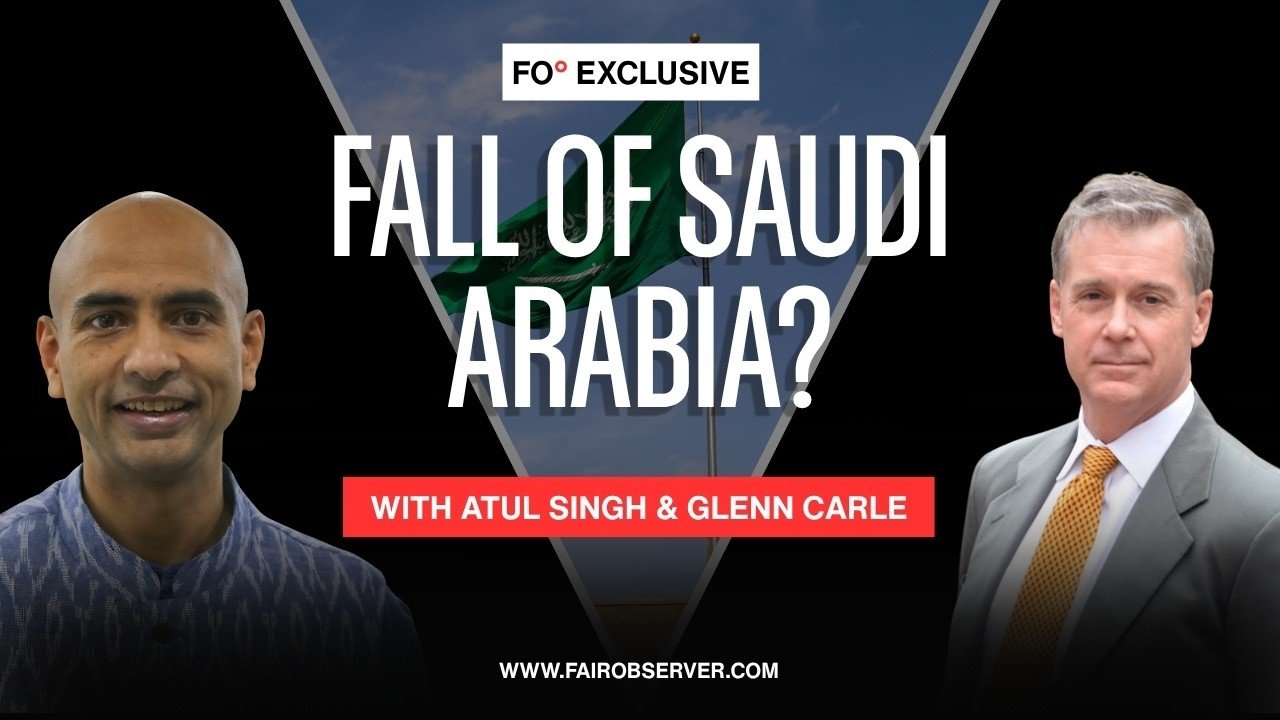
Editor-in-Chief Atul Singh and FOI Senior Partner Glenn Carle, a retired CIA officer who now advises companies, governments and organizations on geopolitical risk, examine the pressures facing Saudi Crown Prince Mohammed bin Salman (MBS) and the House of Saud. Atul draws on FOI’s military, diplomatic and intelligence sources to explain how these pressures could threaten the monarchy. Glenn shares many of his concerns but offers a different assessment of the Kingdom’s resilience.
Houthi advances change the strategic reality
Houthi attacks and advances demonstrate the limits of Saudi military might, putting unprecedented pressure on the kingdom and the current regime. To the east, the Iranians have blocked the Strait of Hormuz and severely disrupted Saudi exports. To the southwest, Houthis threaten to choke off the Bab al-Mandab, the strait connecting the Red Sea to the Gulf of Aden and the Indian Ocean. Drone and missile attacks on Saudi infrastructure have greatly damaged critical oil, port and pipeline facilities, causing a significant shortfall in revenues.
Houthi advances change the strategic reality of the Arabian Peninsula. In September 2026, the Houthis captured significant parts of Yemen’s Red Sea coast and several strategic islands. They began their offensive on September 3 and made rapid advances. They captured the city and port of Mokha on September 10 and Perim, also known as Mayyun, in the Bab al-Mandab Strait on September 11.
They also fought for control of key passes in the Kahboub Mountains, rugged highlands in the Lahj and Taiz governorates. Commanding these highlands, some of whose heights lie about 40 kilometers from Bab al-Mandab, secures the rear of Houthi-controlled territory on the coast. Reporting on September 22 described continuing battles for the mountain range, rather than confirmed control of the entire area.
The Houthis now have the ability to threaten passage through the strait more directly, though according to Atul, they have promised not to target European or American ships for now. In contrast, they have formally announced a ban on Saudi-flagged, owned or operated vessels, as well as any shipping moving to or from Saudi Red Sea ports such as Yanbu and Jeddah. Their island positions improve their ability to observe passing vessels and reduce the warning time available before an attack.
Saudi Arabia faces unattractive choices in Yemen
FOI’s sources say Saudi Arabia increasingly faces an impossible situation. The Houthis want the Saudis to pay salaries in Houthi-controlled territory, share Yemen’s oil revenues and compensate for war losses. MBS would lose face if he gives in to this extortion racket. In 2015, he intervened in Yemen’s civil war to restore the Yemeni government but got bogged down in protracted conflict that led to a truce in 2022. The Saudi-led intervention began on March 26, 2015 and MBS failed to achieve victory, accepting a UN-brokered truce that took effect on April 2, 2022.
The relative calm that followed that truce has now broken down. MBS could choose military escalation but that would lead to more Houthi strikes on Saudi energy infrastructure. Neither giving in to extortion nor choosing escalation are attractive options.
FOI’s sources also argue that Saudi Arabia’s diplomatic blunders have led to humiliation in Yemen. The Yemenis backed by MBS have proved to be divided, corrupt and incompetent in their assessment. MBS has fallen out with UAE President Mohammed bin Zayed (MBZ). Initially, MBS and MBZ intervened together against the Houthis in 2015. Now, they have become rivals.
The UAE backs the Southern Transitional Council (STC), a separatist group pushing for southern Yemeni autonomy. The Saudis back the Presidential Leadership Council (PLC) that operates largely out of Riyadh and stands for a united Yemen. Though the PLC is internationally recognized, it commands no effective authority and Yemen has become a fractured, failed state with shifting tribal loyalties and competing regional militias. These sources hold MBS responsible for the Saudi humiliation in Yemen.
Saudi troubles stem not only from the Houthis and Iranian attacks but also Shia militants in Iraq. Their attack forced the closure of a key pipeline. Drone attacks that Riyadh blamed on Iraqi militias forced the East-West pipeline to shut on September 11, interrupting crude loading at the eastern Saudi port of Yanbu. Operations subsequently resumed. Note that the East-West pipeline carries oil across Saudi Arabia to the Red Sea, providing an alternative export route to Hormuz. That alternative route faces twin threats: the Houthis to the south and the Iraqi Shia militias to the north.
The Islamic Revolutionary Guard Corps (IRGC) has been active in Iraq for the last two decades and the IRGC-backed Shia militias are engaging in asymmetric warfare across Saudi Arabia’s northern border. Riyadh worries about attacks on Eastern Province, which holds an estimated 70%–90% of Saudi oil reserves. Both Ghawar, the world’s largest conventional onshore oil field, and Safaniya, the world’s largest offshore oil field, are in this province.
Shias form an estimated 25%–33% of the population in the province. Riyadh has persecuted these Shias for decades, some of whom are bound to have sympathies with Iran. With local Shia help, Iran and IRGC-backed Iraqi militias can cause significant damage to energy facilities, especially the Abqaiq processing facility that processes 50%–70% of the total Saudi oil output.
A fragmented military protects the dynasty
FOI’s military sources also express grave doubts about the command structure of the Saudi military as well as the quality of officers and troops. Per Stockholm International Peace Research Institute, Saudi Arabia’s military expenditure was an estimated $83.2 billion in 2025.
Despite spending this money, FOI’s sources doubt the military’s combat readiness. Saudi Arabia has some of the best Western hardware and the Royal Saudi Air Force (RSAF) is regarded by these sources as the best in the Arab world. However, Saudi forces other than RSAF do not have a high reputation.
Atul’s approximate personnel estimates put the regular military at the Royal Saudi Land Forces (~75,000), the RSAF (~20,000), the Royal Saudi Air Defense Forces (~16,000), the Royal Saudi Naval Forces (~13,500) and the Strategic Missile Forces (~2,500). FOI’s sources contend that forces other than RSAF cannot maintain their military equipment, lack combat experience, lack professionalism and cannot take casualties.
The House of Saud has long feared a coup and created loyal forces to counter Saudi regular forces. Atul points to military seizures of power in Egypt, Syria and Iraq as examples of the outcomes Saudi rulers wanted to prevent.
An approximately 130,000-strong Saudi Arabian National Guard (SANG) counterbalances the 127,000 regular forces. The purpose of SANG, known as the White Army, is the perpetuation of the House of Saud. Tribal loyalties matter. Financial retainers, patronage and family integration bind local sheikhs and tribes to the monarchy. SANG has mechanized infantry, armored vehicles, artillery and aviation to ensure that it is not dependent on regular forces.
The Saudis also have the Royal Guard Regiment to protect the monarch and the palaces. Members of this Praetorian guard have deep tribal and familial loyalty to the Al Saud dynasty. The Royal Guards and SANG keep the Saudi regular forces in check to ensure the continuation of the regime.
FOI’s sources explain that the fragmented Saudi forces cannot guarantee the country’s security anymore. They mention two factors as particularly debilitating. Top-down centralization has led to bureaucratization, suboptimal feedback loops and poor decision-making. Different Saudi forces operate separate intelligence, supply and communication lines, making coordination difficult and undermining combat effectiveness. Critics call Saudi forces a “checkbook military” that can buy expensive military kit but cannot maintain or operate what they buy. Saudi forces reportedly have “all the gear, no idea.”
Asymmetric warfare tests the American security umbrella
FOI assesses that Saudi Arabia is not in a position to counter the asymmetric warfare unleashed by Iran and its proxies. Atul puts the cost of Saudi air defenses’ MIM-104 Patriot interceptors at $3–$4 million per missile when used to intercept low-cost Iranian-designed loitering munitions costing less than $20,000. Interceptor missiles are both expensive and scarce.
Saudi soft targets such as water desalination plants, energy processing facilities, oil terminals and pipelines are particularly vulnerable to low-cost, low-flying Iranian drones. From 2015 to 2021, the Houthis launched 430 ballistic missiles and 851 armed drones on Saudi targets.
On September 14, 2019, low-altitude cruise missiles and suicide drones struck Saudi Aramco’s oil processing facilities at Abqaiq and Khurais. Saudi Arabia attributed the attack to Iran, while the Houthis claimed responsibility. The strike knocked out 5.7 million barrels per day, about 50% of the total Saudi oil production and 5% of the global supply. Aramco confirmed the suspension of 5.7 million barrels of daily production that day.
FOI sources in Washington reveal that the Trump administration does not want to guarantee Saudi security, leaving the country extremely vulnerable. US President Donald Trump wants Saudi forces to buy American-manufactured military hardware and take on Iran. His administration would like Saudi Arabia to become a self-reliant fortress that becomes an economic engine for American defense manufacturing.
So far, the Saudis have relied on the American security architecture but according to FOI’s sources, the US has moved assets and operations out of its bases in the Persian Gulf because of targeted and sustained Iranian attacks. With American security increasingly uncertain, the Saudis are looking for alternatives.
On August 7, 2026, Saudi Arabia, Turkey and Pakistan signed the Mecca Joint Defense Agreement, creating what Atul describes as a Sunni coalition against Shia Iran. During the period discussed, neither Turkey nor Pakistan had stepped in to counter Iran and its proxies directly. On September 24, the three countries’ foreign ministers discussed arrangements for an urgent meeting of their chiefs of staff.
The Saudi social contract comes under strain
FOI’s diplomatic sources in London believe that Saudi military vulnerability could lead to the downfall of MBSl. The ambitious crown prince has centralized power in his hands, shaking down members of his family, undermining traditional tribal authority and marginalizing the kingdom’s religious establishment. Tribal and religious leaders oppose top-down Westernization and wasteful mega projects, according to these sources.
Key southwestern confederations such as the Khawlan bin ‘Amr, Yam and Qahtan were loyal to the Al Saud family for decades. MBS stripped them of their financial stipends and tribal autonomy. FOI’s sources report that these tribes have not only rejected the demands of the Saudi palace but also actively enabled the Houthis. Atul describes their conduct as a refusal to cooperate fully with the palace.
MBS has been turning his security apparatus against these non-cooperative tribes. That poses a risk because many SANG troops hail from these very tribes and could mutiny.
FOI’s sources think that the Saudi social contract no longer works. Historically, the House of Saud has distributed oil rents in exchange for political allegiance. These rents have flowed through tribal and religious leaders.
In 2025, oil revenues accounted for 54.55% of total government income according to the Ministry of Finance. Reported figures put oil revenue at 606.54 billion ($161.74 billion) out of total revenue of approximately 1.11 trillion ($295.53 billion). Economists estimated this figure to be higher. Iran has severely threatened the export earnings underpinning Saudi state revenue. The 2025 budget deficit reached approximately 276.61 billion ($73.69 billion). With earnings down and spending up, Saudi Arabia faces significant financial strain and MBS has less money to buy allegiance.
FOI’s sources in the region report that alienated tribal leaders, angry traditional Muslim clerics and demoralized mid-level military officers might collaborate with rival royals and business elites MBS purged and humiliated to get rid of the crown prince. With uncertain external support, internal opposition from powerful groups and cashflow problems, the survival of not only MBS but the House of Saud itself is now in question.
Glenn expects resilience rather than collapse
Glenn agrees that these pressures are real but argues that Saudi rulers have faced several challenges for decades. Yemen has long presented a security challenge, while factional rivalries and tensions involving the Shia minority predate MBS. Fighting a movement rooted in local society, operating in difficult terrain and receiving Iranian support would challenge even a much stronger military. So, the Saudis deserve some slack for their military debacle.
Glenn views MBS’s achievements in centralizing power, streamlining authority around himself and weakening conservative religious leaders as a success and a source of strength. Many young Saudis support the crown prince because he has expanded entertainment and brought substantial changes to everyday life. Cristiano Ronaldo’s presence in Saudi football provides one conspicuous example.
For Glenn, the two largest strategic dangers are a less dependable American security commitment and the economic consequences of disrupted petroleum exports. Without those earnings, MBS’s social, military and political projects could face existential pressure. Nevertheless, Glenn expects the monarchy to muddle through rather than suffer a sudden collapse.
Atul maintains that MBS has spent excessively on prestige projects without sufficiently improving productivity. Popularity among young Saudis may not offset opposition from powerful groups with greater organization and ability to use force. If falling oil income reduces the resources available for patronage, MBS’s popularity could fall quickly.
Glenn closes by pointing to Saudi Arabia’s substantial sovereign wealth assets. He cites Saudi sovereign wealth of roughly $1 trillion. Note that the Public Investment Fund’s 2025 reporting confirms more than $900 billion in assets under management. These assets provide a financial cushion for a beleaguered MBS, even if they are not all immediately available cash. Atul accepts the point and acknowledges efforts to restructure major development projects and build capacity. However, he doubts if Saudi assets and efforts can offset military and financial pressures now testing MBS and his dynasty.
[Lee Thompson-Kolar edited this piece.]
The views expressed in this article/video are the author’s own and do not necessarily reflect Fair Observer’s editorial policy.


































Join the conversation
Share your perspective
Log in to share your thoughts and take part in the discussion.