


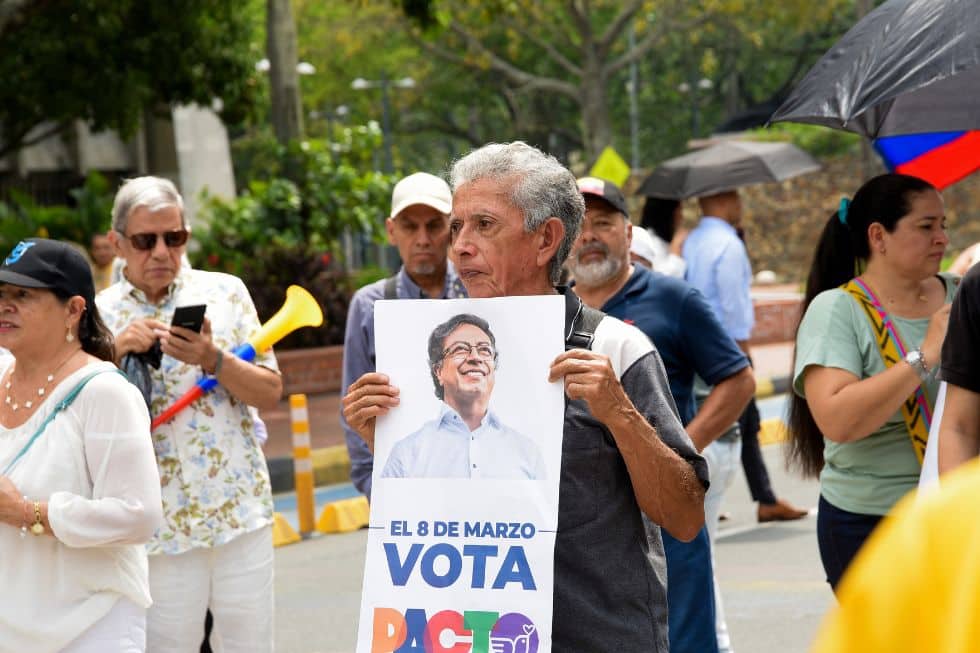



This year, Colombia is entering a pivotal election cycle, the outcome of which will redefine US–Colombian relations. This is happening at a time when personal dynamics increasingly rival ideology in shaping American foreign policy toward Latin America.
Colombia’s vote is not merely a domestic political contest. It is a test of how security policy, narcotics enforcement and leader-to-leader diplomacy will interact in an era when personality often carries as much weight as formal alignment. For Washington — and for investors and multinational firms with exposure to Latin America — the implications extend well beyond Bogotá.
A fragile foundation: Colombia’s shifting security landscape
For decades, Colombia has been one of Washington’s closest security partners in South America and one of the region’s largest economies. That relationship is now under strain. Colombian President Gustavo Petro’s “Total Peace” strategy — an effort to halt military confrontation with armed groups and bring them to the negotiating table — has triggered deteriorating security conditions, the rearming and territorial expansion of criminal and insurgent organizations, and record-high cocaine production.
Colombia’s security posture is a direct US national security issue. A new working paper from the National Bureau of Economic Research links the surge in Colombian cocaine production since 2015 to roughly 1,500 US overdose deaths per year, with fentanyl contamination — now reaching one in four tested cocaine samples — dramatically intensifying the toll. Washington must evaluate regional partners with these realities in mind. However, policy alone does not explain why this bilateral relationship feels so fragile. Increasingly, personality plays a part.
The role of personality in foreign policy
In the current US political environment, interpersonal relationships between leaders matter more than they have in decades. Where public persona ends and policy begins is an increasingly gray area. Colombia experienced this firsthand after a series of social media clashes escalated tensions between Petro and US President Donald Trump, jeopardizing decades of cooperation in a matter of days. Relations ultimately stabilized through private diplomacy, but the episode underscored how tone, respect and personal chemistry matter today at least as much — if not more — than ideology.
A similar dynamic is playing out across Latin America. Leaders with little ideological alignment have maintained productive ties with Washington by avoiding public confrontation and cultivating personal rapport. Mexico’s President, Claudia Sheinbaum, exemplifies this approach. Despite having campaigned on a platform largely at odds with Trump’s priorities, she has successfully fended off trade penalties and US intervention by increasing security cooperation and staying in close, regular contact with both Trump and US Ambassador Ronald Johnson.
This dynamic looms large as Colombia approaches its next election. By 2025, most ceasefires had collapsed, extortion had risen, mass displacements returned to post-2016 peaks and public perceptions of insecurity reached their highest level in a decade, according to Global Guardian’s 2026 Election Report. The next government must now decide whether to continue pursuing negotiated coexistence with armed groups or pivot toward a more militarized security strategy.
The stakes for Colombia’s 2026 election
If left-leaning candidate Senator Iván Cepeda Castro, who is aligned with Petro’s political movement, prevails, security policy is likely to resemble a more tactical version of Total Peace. While less likely to draw Trump’s ire due to Castro’s considerably more stoic temperament, the continuance of Total Peace would likely prolong tensions with US officials concerned about narcotics and insurgent expansion.
Right-wing outsider Abelardo de la Espriella, who has modeled his own political brand after Trump as well as El Salvador’s Nayib Bukele, promises a tougher security posture. While such an approach may appear more aligned with US priorities, Colombia is not El Salvador. Attempting to replicate hardline models could provoke direct confrontation with well-armed insurgent and criminal networks capable of sustained retaliation, increasing violence over the medium term.
Center-right candidate Paloma Valencia offers perhaps the most conventional path forward. A seasoned legislator and vocal critic of Petro’s peace strategy, Valencia favors a return to security-first governance — stronger military operations, less tolerance for armed-group negotiations and, most crucially, close cooperation with Washington. As stated at a recent campaign event, perhaps equally to her supporters as well as the White House: “No Colombian government can sort out the security question unless the US helps us.” While Valencia’s strategy, which resembles a return to traditional Colombian confrontation against armed groups since the 1960s, would likely push back insurgents in the long term, it would almost certainly increase violent retaliations in the coming years.
In other words, Colombia’s election offers no easy security solution, only different types of risk. Election-period violence, insurgent interference and cartel retaliation remain real risks regardless of who wins. Armed groups have openly signaled their intention to influence elections by attacking polling sites, political offices, police stations, government buildings and other electoral infrastructure. Such tactics reflect a broader regional trend in which non-state actors increasingly treat democratic institutions as strategic leverage points — blurring the line between political contestation and operational risk for companies with personnel and assets on the ground.
Operational risks for companies in Colombia
For companies in the country, risk planning can no longer be hypothetical as extortion demands, employee coercion, kidnapping threats and pressure to provide logistical support to criminal groups are increasingly part of the operating landscape. This is the reality in Colombia, as well as any other international hub, as the geopolitical climate heats up and longstanding international relations are called into question.
International relations between the US and Colombia, as well as other countries in Latin America and beyond, continue to be shaped less by formal policy frameworks than by who holds power, how they relate to Washington and how security conditions evolve on the ground.
The US has demonstrated that it will work with governments across the ideological spectrum, provided core security interests are respected and personal channels remain functional. For Colombia’s next president, the lesson is clear: When national security cooperation depends heavily on US partnership, public confrontation can carry real costs.
Colombia’s 2026 election may not determine whether Washington remains engaged in the region, but it will test the terms of that engagement. In an era where diplomacy is increasingly personalized and security threats are transnational, even longstanding alliances must be actively managed. Stability is no longer inherited. It is negotiated.
[Kaitlyn Diana edited this piece.]
The views expressed in this article are the author’s own and do not necessarily reflect Fair Observer’s editorial policy.
South America Has Tilted Right. Will Colombia Follow?
Colombia’s 2026 presidential race features leftist Iván Cepeda, center-right Paloma Valencia and right-wing outsider Abelardo de la Espriella, reflecting a...
FO° Talks: The Donroe Doctrine: Will Trump Go After Mexico, Colombia and Brazil?
In this episode of FO° Talks, Rohan Khattar Singh and Joseph Bouchard discuss the US raid that captured Venezuelan President...
US Revokes Colombian President’s Visa: The Volatile Relationship Between North and South America
Colombian President Gustavo Petro confronted US President Donald Trump at the UN General Assembly over foreign intervention and climate policy....

Support Fair Observer
We rely on your support for our independence, diversity and quality.
For more than 10 years, Fair Observer has been free, fair and independent. No billionaire owns us, no advertisers control us. We are a reader-supported nonprofit. Unlike many other publications, we keep our content free for readers regardless of where they live or whether they can afford to pay. We have no paywalls and no ads.
In the post-truth era of fake news, echo chambers and filter bubbles, we publish a plurality of perspectives from around the world. Anyone can publish with us, but everyone goes through a rigorous editorial process. So, you get fact-checked, well-reasoned content instead of noise.
We publish 3,000+ voices from 90+ countries. We also conduct education and training programs
on subjects ranging from digital media and journalism to writing and critical thinking. This
doesn’t come cheap. Servers, editors, trainers and web developers cost
money.
Please consider supporting us on a regular basis as a recurring donor or a
sustaining member.
Will you support FO’s journalism?
We rely on your support for our independence, diversity and quality.





Comment