



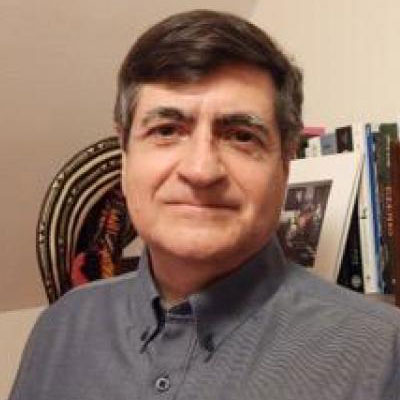

Fair Observer’s Video Producer Rohan Khattar Singh speaks with Leonardo Vivas, a Venezuelan scholar of Latin American politics, about the escalating standoff between the United States and Venezuela. Their conversation explores how Washington’s strategy has evolved under US President Donald Trump’s administration, how Venezuelan dictator Nicolás Maduro’s regime has managed to endure and what these developments mean for Venezuelans.
US–Venezuela tensions
Relations between Washington and the Venezuelan capital of Caracas have been tense for decades. The conflict deepened after the rise of former Venezuelan President Hugo Chávez and deteriorated further under Maduro. As Vivas explains, the early Trump administration pursued a “maximum pressure” campaign designed to remove Maduro from power. Yet over time, that posture shifted. The administration’s rhetoric now emphasizes national security over regime change — a pivot that reflects both declining enthusiasm within the Republican Party and an attempt to frame the Venezuelan issue for a domestic audience.
The new narrative links Venezuela to terrorism and narcotrafficking, particularly through the “cartel of the suns,” a network of military and political insiders accused of running drug operations from within the state. These allegations justified a naval deployment to the Caribbean involving warships, stealth jets in Puerto Rico, and a nuclear submarine. While Pentagon statements warned that any aggression from Maduro’s forces would be met in kind, Vivas stresses that a full invasion is “totally out of the picture.” Venezuela, he notes, is far too large, and such a move would dwarf the 1989 Panama invasion that required 25,000 troops.
Cartels or oil?
Khattar Singh asks whether the focus on cartels conceals a more traditional motivation: access to Venezuela’s vast oil reserves. Vivas rejects the theory outright, pointing out that the industry is in “pretty bad shape.” Production has collapsed from over three million barrels per day to roughly half that figure, and much of Venezuela’s heavy crude requires expensive refining technology that few facilities possess.
Vivas concludes that oil can no longer drive US policy. Instead, he suspects the security narrative helps Washington sell its approach internally. Behind the public rhetoric may lie other objectives — pressuring Caracas to cooperate on deportations or creating leverage to push Maduro toward negotiations.
Who supports Maduro
Maduro’s survival has baffled outside observers. Vivas explains that the regime functions as a coalition of vested interests, centered on the military. With Cuban assistance, the armed forces were restructured to make coups nearly impossible. Security agencies monitor officers and politicians alike, ensuring loyalty through surveillance and lucrative side deals.
As oil wealth declined, illicit economies replaced ideology as the main source of cohesion. Drug trafficking, gold smuggling and corruption now underpin the system. Vivas recounts a case near the Colombian border where a landowner was jailed after refusing to sell land coveted for drug operations, highlighting how criminal networks and state actors intertwine. Colombian insurgents such as the National Liberation Army also operate freely inside Venezuela, sustaining this hybrid order.
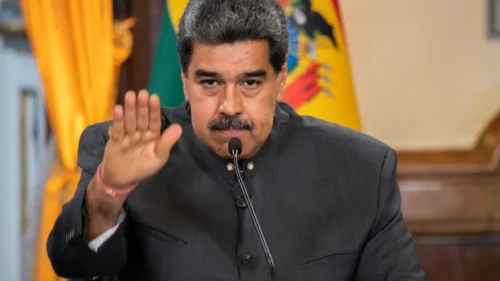
Maduro, Vivas says, serves as the cement holding it all together. His fall would shatter the current structure. While democracy’s return would face immense obstacles — the regime dominates the courts, media and oil sector — Vivas doubts that the coalition could survive without its central figure.
What Venezuelans feel
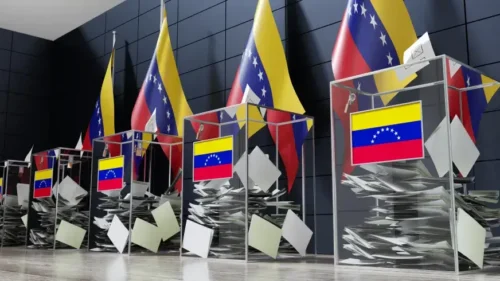
Khattar Singh turns the conversation to public sentiment. Vivas believes most Venezuelans have lost faith in elections after the July 28 contest, when the opposition’s clear victory was nullified by the government. For many, it proved that ballots alone cannot end authoritarian rule.
The despair extends to the diaspora. Around 800,000 Venezuelans live in the US under temporary protection, asylum or refugee status. Many risk deportation yet cannot return to a country suffering hyperinflation, chronic power outages and institutional decay. Vivas suggests that, despite their disillusionment, many quietly welcome American pressure as a potential catalyst for change.
Gen Z in Venezuela
Asked about the younger generation, Vivas compares Venezuela to Nepal, where youth movements recently drove political reform. He argues that Venezuelans have not surrendered completely. The country’s 40 years of 20th-century democracy left a collective memory of freedom that resists authoritarian normalization. Nonetheless, frustration is intense. Young people, seeing few prospects at home, increasingly choose emigration over activism.
Maduro’s allies
Internationally, Maduro stands more isolated than ever. “Nobody wants to take [...] a selfie with Maduro,” Vivas jokes. His only dependable allies remain Cuba and Nicaragua, while former regional partners now keep their distance. The regime further alienated neighbors by reviving claims to annex the Essequibo region between Venezuela and Guyana, provoking Brazil to deploy troops along its northern border. Even Cuba, despite its alliance, has sided with Guyana on this dispute.
For Vivas, this combination of diplomatic isolation, economic collapse and creeping military pressure leaves Maduro in his weakest position yet. Still, he cautions, the Venezuelan regime has repeatedly shown a remarkable capacity to adapt — and its end, however near it may seem, is far from guaranteed.
[Lee Thompson-Kolar edited this piece.]
The views expressed in this article/video are the author’s own and do not necessarily reflect Fair Observer’s editorial policy.



























Comment