




Editor-in-Chief Atul Singh and political anthropologist and author David Vine explore the history, displacement and enduring struggle over the Chagos Islands, a remote archipelago in the Indian Ocean that saw one of the most significant legal and moral confrontations in modern geopolitics. Together, they trace the arc from colonial dispossession to a landmark international victory, examining what justice might still mean for the Chagossians today.
What are the Chagos Islands?
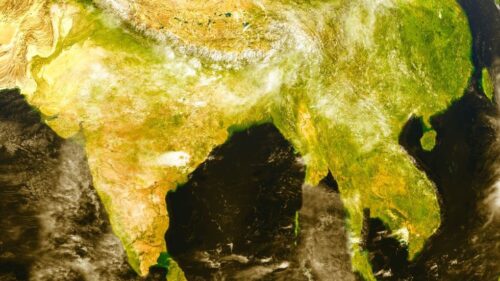
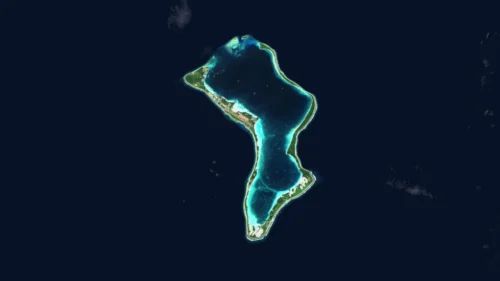
The Chagos Islands sit almost equidistant between Africa and Indonesia, directly south of India. This isolation, Vine explains, made them strategically appealing to imperial powers but devastating for their inhabitants. The largest island, Diego Garcia, now hosts one of the most important US military bases outside North America.
The islands were uninhabited until the late 18th century, when French settlers brought enslaved Africans from Madagascar and mainland Africa, followed by Indian indentured laborers. After the Napoleonic Wars, Britain took control of the territory, which remained tied to Mauritius until 1903. For generations, a small Creole-speaking population developed a self-sustaining society — until Cold War strategy intervened.
Strategic importance of Diego Garcia and UK-US takeover of Chagos
In 1965, Britain and the United States struck a secret agreement to build a base on Diego Garcia. The arrangement came with a $14 million payment — disguised as a military debt write-off — and the understanding that the local population would be removed. Between 1967 and 1973, British officials expelled roughly 1,500 Chagossians, forcing them onto ships bound for Mauritius and the Seychelles, an archipelago north of Madagascar.
Vine recounts how the US falsely told Congress that the islands had no permanent inhabitants. The displaced islanders were left destitute while the Pentagon built a massive air and naval complex on their homeland. This act of ethnic cleansing, carried out in secrecy, remains one of the darkest chapters in postwar Anglo-American relations.
For decades, Diego Garcia has served as a linchpin of US military operations, launching missions in the Gulf War, Afghanistan and Iraq. Singh notes that the island occupies a pivotal position in American strategy.
Vine challenges the claim that Diego Garcia is indispensable, arguing that national security is invoked reflexively with little evidence to support it. He adds that most conflicts launched from the island produced catastrophic consequences. Singh counters that some wars achieved their goals, but Vine identifies that even military success cannot erase the moral cost of war.
British vs. Chagossians
When the Chagossians sought justice, British authorities resisted fiercely. Their lawsuits were initially successful: In 2000, the High Court ruled their expulsion unlawful and recognized their right to return to all islands except Diego Garcia. Yet the government appealed, and in 2008, Britain’s House of Lords reversed the ruling.
Soon afterward, London announced a Marine Protected Area (MPA) across the archipelago, ostensibly for conservation. Leaked diplomatic cables later revealed that the MPA had been designed to prevent the Chagossians’ return — a cynical move that disguised political obstruction as environmentalism.
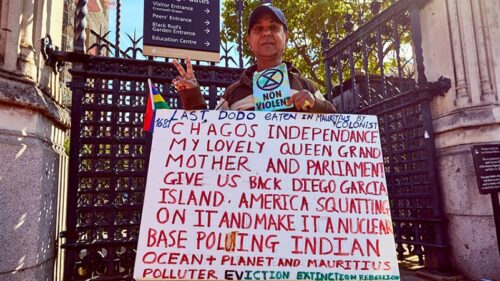
Despite decades of defeat, the Chagossians never gave up. Under leaders like Louis Olivier Bancoult and the Chagos Refugees Group, they organized protests, petitions and legal cases. Vine calls it a “David and Goliath story,” a small, impoverished community confronting two of the world’s most powerful states.
Their persistence paid off on February 9, 2019, when the International Court of Justice ruled that Britain’s 1965 separation of Chagos from Mauritius had been illegal. The UN General Assembly followed with a resolution demanding that the United Kingdom end its colonial administration. London, backed by Washington, ignored the verdict — showing, Vine says, the lingering arrogance of the empire.
Pro bono lawyers and resettlement plans
Behind this struggle stood a network of pro bono lawyers drawn to a simple moral case: a people unlawfully deprived of their homes. Their creativity turned a local injustice into a global precedent for decolonization and exposed how Cold War politics outlived their purpose.
After years of denial, on November 3, 2022, the UK announced it was reversing course. It began negotiating with Mauritius, culminating in a treaty transferring sovereignty while leasing Diego Garcia back to Britain for 99 years. The arrangement, backed by the US and India, marked what Singh calls a rare triumph of diplomacy and law.
Still, the treaty prevents Chagossians from resettling on Diego Garcia — a restriction Vine calls “a major flaw.” He points out that civilians live near other military bases and that large parts of the island are unoccupied. The agreement provides £45 million (over $60 million) for Chagossian welfare and £125 million (over $167 million) in development funds, but divided among 8,000 people, the payments are modest.
Resettlement studies suggest that rebuilding on smaller islands would be feasible. The possible industries would include fishing, coconut processing and ecotourism. Chagossians emphasize that they are the natural stewards of their environment and want to rebuild sustainably.
What’s next for Chagossians?
While the treaty marks a milestone, the fight for full justice continues. Some Chagossians support the sovereignty deal, hoping it will enable return and reconstruction. Others, wary of promises, demand an independent Chagossian administration or full Mauritian rights. Internal divisions, often reinforced by colonial manipulation, still complicate unity.
Vine concludes that the Chagos story is not just about geopolitics but about racism and the theft of a homeland. The British and American governments built a base for power projection; the Chagossians built a moral case for dignity. Their decades-long campaign has already changed international law, and they are determined to make sure it also changes their future.
[Lee Thompson-Kolar edited this piece.]
The views expressed in this article/video are the author’s own and do not necessarily reflect Fair Observer’s editorial policy.



























Comment