


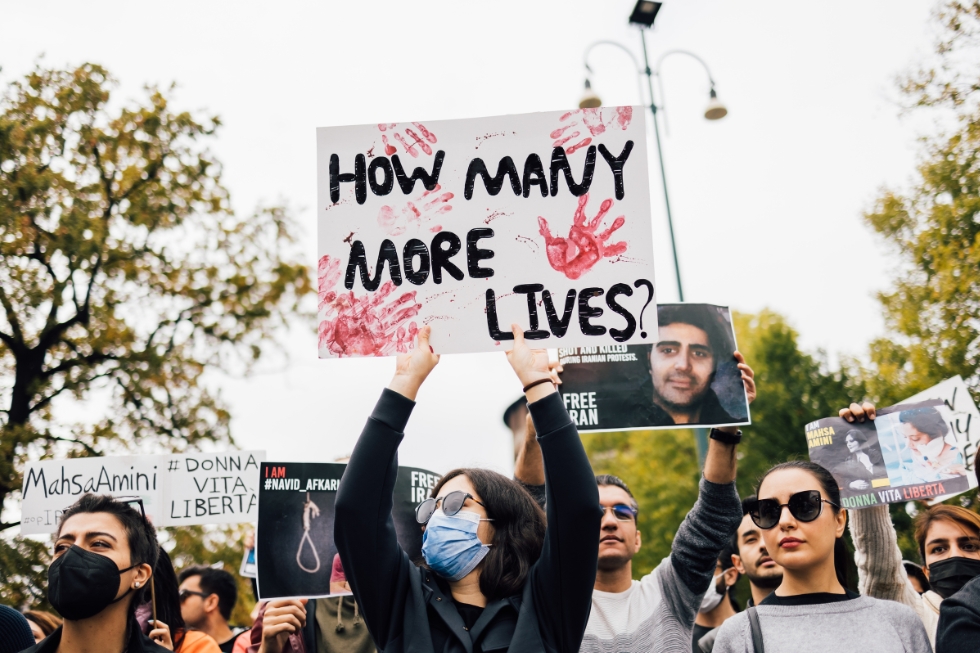



The protests that should have changed everything have led Iran into a nightmare few saw coming. In early 2026, as Iranians took to the streets demanding dignity, freedom and a transition from the Islamic Republic’s suffocating grip to a more democratic system, many hoped for a genuine opening toward something better. Yet months later, the country remains fractured, caught between a vengeful successor and the relentless pressure of American and Israeli military campaigns, with Persian Gulf Arab states quietly aligning against it. The result is a nation suspended in limbo, its people exhausted, radicalized factions empowered and the future more opaque than ever.
For ordinary Iranians, this limbo has become a daily struggle. Strikes have damaged factories, power plants and transport networks, while electricity cuts and water shortages disrupt homes and workplaces. Trade restrictions have raised the cost of basic goods and placed new pressure on fuel supplies. By July, annual inflation had reached 66%, with food prices 128% higher than a year earlier.
Repression has intensified alongside these hardships. Iranian authorities have executed protesters and issued further death sentences, while parliament is advancing repressive legislation. In a sweeping bill that could restrict interviews with foreign media and scientific cooperation with foreign universities and research institutions outside an Intelligence Ministry-approved list, the proposed prison terms range from six months to two years. The bill’s individual provisions have yet to receive final approval from the parliament and Guardian Council.
A new Supreme Leader and the rise in Iran’s ideological hardliners
Ayatollah Mojtaba Khamenei, now supreme leader, wasted little time signaling the new direction. In statements released through official channels, he vowed to avenge his father’s assassination in the February 28 US–Israeli strikes and the blood of all “martyrs” in the conflict. This pledge of inevitable revenge has become the rallying cry for hardliners. This is no longer simply the old Islamic Republic continuing by inertia. It is a wounded security state trying to turn bereavement into ideology and martyrdom into political capital. A regime whose legitimacy had been fraying has discovered that foreign attacks can restore cohesion among its hardest believers and recast a diminished ruler as a national martyr.
The strikes that killed Ayatollah Ali Khamenei, along with family members and senior officials, decapitated the old leadership but did not collapse the system. Instead, they breathed new life into its most ideological veins. The martyr narrative reversed the demonstrations that were weakening the regime, despite the protests even eroding support among some of Iran’s traditional base. It has elevated Ali Khamenei to a symbol of resistance against foreign aggression.
The ideological core, particularly within the remaining Islamic Revolutionary Guard Corps (IRGC) and families who lost their own in the fighting, now burns with fresh hatred for Israel, the United States and perceived Arab collaborators. The families of Revolutionary Guard commanders, security officials and other ideological loyalists killed during the war may also become an important pillar of the new order. If Mojtaba Khamenei consolidates his leadership, these families could form part of the regime’s core military and security constituency, bound together by grief, a sense of betrayal and a demand for revenge. Their growing influence would make Iran’s future darker, creating the possibility of an even more ideological state that concentrates power among people who regard compromise as weakness and retaliation as a political duty.
Iranian public sentiment reacts to the diminishing quality of life in Iran
Ordinary Iranians, both inside the country and in the diaspora, live in a state of perpetual anxiety. They wake each day to news of fresh infrastructure strikes, internal power maneuvers, or new execution orders. The government issued dozens of death sentences amid the “wartime” crackdown, targeting protesters from the January uprising and perceived dissidents. The repression that followed the protests — mass arrests, killings and now politically motivated executions — has only intensified.
Many Iranians harbor deep resentment toward the Islamic Republic, but they regard the intentions of US President Donald Trump and Israeli Prime Minister Benjamin Netanyahu with equal suspicion. The Trump administration initially spoke to Iranians as though American pressure and military force would support their freedom. In practice, however, its policies have subjected the same people to bombardment, damaged infrastructure, visa restrictions, degrading rhetoric and greater insecurity both at home and abroad.
The campaign against Iran’s infrastructure has been methodical and unsparing, with power plants, bridges and other civilian-linked sites repeatedly threatened or attacked. Yet there appears to be little long-term strategy from the US beyond disruption and the vague hope that the regime will implode. Rather than helping Iranians escape authoritarian rule, this approach risks strengthening the state’s most repressive factions while leaving ordinary people to absorb the consequences.
US rhetoric and foreign bombs will not save Iranians
Trump’s rhetoric has deepened the damage. Hostile language about Iranians and their culture has helped create a climate in which nationality itself becomes a source of suspicion, fuelling travel restrictions, discrimination and mistreatment abroad. These pressures affect ordinary Iranians as well as public figures. One visible example was the treatment of Iran’s national football team during the World Cup in the United States, where players and officials faced heightened scrutiny from US authorities.
The opportunism of some Persian Gulf Arab governments has added to the sense of betrayal. Iranians therefore find themselves trapped between a regime they despise and foreign powers whose actions offer destruction without a credible political future.
This leaves many Iranians in a political purgatory. They despise the clerical system’s authoritarianism and corruption but see no salvation in foreign bombs or the prospect of territorial fragmentation. A July 2026 survey captured this tension: 70% favored regime change or structural transition, while only 30% regarded foreign military intervention as an effective means of achieving change. Even among regime critics, fears of economic collapse, prolonged instability and territorial fragmentation complicate the claim that foreign bombs offer a path to freedom.
Every day brings the stress of potential escalation, whether from external strikes or internal purges. When external threats ease momentarily, the risk grows that the regime’s more ambitious, ideologically hardened elements — now including Mojtaba Khamenei’s circle and grieving IRGC networks — will turn their vengeance inward against the population.
Iranian leaders’ personal and collective loss has supercharged the same hatred that once targeted Israel and the West. Unable to strike Washington or Tel Aviv directly, the temptation to reassert control through domestic terror becomes acute.
Will Iran’s internal instability lead to more radicalism?
Alongside external threats, a struggle within the ruling establishment has made Iran’s future even less certain. Mojtaba Khamenei owes his elevation in large part to the IRGC, which now exercises greater influence over civilian institutions and the conduct of the war. A more pragmatic bloc around Parliament Speaker and lead negotiator Mohammad Bagher Ghalibaf, President Masoud Pezeshkian and Foreign Minister Abbas Araghchi has pushed for greater flexibility toward the West, while senior IRGC commanders have resisted that approach. Networks associated with former President Hassan Rouhani remain another center of influence within the system. These rivalries complicate state decision-making and increase the prospect of further military control.
Stabilizing Mojtaba’s power through any tacit Western accommodation would likely entrench a more radical posture, not moderate it. We are dealing with a leadership shaped by fresh trauma, surrounded by hardliners who see compromise as betrayal and revenge as sacred duty. Their apocalyptic worldview, particularly among certain IRGC factions, suggests little hesitation about high-stakes gambles, even at the cost of further regional devastation or confrontation with Arab neighbors and Israel.
In addition, the conflict has already reached the level of infrastructure warfare. If attacks on Iran’s energy and communications networks intensify, the IRGC may respond by targeting energy facilities and urban infrastructure across the Persian Gulf, including data centers and power systems supporting the region’s growing AI industry. Such a strategy would turn the crisis into a destructive regional contest in which civilians bear the greatest cost.
Six months ago, amid waves of protests, many Iranians dared to imagine a more democratic transition and a prosperous, less isolated region. Today, those dreams feel distant. The US–Israeli campaign, while weakening military capabilities and infrastructure, has handed the regime a unifying enemy and prolonged the very crisis it claimed to resolve. Trump’s approach appears improvisational — costly in human and regional terms, yet cheap enough politically to sustain as a spectacle of toughness, with no clear endgame that benefits ordinary Iranians.
Civilians suffer daily from foreign and domestic conflict
The human cost is staggering. Beyond the dead and wounded in the initial strikes and ongoing exchanges, the psychological toll is immense: families torn apart, infrastructure in ruins and a generation caught between two fires. Iranian society has shown remarkable resilience, but resilience under constant bombardment is not progress. Ordinary people remain trapped between power struggles, repression, inflation of more than 68%, fear of renewed war and the loss of basic infrastructure.
Iran’s future remains profoundly uncertain. Without a genuine political horizon that addresses both the regime’s authoritarianism and the destabilizing effects of external intervention, the country risks cycling between repression and chaos. The protests of 2026 exposed deep fractures in the Islamic Republic, but foreign military pressure has allowed its most dangerous elements to regroup under the banner of resistance and revenge.
For Iranians trapped in this purgatory, clarity cannot come from more bombs or more martyrs. It demands an end to the cycle of vengeance, internal and external, that has once again hijacked their aspirations. Until then, daily life remains a tense navigation between hated domestic authority and distrusted foreign saviors, with the real losers being the Iranian people themselves.
[Aliyah A. Omar edited this piece.]
The views expressed in this article are the author’s own and do not necessarily reflect Fair Observer’s editorial policy.
Beyond the Funeral: What Khamenei’s Final Farewell Reveals About Iran’s Next Chapter
Iran recently held a massive state funeral for its Supreme Leader Ali Khamenei, who had been killed early on in...
FO Talks: Make Sense of Donald Trump’s New Peace Deal With Iran
In this episode of FO Talks, Atul Singh and Gary Grappo argue that the Trump administration’s agreement with Iran has...
Ayatollah Khamenei’s Grand Funeral Projects Iranian Power
On July 3–9, Iranian Supreme Leader Ali Khamenei was laid to rest alongside other Iranian military leaders in a grand...
Support Fair Observer
We rely on your support for our independence, diversity and quality.
For more than 10 years, Fair Observer has been free, fair and independent. No billionaire owns us, no advertisers control us. We are a reader-supported nonprofit. Unlike many other publications, we keep our content free for readers regardless of where they live or whether they can afford to pay. We have no paywalls and no ads.
In the post-truth era of fake news, echo chambers and filter bubbles, we publish a plurality of perspectives from around the world. Anyone can publish with us, but everyone goes through a rigorous editorial process. So, you get fact-checked, well-reasoned content instead of noise.
We publish 3,000+ voices from 90+ countries. We also conduct education and training programs
on subjects ranging from digital media and journalism to writing and critical thinking. This
doesn’t come cheap. Servers, editors, trainers and web developers cost
money.
Please consider supporting us on a regular basis as a recurring donor or a
sustaining member.
Will you support FO’s journalism?
We rely on your support for our independence, diversity and quality.





Comment