




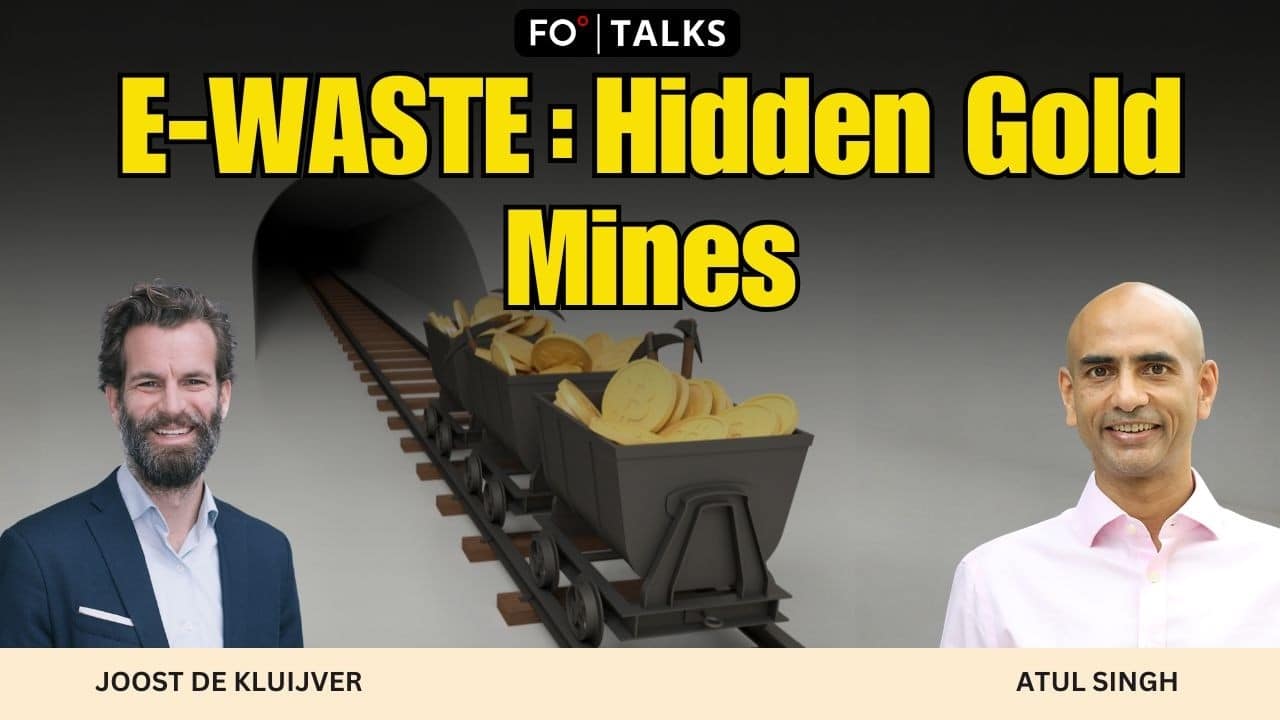
Editor-in-Chief Atul Singh and Joost de Kluijver, CEO of Closing the Loop, discuss the growing challenge of electronic waste and why conventional sustainability campaigns have failed to address it. They explore the hidden value locked inside discarded electronics, the commercial incentives needed to recover critical materials and the policies that could transform e-waste into an economic opportunity. De Kluijver believes that market incentives and customer-focused business models offer a path toward a circular economy.
Hidden wealth in discarded electronics
De Kluijver begins by highlighting the enormous scale of electronic waste. Billions of mobile phones, laptops and other connected devices reach the end of their lives every year, yet each contains dozens of valuable materials. A single smartphone includes between 40 and 60 different metals and minerals, ranging from gold and silver to strategically important resources such as lithium, cobalt and tungsten. Many of these materials originate in politically unstable regions, making recovery increasingly important for economic and geopolitical reasons.
Most electronics, however, do not see immediate recycling. Consumers frequently keep old devices in drawers because of their personal value, while many functioning products are exported for reuse in Africa and Asia. Extending the lifespan of electronics benefits consumers in developing countries, but eventually every device becomes waste. Once that happens, the lack of formal recycling infrastructure creates serious environmental and public health challenges.
Why sustainability needs a better business model
De Kluijver says traditional environmental campaigns have struggled because they rely too heavily on guilt and responsibility rather than customer demand. Sustainability reports, lifecycle analyses and moral appeals rarely motivate consumers or corporate leaders. As he phrases it, “commercial beats sustainability” when companies decide where to invest and what products to promote.
Instead, he believes businesses should present waste reduction as an attractive service rather than a sacrifice. Instead of asking consumers to change their behavior for environmental reasons alone, companies should integrate sustainability into products people already want to buy. By making waste reduction simple and convenient, firms can appeal to what he describes as “light green” customers who support environmental goals but prefer companies to handle the practical work.
De Kluijver used this customer-centered philosophy to shape his business. Rather than framing recycling as an obligation, he aims to make it a competitive advantage that strengthens customer loyalty while reducing waste.
Turning recycling into a commercial opportunity
The discussion then turns to Closing the Loop’s “one-for-one” model. When customers purchase a new electronic device from participating companies, the company finances the collection and recycling of one end-of-life device elsewhere in the world. Customers do not have to surrender their old phones or alter their habits. Instead, the environmental benefit comes as an additional service.
The model helps finance extensive collection networks, particularly in Ghana and Nigeria, where informal waste collectors recover discarded electronics before they enter dangerous recycling practices. Over the past 15 years, the organization has collected more than seven million scrap devices while creating local employment and recovering valuable materials that would otherwise be lost.
De Kluijver believes this approach succeeds because it aligns commercial incentives with environmental goals. Companies gain a distinctive marketing message while consumers receive a tangible sustainability benefit without additional effort. “We need to deliver sustainability... in a way that the customer does want to use it,” he explains.
Building markets instead of relying on punishment
Singh asks what governments can do to improve electronic waste management. De Kluijver states that stricter enforcement alone will not solve the problem, particularly in countries where recycling infrastructure barely exists. In many African nations, informal recycling dominates because there are few formal alternatives. Simply prohibiting illegal activity without providing processing capacity leaves waste with nowhere to go.
Instead, he advocates policies that create sustained demand for recycled materials. Governments could require manufacturers to include minimum percentages of recycled content in new electronics, encouraging investment throughout the recycling chain. Building regional recycling facilities would also allow African countries to process valuable materials locally before exporting them into global supply chains.
Such investments, he argues, would benefit both Africa and Europe. African countries would transform a dangerous waste stream into an economic opportunity, while Europe would strengthen access to critical materials that are increasingly important for advanced manufacturing and the green transition.
Urban mining and Europe’s strategic future
The conversation concludes by placing electronic waste within a broader geopolitical context. Europe possesses relatively few critical mineral resources yet depends heavily on them for clean energy technologies and advanced electronics. Recovering metals from discarded devices, often described as urban mining, offers an opportunity to reduce that dependence.
De Kluijver says governments should emphasize mutual economic benefit. Europe could export recycling technology, develop local processing capacity and strengthen long-term partnerships while securing reliable supplies of essential materials. He believes this positive narrative will attract far broader support than older sustainability campaigns rooted primarily in virtue.
De Kluijver closes by encouraging commercially minded entrepreneurs to bring greater creativity into waste reduction. “It is a beautiful topic especially when you look at this from a commercial... perspective,” he says, arguing that innovation and profit can become powerful tools for solving one of the technology sector’s fastest-growing environmental challenges.
[Lee Thompson-Kolar edited this piece.]
The views expressed in this article/video are the author’s own and do not necessarily reflect Fair Observer’s editorial policy.









































Join the conversation
Share your perspective
Log in to share your thoughts and take part in the discussion.