








 | ||
| ||
| ||
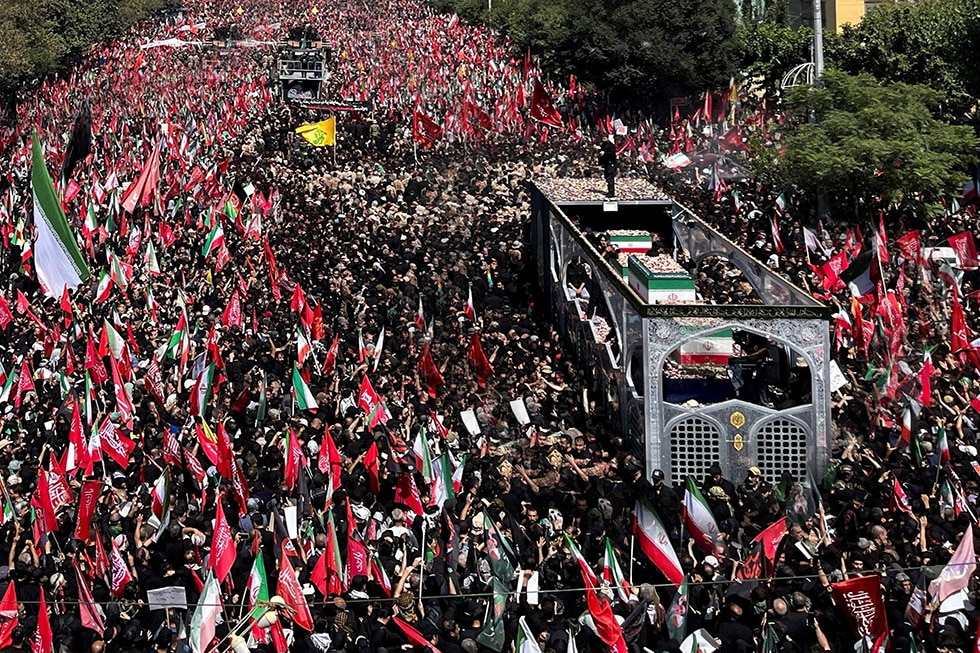
Dear FO° Reader, At a time when it is uncertain what exactly is happening or where things are going, we turn our focus once again to the US/Israel–Iran War. Specifically, to an event that reflects, in its own way, the uncertainty and confusion of the entire conflict: the Iranian state funeral for Supreme Leader Ali Khamenei and other officials killed in the initial days of the war, and the absence of Mojtaba Khamenei, his son and successor. Millions of Iranians attended various funeral ceremonies during the days of July 3–9. While there are disputes over the actual number of attendees, the scale of Iranian support is undoubtedly large, even for a man many loathed before the war due to his regime’s numerous crimes against its citizens. This signals a clear public shift in Iran. Before the war, there had been years of civil unrest and active protests. The US’s and Israel’s goal of Iranian regime change most likely meant to capitalize on this. However, while they succeeded in killing Khamenei, they have spectacularly failed in true regime change. Instead, they have shored up Iran’s crumbling social contract and granted the Iranian Revolutionary Guard Corps (IRGC) legitimacy through collective national grief. Sources: Slain Iranian leader buried as successor remains out of sight | Reuters The War with Iran Made the IRGC Stronger | Journal of Democracy
via shutterstock What did Khamenei mean to Iran? Iranian officials are calling the ceremony the largest public gathering in Iranian history. Iran’s government saturated the funeral procession with grand symbolism about Khamenei’s life and theocratic practices, presenting his reign favorably. Examples such as the prominent display of red flags at the funeral symbolically call for avenging innocent deaths. At the outset of the US/Israel–Iran War, the death of Khamenei incited celebration. Protesters toppled statues in the streets, removing symbols of the Islamic Republic’s authority in public spaces. Their joy was partly in response to a hope for an end to the government’s deadly use of force on protestors just weeks before. However, thousands still gathered in Tehran to mourn the supreme leader, showing the deep divide in public sentiment. The funerals’ organizers waited for the month of Muharram, when warfare is traditionally impermissible for Muslims, to hold the funeral. In this month, the day of Ashura, which fell on June 25 this year, is a day of mourning for Shi’a Muslims to commemorate the death of the Islamic prophet Muhammad’s grandson Husayn ibn Ali. Husayn was also the third Imam in Shi’a Islam and was an important religious leader. People spell Husayn’s name in various ways across the Islamic world, from Hussain to Hussein, but Iranians often spell it as “Hussein.” Khamenei himself referenced Husayn’s death and the martyring of Husayn’s 72 family members in his last sermon before his death. Clearly, Iran’s government hoped to symbolically link Khamenei’s death to the death of Husayn in order to emphasize that his reign is a part of the 1,300-year-old sacred narrative of suffering and vengeance. To significantly religious Iranians, this correlation is more important than any single leader’s popularity. Non-religious citizens view the procession differently. As many Iranians have experienced decades of economic hardship due to US sanctions and government crackdowns, some denounce the state-funded event as a waste of resources while the country suffers from inflation. Additionally, Sunni Iranians — who make up less than a quarter of the country’s population in the more generous census estimates — experience these sectarian fault lines as well. Their religious perspective does not share the reverence Shi’a Muslims have for the clerical, hierarchical structure of Iran. Sources: Iran prepares to bury slain supreme leader with week of mass mourning | Reuters Tehran teemed with Khamenei mourners, but divisions – and demands for change – remain | The Guardian What is the religious and political messaging behind Khamenei’s funeral? | Al Jazeera 2023 Report on International Religious Freedom: Iran | U.S. Department of State Sorting through the crowds: What is real? As stated above, the exact number of people who attended the funeral services is not quite clear. While many have rallied around the flag in the wake of the war, there were also millions who did not attend the funeral proceedings and are still resentful of the regime they live in. In Iran, thousands have been jailed, tortured and even executed for crimes as minor as using the internet. Their enthusiasm is not helped by the fact that the US, the nation many of Iran’s secular hopefuls look to as an example, has been bombing Iranian schools and infrastructure. Furthermore, political divisions within Iran are apparent to see. Several reformist presidents who clashed with the deceased Khamenei were not seen at any of the ceremonies. More peculiarly, the new Supreme Leader, who again is the son of the previous Supreme Leader, has not shown his face throughout the proceedings, driving much speculation. It isn’t clear if this is something sinister, or his personal security taking things very seriously after the US assassinated his father. Finally, there are the smaller, pettier bits of pageantry, notably the funeral’s date. Analysts consider the funeral overlapping with America’s 250th Independence Day anniversary as a distinguishable political statement. Proceedings began on July 4, after the funeral was delayed in March due to the war. While there was no official comment by the Iranian government acknowledging the date’s overlap, it has been seen as a clear thumbing of the nose in a country that regularly chants “death to America” in official matters of state. Sources: Iran says millions are mourning Khamenei. That’s not the full picture | CNN What people in Iran are saying about the war and their government | PBS News Iran begins dayslong funeral for Supreme Leader Ayatollah Ali Khamenei, killed in war | AP News Iran postpones Khamenei funeral as US-Israeli bombardment continues | BBC There’s a chance Iran will extend influence even more now Iran’s national identity and influence has only grown stronger after Khamenei’s funeral, that much is clear. But what about outside of its borders? For decades, Iran has attempted to cast its influence out into the wider Middle East region and beyond. Now, after framing Khamenei as a martyr in the state’s larger war against the West, it may be uniquely positioned to consolidate that influence. The most visible way Iran exerts influence in the region is through the Axis of Resistance, an informal network of militant groups such as Hamas, Hezbollah and the Houthis. While each group acts independently of one another, they are supported by Iran and the IRGC, namely through training, weaponry and encouragement. Support is orchestrated mostly by the Quds Force, one of the five arms of the IRGC. The Quds force is considered Iran’s de-facto foreign affairs branch. Sources: The Islamic Revolutionary Guard Corps (IRGC) | Council on Foreign Relations The Axis of Resistance shares Iran’s firm anti-West stance, and Tehran hopes to export that stance even further by supporting these groups. And, with Khamenei as a martyr, it might be even easier for Tehran to strengthen cooperation amongst its proxies. You can consider this a sort of military and political proselytism, if you would like — converting others to a political stance through effective religious posturing. Whatever Tehran’s intentions and next steps might be, it’s clear that US and Israeli actions in the region have not achieved what they originally set out to do. Between the Memorandum of Understanding, the recent ceasefire break and Khamenei’s funeral, Iran is uniquely positioned to exert its influence in the region further than it has before. Sources: U.S.-Iran Memorandum of Understanding: Full Text | Foreign Policy US and Iran threaten return to war after fiercest exchange of fire since truce | The Guardian Casey Herrmann, Aliyah A. Omar & Alexandros Ouzounis Assistant Editors | ||
We are an independent nonprofit organization. We do not have a paywall or ads. We believe news
must
be free for everyone from Detroit to Dakar. Yet servers, images, newsletters, web developers and
editors cost money.
So, please become a recurring donor to keep Fair Observer free, fair and independent. 
| ||
| ||
| About Publish with FO° FAQ Privacy Policy Terms of Use Contact |





Explore More FO° Spotlight

Support Fair Observer
We rely on your support for our independence, diversity and quality.
For more than 10 years, Fair Observer has been free, fair and independent. No billionaire owns us, no advertisers control us. We are a reader-supported nonprofit. Unlike many other publications, we keep our content free for readers regardless of where they live or whether they can afford to pay. We have no paywalls and no ads.
In the post-truth era of fake news, echo chambers and filter bubbles, we publish a plurality of perspectives from around the world. Anyone can publish with us, but everyone goes through a rigorous editorial process. So, you get fact-checked, well-reasoned content instead of noise.
We publish 3,000+ voices from 90+ countries. We also conduct education and training programs
on subjects ranging from digital media and journalism to writing and critical thinking. This
doesn’t come cheap. Servers, editors, trainers and web developers cost
money.
Please consider supporting us on a regular basis as a recurring donor or a
sustaining member.
Will you support FO’s journalism?
We rely on your support for our independence, diversity and quality.





Comment