



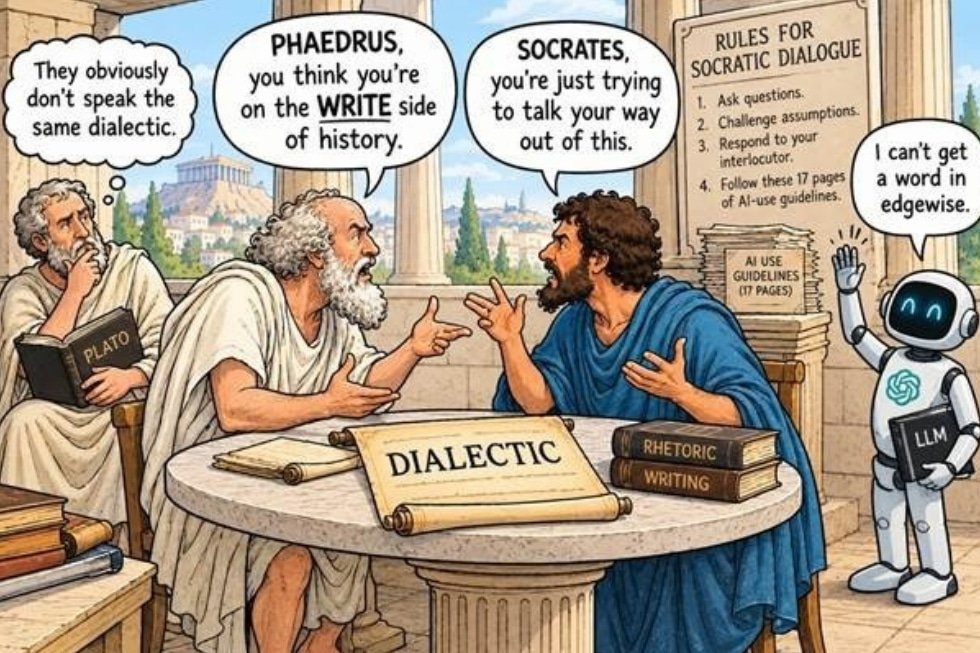



In the context of the ongoing debate about what is perceived as the devastating impact of AI on education, I was delighted to read in The New York Times a provocative opinion essay by philosophy professor Joe Cruz. In the article, “I’m a College Professor. Writing Isn’t as Important as We Think,” the chair of Williams College’s philosophy department guides us back to the roots of Western philosophy as he revives an insight attributed to Socrates, the unkempt street philosopher and Athenian gadfly. In the dialogue Phaedrus, Plato, an accomplished writer, reminds us that Socrates viewed writing as suspect because it impedes the development of dialectic and weakens rather than reinforces our memory.
Socrates presented the notion of dialectic as the right way to doing philosophy. He viewed it as a dynamic, cooperative method of inquiry designed to move the mind from unexamined opinion (doxa) toward genuine knowledge (episteme). He contrasted dialectic specifically with writing that he contends subordinates knowledge to rhetoric, or persuasion.
Drawing on Socrates’s insight, Cruz calls into question the established tradition of assessing student performance almost exclusively on written essays that AI tends to produce much more efficiently and accurately than human students. The professor comes straight out and agrees with the Athenian trouble-maker: “Socrates was right, and we think best by speaking, answering and defending our ideas.”
The AI challenge, rethinking how we learn
Cruz’s real point, however, concerns the problem that for the past four years has obsessed so many people in higher education: the access students have to AI and their very natural reflex to rely on it, whenever possible, to write their essays. He makes the radical suggestion, consistent with his Socratic doctrine, that “we need to embrace a different image of a university education — one in which ideas are expressed in real time and analytical thought unfolds as a debate or an oral defense or a group discussion.”
But Cruz very quickly appears to do an about-face, telling us that “Socrates was wrong if he was suggesting that there should be no writing at all.” In the Phaedrus, Socrates does nothing of the kind. In the dialogue, the philosopher highlights the difference between writing and genuine dialogue and recommends adapting the communication strategy of a written speech to the audience (their variable “souls”) rather than relying on a toolkit of rhetorical tricks that some specialists recommend. Substance matters, but so does understanding one’s audience and adapting to their culture.
Cruz’s first practical conclusion — before addressing the question of how students may or may not use AI — tells us professors should be the first to follow Socrates’s dialectical method. He cites his own practice of engaging “seminar students through messy, searching conversation, responding to their presence in the classroom to gauge whether we’re understanding one another.”
My own student experience half a century ago of seminars at UCLA and then Oxford — two institutions with very different pedagogical cultures — tells me there is nothing startlingly new or revolutionary in this recommendation. The seminars I was enrolled in were always about dialogue and participation. I agree with Cruz’s wish to see dialectic replace traditional teaching, but he never makes it clear whether he sees a way of applying the same logic to the classic instance of teaching in higher education: lectures.
Instead, Cruz focuses on how he expects his students to use AI. He encourages them to use AI for their final essays and follows that up with a 45-minute oral exam. Concerning the final essay, he provides a link to his “guidelines,” which read more like a set of bureaucratic regulations than a framework for dialectical exchange or creative thinking. Having consulted his rulebook, I try to imagine what the psychological effect might have been on Socrates’s interlocutors had he proposed a similar set of constraints before engaging in his celebrated dialogues.
Can we recreate dialectical learning?
Cruz’s basic insight makes sense. Dialectic is the way to go, but Socratic dialogues as related by Plato are always bottom-up and unconstrained at the start. Once engaged, they tend towards a conclusion in which Socratic wisdom resolves the tension. That’s when you could say they become top-down. Undoubtedly, today’s educational institutions are not designed for such an open-ended, nonlinear approach. Nor do I think many universities have the means of integrating the idea of a 45-minute oral exam for all students of every class, for purely economic and possibly logistical reasons (even if the exams take place as Zoom calls).
Cruz is right to invite us collectively to rethink the role of writing in both teaching and assessment. But writing still has its place and plays a role in the construction of thinking. He might have paid more attention to Socrates’s helpful recommendations about effective rhetorical strategies in writing. He criticized rhetorical abuse but did not condemn writing. Plato, a prolific writer, certainly understood that lesson.
This raises a deeper question of the history of a civilization. I have in the past lamented the disappearance of the study of rhetoric, which for two millennia in Europe advertised its nobility as one of the “seven liberal arts.” Until the industrial revolution, in many European schools rhetoric was closely associated with grammar and logic among the seven liberal arts in a program known as the Trivium. Much of the great literature from the Middle Ages and the Renaissance to the Enlightenment can be attributed to the teaching of the Trivium.
A new turning point in education?
I maintain the secret hope that, thanks to AI, rhetoric and logic might reappear, precisely as the pretext for inducing future generations to be effective writers and thinkers. Paradoxically, in the age of “fake news,” we no longer train teachers to inculcate the Trivium’s skills that aim at “the promotion of thought and understanding in the service of truth.” Education historian Harley Richardson reminds us “that studying the Trivium is a social, not a solitary pursuit. For at the metaphorical junction of the Trivium’s three roads is the public square, the place where people meet to discuss their common experience.”
Who today would deny that the public square has either been paved over or metamorphosed into a brutally disorganized, dysfunctional and largely commercial form as social media? Plato, alas, failed to append either a subscribe button or a comments section to his dialogues.
For centuries the dialectic tradition and the reliance on verbal exchange lived and evolved. We know that all learning — with one exception — at Plato’s Academy, where Aristotle was a student, took the form of dialectic. The exception that proves the rule was a public lecture Plato gave on the topic of “The Good,” a central concept in the Socratic tradition. The audience couldn’t follow a form of reasoning that appealed to mathematical concepts. “It was a PR disaster,” the website Ancient Greece Declassified informs us. “And Plato never gave another public lecture again.” What better proof of the value of open, inquiring dialogue? The age of boring, incomprehensible lectures was still someway off in the future.
After spending 20 years as student and researcher at Plato’s academy, Aristotle launched his own school, the Lyceum. Although he sought to move beyond dialectic notably by creating the discipline of formal logic, his commitment to dialogue as the basis for learning was reflected in the epithet that became attached to his school and Aristotle himself: “peripatetic.” Instead of sitting in a classroom, learning took place while walking around the grounds. Peripatos signifies “covered walkway.”
Somewhere along the line in the more than two thousand years following our Greek ancestors’ pedagogical innovations, the commitment to a peripatetic dialectic as the fundamental basis of learning faded away. By the dawn of the industrial age, sitting for hours in front of a lecturing professor, or more recently a computer screen, emerged as the norm. In the age of AI, sitting need no longer be the default posture for learning. Instead of note-taking, multiple forms of permanent interaction (dialectics) become the norm.
The real AI challenge
Cruz raises the issue and pushes the concept of learning towards the dialectic. But he proposes only a timid, ambiguous solution. I believe my own experiment in an Indian university conducted two months after the launch of ChatGPT nearly four years ago draws us closer to the Socratic method. I documented the experiment in my article published in March 2023. Procedural simplicity has merits we often underestimate. In this case, the logic was reduced to a transparent dialogue with the LLM. There were no guidelines, though I did offer a model to my students in the form of a spontaneous Socratic dialogue with ChatGPT which Fair Observer published as Breakfast with Chad.
Over the past four years, the quality of dialogue chatbots are designed to produce has measurably improved. Our thinking about a deeper role AI can play as a Socratic coach has developed to take the form of an operational product we will soon be experimenting at scale. My initial idea consisted of treating an LLM as an imperfect, fallible classmate with whom we could informally explore ideas. By working on conversational discipline and augmenting our rhetorical awareness, we can begin to develop the kind of connection Socrates hints at in Phaedrus. And that connection becomes a constantly enriching pedagogical experience.
Cruz raised a fundamental question concerning the relationship between writing and thinking. As we move forward we must begin to address the implications of a basic truth. Despite its expressive talent, AI writes because it doesn’t think. Of course, it can also recite what it writes, just as Phaedrus declaimed the speech penned by Lysias. What the LLMs we see today have not been trained to do is to engage in dialectic. That doesn’t mean they can’t participate in exchanges resembling dialectic. They can do so and admirably well, since they mirror what you put before them. But it requires their human interlocutor’s understanding of the logic of dialectic.
What this means is that instead of Cruz’s guidelines, successful practice of learning through dialectic requires the learner’s familiarity with what my friend and associate, Pierre Morlière, calls the dialogue’s “algebra of finalities.” This implies sensitivity of the participant to what Socrates calls the “complex soul” of a dialogue involving at minimum three voices: the learner, the professor and classmates.
The Trivium, as we have seen, “is a social, not a solitary pursuit.” I would maintain that this is and has always been true of all learning. For reasons linked to a culture of competitive individualism, we have neglected that dimension. Can the voice or even the “soul” of an LLM help us to make learning both social and dialectic?
Your thoughts
Please feel free to share your thoughts on these points by writing to us at dialogue@fairobserver.com. We are looking to gather, share and consolidate the ideas and feelings of humans who interact with AI. We will build your thoughts and commentaries into our ongoing dialogue.
[Artificial Intelligence has become a feature of everyone’s daily life. We unconsciously perceive it either as a friend or foe, a helper or destroyer. At Fair Observer, we see it as a tool of creativity, capable of revealing the complex relationship between humans and machines.]
[Lee Thompson-Kolar edited this piece.]
The views expressed in this article are the author’s own and do not necessarily reflect Fair Observer’s editorial policy.
The Death of the Expert? Why AGI Won’t Relieve Us of Dialogue — Part 1
Societies rely on “hierarchies of understanding,” where trusted experts interpret complex realities through ongoing dialogue. Tech visionaries claim Artificial Superintelligence...

Can Socrates Replace Lindsey Graham?
With “military Keynesianism,” US foreign policy shifted from weighing war’s costs to calculating expected profits. The Devil’s Advocate cites his...

To Soliloquize or Not To Soliloquize? That Is Education’s Question
Can education reclaim the lost art of thinking itself? Drawing on Socratic dialogue and Shakespeare’s soliloquies, Claude and I have...

An Insightful Journey Through Breakfast Conversations
AI can be a valuable partner in dialogue, if we approach it with intentionality, intelligence and a healthy degree of...

How I Got Students to Accept ChatGPT as a New Classmate
In a course on geopolitics at IIT Gandhinagar (India) at the beginning of the year, I invited ChatGPT to join...

Support Fair Observer
We rely on your support for our independence, diversity and quality.
For more than 10 years, Fair Observer has been free, fair and independent. No billionaire owns us, no advertisers control us. We are a reader-supported nonprofit. Unlike many other publications, we keep our content free for readers regardless of where they live or whether they can afford to pay. We have no paywalls and no ads.
In the post-truth era of fake news, echo chambers and filter bubbles, we publish a plurality of perspectives from around the world. Anyone can publish with us, but everyone goes through a rigorous editorial process. So, you get fact-checked, well-reasoned content instead of noise.
We publish 3,000+ voices from 90+ countries. We also conduct education and training programs
on subjects ranging from digital media and journalism to writing and critical thinking. This
doesn’t come cheap. Servers, editors, trainers and web developers cost
money.
Please consider supporting us on a regular basis as a recurring donor or a
sustaining member.
Will you support FO’s journalism?
We rely on your support for our independence, diversity and quality.





Comment