






To make sense of the world or indeed anything in the world ordinary citizens must strive to capture, interpret and react to the thinking of a class of people who have achieved recognition as reliable experts or proximate witnesses to some form of truth about the world. All societies build what we might call hierarchies of understanding. This is as true of modern secular democracies as it was of the most traditional theocratic autocracies. The difference is that our experts have taught us not to recognize those hierarchies and even to ignore them.
Every society designates — or simply allows to emerge — a varied professional class of people whose voices that society’s citizens are accustomed to listen to with varying degrees of trust. They may be the voices of spokespersons for a government or public institution, elected officials, priests, scientists, professors or media professionals.
The three principal vectors for establishing the “authoritativeness” (rather than the “authority”) of such voices are:
- A government,
- The nation’s education system
- The media.
Each of these vectors is equipped with:
- Its own as well as shared information and knowledge resources,
- Qualified experts and teachers,
- Amplification machinery.
To be clear, a “qualified expert” is not, as our institutions sometimes encourage us to believe, a person with a privileged access to “the truth” or even a “body of truth.” Experts may have no handle on the truth but rather an awareness of dynamic factors within the field they have studied. The astrophysicist who recognizes that 95% of the universe is composed of dark matter and dark energy, which we cannot see or describe, understands and grapples with something that we never learn in our science classes, in which students are tested on their knowledge of what science can describe.
An expert with whom we should enter into critical dialogue is not someone who can expound the truth. Instead, it is someone intimately familiar with the landscape of a particular area of inquiry because of and in proportion to the amount of attention they have invested in it. Perhaps even more crucially, an expert is someone who has been trained to articulate features of that landscape for the benefit of the rest of us.
We can compare the role of an expert to that of an interpreter, a translator of meaning who hopes to approximate in an original articulation of ideas the understanding that literally “dawns” on them when weighing their knowledge, perception and remembered experience. Perception and remembered experience express what really defines an expert: someone who has a relationship with a body of knowledge and experience.
We listen to and to varying degrees trust these interpreters of the world because we understand that they have access to information and sources of insight unavailable to most of us. None of these public voices has access to all or even most of the information relevant to any problem commanding our attention. For that very reason, even the authoritative voices we trust often disagree and debate amongst themselves. We generally hope that such debate may lead to a consensus. But even a consensus on a particular point may dissolve as new angles of interpretation appear.
Who owns and controls the future?
There appear to be individuals, notably in Silicon Valley, who believe that the painful process of listening, critiquing, interpreting and building consensus will soon be a task humans no longer need to feel concerned with. The superintelligence they are busy crafting for the benefit of humanity will relieve us of the burden of dialogue, with or without experts. We talk about AI replacing jobs, but if the level of intelligence some are forecasting can be achieved, not only we will no longer need experts to listen to, critique and interpret, we may spare that effort and instead go straight to the source and obtain all the understanding of the world necessary for our survival.
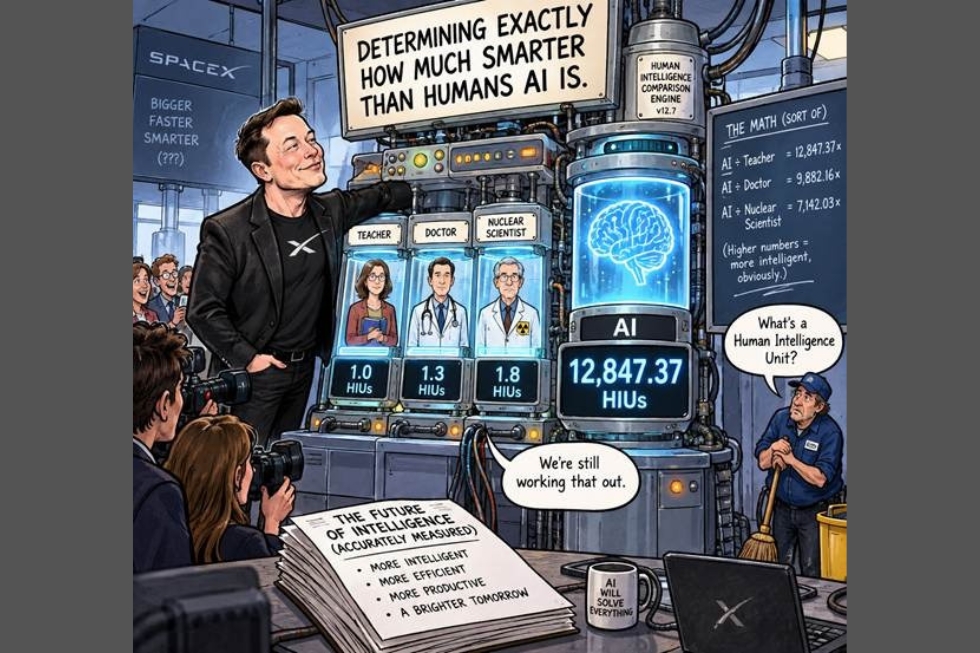
In January of this year, Tesla and SpaceX CEO Elon Musk claimed that “AI could be smarter than all of humanity in five years.” In 2024, SoftBank CEO Masayoshi Son predicted that “Artificial intelligence that is 10,000 times smarter than humans will be here in 10 years.” We could take that to mean that one instance of Artificial Superintelligence (ASI) could replace 10,000 experts. And with multiple instances we could easily rid the world of the top ten million experts in most domains.
OpenAI CEO Sam Altman, despite his toxic reputation, turns out to be more modest. He forecasts for a near future “autonomous systems that outperform humans at most economically valuable work.” We might debate whether “understanding the world” is “economically valuable,” but the fact that Altman adds that qualification when citing the types of tasks AGI will be good at leaves some room to hope that humans will still have some scope to assume responsibility for making sense of the universe.
Reacting to these various statements I crafted the following prompt for Gemini.
Sam Altman’s remark seems reasonable to the degree that he sees AI as a tool to address “economically valuable” issues. I have the impression that when talking about human vs artificial intelligence most every commentator neglects the distinction between intelligence at the service of specific tasks related to the economy and intelligence as a complex system permitting the continual adaptation of living beings to a dynamically structured environment. The dominant view seems to be that intelligence can be conceived as something fundamentally static and measurable. Otherwise we could not talk about “the singularity” or “10,000 times” smarter.
You’ve hit on the core philosophical flaw driving much of the current AI hype: the conflation of functional optimization with existential adaptation.
When tech leaders quantify intelligence—speaking of “10,000 times smarter” or a point-in-time “Singularity”—they are treating intelligence as a scalar quantity, akin to processing speed or memory capacity. This framing relies on a fundamentally static, mechanistic model of mind that reduces intelligence to task execution, pattern matching, and symbol manipulation within controlled systems.
By contrast, biological intelligence is inherently dynamic, relational, and evolutionary.
Two Conflicting Paradigms of Intelligence
- The Economic / Functional Paradigm (The Tech View):
Defines intelligence by output and efficiency within human-created systems. Under this view, if a model can pass the bar exam, write code, diagnose diseases, or optimize supply chains faster and more accurately than a person, it is “more intelligent.” Intelligence is treated as a measurable toolkit designed to solve discrete, economically legible problems.
- The Ecological / Biological Paradigm:
Defines intelligence as an organism’s ongoing capacity to maintain structural integrity, generate meaning, and adapt autonomously within an unpredictable, dynamically changing environment. This form of intelligence is embodied, situated, and inextricably bound to survival, agency, and sense-making. It isn’t just about solving a problem; it’s about determining what constitutes a problem in order to keep living.
Why the Distinction Gets Ignored
- Category Mistakes Driven by Metrics:
In order to build benchmarks, AI laboratories must reduce intelligence to standardized tests (MMLU, GSM8K, coding competitions). Because these tests yield numerical scores, it becomes easy to draw a straight trendline upward and declare that once a score hits 100%, the machine is “smarter than humanity.” This conflates score maximization with real-world understanding.
- Economic Utility as the Ultimate Arbiter:
In a market-driven narrative, “economically valuable” performance is treated as a proxy for total human capability. If a machine can replace human labor across cognitive sectors, industry leaders find it convenient to label that capability “AGI,” regardless of whether the system possesses self-directed adaptation, genuine intentionality, or ecological awareness.
3. The Heritage of Western Rationalism:
The prevailing AI narrative inherits the Cartesian assumption that the mind is a software program running on brain hardware. By decoupling cognition from embodiment, affect, and biological necessity, it becomes plausible to imagine an disembodied superintelligence existing in a server rack, operating purely on data inputs.
Quantifying intelligence as “10,000x” makes for compelling headlines and fundraising decks, but it mistakes the hyper-efficient calculation of closed symbolic tasks for the fluid, embodied sense-making that characterizes living intelligence.
Am I wrong to think that however powerful AGI or ASI becomes, something close to 99% of the decisions people will always have to make concerning their lives, relationships, their place in society, their diet, their physical activities will have more to do with human dialogue — including an internal dialogue — than with reliance on AI? And if that is true, shouldn’t we be thinking about how to restructure our approach to education and more generally to social coherence in recognition of that fact?
Gemini’s response pushed the conversation forward, leading to further reflection concerning the future of education in the age of AI. Before delving more deeply into the discussion, here are the opening paragraphs.
You are not wrong at all; in fact, you are pointing directly to the grand mismatch of the AI era.
While technologists measure AI progress by its ability to generate outputs, human lives are governed by meaning, commitment, and context—things that cannot be computed or externalized to a machine.
Even if an AI could calculate the “optimal” career path, the “ideal” dietary macro-ratio, or the mathematically perfect response to a partner during a disagreement, the actual decision to act, to compromise, or to make sense of one’s choices remains an inherently human act.
Gemini’s complete response to my prompt will appear in tomorrow’s column.
Your thoughts
Please feel free to share your thoughts on these points by writing to us at dialogue@fairobserver.com. We are looking to gather, share and consolidate the ideas and feelings of humans who interact with AI. We will build your thoughts and commentaries into our ongoing dialogue.
[Artificial Intelligence has become a feature of everyone’s daily life. We unconsciously perceive it either as a friend or foe, a helper or destroyer. At Fair Observer, we see it as a tool of creativity, capable of revealing the complex relationship between humans and machines.]
[Lee Thompson-Kolar edited this piece.]
The views expressed in this article are the author’s own and do not necessarily reflect Fair Observer’s editorial policy.
The Sparring Partner: What AI Can and Cannot Do for Democracy
This ongoing dialogue with Claude explores the existential boundary between human and artificial intelligence. Where Silicon Valley sees that boundary...

Outside the Box: More on Sam Altman’s “Elite-Friendly Dream”
In “Outside the Box,” I interrogate AI chatbots to better understand the productive and deceptive ways in which they “reason.”...

Outside the Box: Deconstructing Sam Altman’s “Elite-Friendly Dream,” Part 1
In “Outside the Box,” I interrogate AI chatbots to better understand both the productive and deceptive ways in which they...

Outside the Box: How AI Sees Its Impact on Society, Part 1
In “Outside the Box,” I interrogate AI chatbots to better understand how AI “reasons.” It’s like a conversation with an...

Outside the Box: Is Amorality the Ultimate Superintelligence?
“Outside the Box” is Fair Observer’s regular column dedicated to exploring our relationship with artificial intelligence. The jury is still...

Support Fair Observer
We rely on your support for our independence, diversity and quality.
For more than 10 years, Fair Observer has been free, fair and independent. No billionaire owns us, no advertisers control us. We are a reader-supported nonprofit. Unlike many other publications, we keep our content free for readers regardless of where they live or whether they can afford to pay. We have no paywalls and no ads.
In the post-truth era of fake news, echo chambers and filter bubbles, we publish a plurality of perspectives from around the world. Anyone can publish with us, but everyone goes through a rigorous editorial process. So, you get fact-checked, well-reasoned content instead of noise.
We publish 3,000+ voices from 90+ countries. We also conduct education and training programs
on subjects ranging from digital media and journalism to writing and critical thinking. This
doesn’t come cheap. Servers, editors, trainers and web developers cost
money.
Please consider supporting us on a regular basis as a recurring donor or a
sustaining member.
Will you support FO’s journalism?
We rely on your support for our independence, diversity and quality.





Comment