






|
||
|
||
|
||
|
Dear FO° Reader,
More than a year ago, our former chief of staff handed me The Benedict Option by American writer Rod Dreher with a knowing smirk and suggested I write a review. After reading and ruminating, I realized that I can’t write a positive review. I can only take inspiration from parts of the book and write from experience. I grew up in a loose Catholic Alpine community: we went to church on Sunday, unless the snow was good or we went hiking looking for blueberries. As an exchange student in Santa Fe, New Mexico, I encountered Navajo, Pueblo and Hopi cosmologies. Later I worked in theater and learned how performative most of life is; then I studied philosophy in Bologna, where I first encountered the Tractatus Logico-Philosophicus (Austrian philosopher Ludwig Wittgenstein’s only book-length philosophical work) and barely stayed afloat, only to be told during the exam that Ludwig spent the rest of his life recanting the book’s thesis. In a history course, I read Irish historian Peter Brown’s writings on early Christian communities, French philosopher Michel Foucault’s writings on social control and more. What they all had in common was that they were all people, those studied in the history books, trying to live at human scale against imperialistic dominance, economic extraction and spiritual demons/forces.
This is how the question of how to live a good life amid chaos resurfaced while reading Dreher. I recognize the longing for the small, slow and shared. I grew up in a small community — not the kind Dreher is describing, but one that taught me what it means to be shaped by place and by neighbors. As a teenager, I fantasized about taking a few weeks off and living in a monastery with nuns, trying the simple life. Later I began and then abandoned the process of converting to Judaism. I was jealous of strong identities, probably because I am the daughter of immigrants. What I came out with was clarity about my own uncertainty: I’m a genuine agnostic, and I now know that accepting uncertainty is an advantage, not a deficiency — it’s the kind of flexibility this world requires. That uncertainty is the lens through which I read Dreher, and it’s the lens I’ll keep returning to. A person who has chosen not to inhabit a totalizing system can sometimes see its architecture more clearly than a practitioner can. He gets a few things right
Consumerism is corrosive as the fuel of eternal economic growth, is extractive and is burning down the only planet we have. We need rebuilding at the level of community and embodied daily life; we lack connections. Dreher is right about this ache. Where I part from him is the diagnosis: Has the modern world lost its story of the good life, or has it simply stopped pretending there was ever only one? If I compare Dreher to historian Tom Holland (author of Dominion, which argues that Christian values so thoroughly shaped the modern West that we no longer recognize them as Christian), I find Dreher’s framing upside down. Holland says those values won so completely we forgot their origin: human rights, the dignity of the individual, the idea that power must answer to the powerless. The secular West isn’t post-Christian; it’s Christianity’s most successful export, running with the branding removed. What Dreher mourns, I suspect, isn’t the loss of Christian values. It’s the loss of visible Christian institutional power, which is a very different thing. The values are everywhere. The church is not. Holland would call that a consummation, not a catastrophe. The dogma problem: when reality becomes the enemy
Dreher’s communities are built on a revealed truth that declares the world outside fallen and dangerous. That logic requires perpetual vigilance against reality itself — and sustained vigilance becomes anxiety. Not personal failure. Structural consequence. Consider the lineage. Benedict of Nursia — the sixth-century Italian who wrote the monastic Rule that gives Dreher his title — wasn’t a priest or monk chasing purity; he wasn’t even ordained. He was a pragmatist who wrote rules to help people function together amid imperial collapse. His Rule even instructs the abbot to use personal judgment, teaches how to welcome the guest at the gate and to adapt. Compare this to the Puritans, those English Calvinists who settled New England in the 17th century seeking to build a “city on a hill” — a community of visible saints. As political theorist Michael Walzer shows, they didn’t set out to build a surveillance apparatus. But visible sainthood requires constant monitoring: who’s in, who’s backsliding. The community’s identity depends on its boundaries, and boundaries require enforcement. That’s not a corruption of the Puritan project. It is the project, working as designed. The dream of moral purity is also always a technology of control. It’s here that my agnosticism sharpens into a diagnostic tool. Foucault generalizes this pattern: The monastery, the prison, the school, the clinic all share an architecture of visibility and norm — what he called the panopticon, a design in which you don’t need a guard in every cell if the prisoner believes he’s always watched. It’s the architecture of total visibility that we now experience in our digital and political lives, where platforms and governments monitor every signal. Standing outside the system of revealed truth, I notice that Dreher’s communities, however sincerely meant, reproduce that same architecture — and I’ve seen the cost. Suicide has been the final answer for an acquaintance who couldn’t conform to the church and the mother, over a single mistake. A humanist or Spinozist approach — following the seventeenth-century philosopher Baruch Spinoza, who argued that understanding the world as it is, desires included, is the precondition for acting well — starts differently. The response to suffering isn’t ascetic armor but attention and care. Acceptance isn’t resignation; it’s the precondition for acting well.
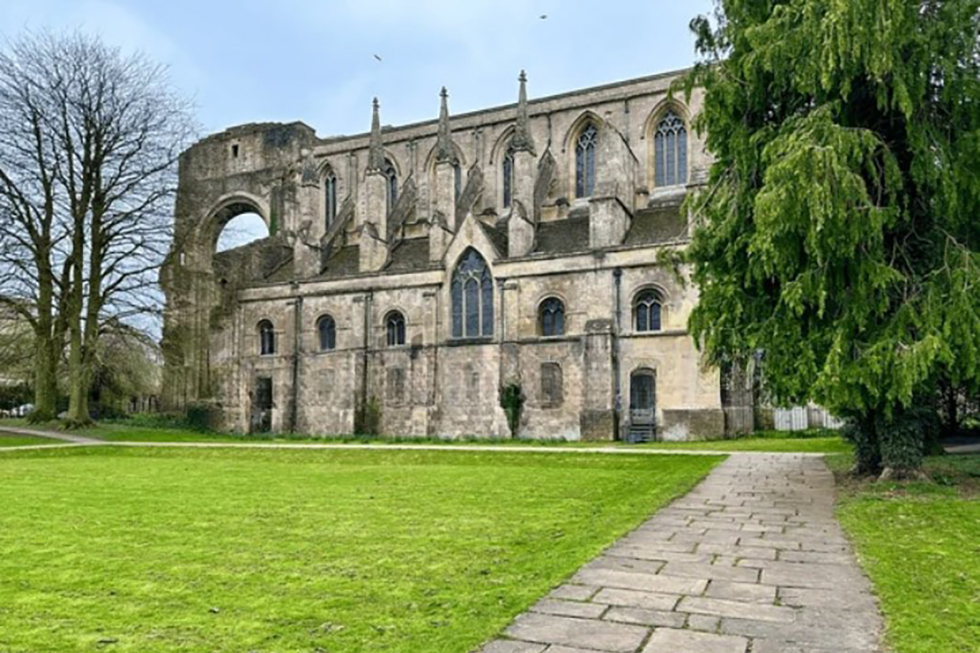
A former Benedictine monastery now a community hub: Malmesbury Wiltshire, | Shutterstock A literary digression: the name of the rose
If Foucault provides the diagnostic tools to see the architecture of control, Italian philosopher Umberto Eco provides the literary warning of what happens when that architecture meets intellectual curiosity. In The Name of the Rose, Eco’s monastery is Dreher’s Benedict Option made literal — self-sufficient, ordered, dedicated to preserving knowledge against chaos. But it unravels from within. [Spoiler alert!] Three murders take place in Eco’s monastery. These murders hinge on a lost treatise by Aristotle on comedy, which the librarian Jorge decides must never be read: If laughter and pleasure have theological dignity, the whole architecture of control cracks. Hence, Jorge poisons the pages. Eco’s point is that the monastery’s pathology is self-generated — the very mechanisms built to preserve purity become the instruments of violence. Jorge isn’t a conventional villain; he’s a man who followed “we are guardians of truth” to its logical end: “We must control what can be thought.” And the library itself is a labyrinth, navigable only by initiates — knowledge is administered, not shared, echoing German theologian Martin Luther’s complaints about a church that hoarded access to God rather than handing it out. Dreher’s communities aren’t plotting murder. But the structural logic is recognizable: A community defined by what it excludes eventually polices thought, treats curiosity as contamination, and mistakes the rule for the reality it was meant to serve. Benedict wrote a rule for navigating chaos. Jorge built a labyrinth to prevent navigation altogether. That’s the difference between a tool and an ideology. Tradition is made, not inherited
Dreher treats tradition as a stable inheritance. But as historians Carlo Ginzburg, Sanjay Subrahmanyam and Michel de Certeau show, tradition is always made in transit — negotiated under pressure, woven from encounters with difference. The “pure” tradition Dreher invokes never existed; the idea of it is the same nostalgic mythology that far-right movements use to coerce people into indefensible behaviors with the promise of a lost golden age. This is where my own collage of geographies becomes relevant. My intellectual formation happened across the Alps, the American Southwest and the Italian academy — each shaped by radically different traditions that were never pure, never closed. Brown’s early Christian communities weren’t uniform or self-enclosed either — they were argumentative, shaped by Hellenistic philosophy, Jewish law, Roman administration and even North African climate. Benedict’s Rule answered a specific crisis. It wasn’t legislation for all time. From my vantage point, having lived across these different intellectual landscapes, I find that the communities worth building face the world, not away from it. They hold their forms loosely, experimentally. I see them as more similar to workshops than fortresses. And, the empire hasn’t retired
The architecture Foucault diagnosed didn’t stay in the monastery, either. Palantir — now embedded in governments, militaries and border agencies worldwide — sells the same Panopticon dream: total visibility as security. Monitor every signal, catch every threat before it forms. France and the EU are putting in place new rights for the police, scary ones. The theological and technological versions of this architecture are structurally identical, and both require a permanent enemy to justify the watching, hence the media spins on some dangerous group. Both dread any kind of freedom or creativity. And creativity is the only quality that could now save our planet. This is no longer a parochial concern. In 2026, surveillance is a transnational reality, and the question of how to live a good life at human scale in the face of global systems of control is no longer a debate limited to America. A reader in Warsaw experiences the residue of ideological enclosures differently than a reader in Singapore or São Paulo — but the structural temptation is the same: trade openness for safety, trade curiosity for certainty. Eco’s own essay, Ur-Fascism — his analysis of the underlying grammar of fascist movements — names it precisely: A community perpetually threatened by an enemy both weak and diabolically powerful; a cult of tradition paired with a rejection of anything modern; fear of difference as contamination. None of this requires a jackbooted movement — it can operate quietly inside people who sincerely believe they’re just preserving something beautiful. Dreher’s communities aren’t fascist. But the family resemblance is worth naming carefully. Dreher leans on philosopher Alasdair MacIntyre’s After Virtue — the argument that modernity fragmented a once-coherent moral vocabulary, and that virtue needs community and narrative to survive. He reads this as a mandate for restoration. MacIntyre himself has said, bluntly, that Dreher seems to have only read a few sentences of the book. The argument is still in motion, genuinely open — not a blueprint for any community’s self-enclosure. I find the regenerative thinkers — Jeremy Lent, David Montgomery, Rob Hopkins, Nate Hagens — more honest about where we stand. They don’t start from a lost golden age but from the ground under our feet: depleted soils, pressured, still generative and nurturing if approached with care. Their communities aren’t organized around recovering something pure but around growing something new from an honest reckoning with present conditions. Dreher wants to conserve what he believes was lost. The regenerative thinkers point out it was never as stable as conservative memory insists — and the conditions that produced it are gone anyway. You can’t restore what the soil no longer supports. Who guards the gate?
Which raises the question Dreher never answers: Who decides what’s natural, what belongs inside, what must be kept out? The exclusions in The Benedict Option — of homosexuality, of gender nonconformity, of theological deviance — aren’t incidental. They follow necessarily from the dogmatic structure. A community organized around a revealed truth about human nature must enforce that truth at its borders. The border isn’t a regrettable side effect. It is the point. My objection, let me be clear, is not to the desire for community. It’s to the technology of exclusion proposed to achieve it. Brown’s early Christian communities had borders too, but porous, contested, endlessly renegotiated. What kept them alive wasn’t the purity of the enclosure but the energy of the argument — micro-Christendoms shaped by local conditions and local improvisation on a shared, never-fixed inheritance. That’s the model worth recovering, if “recovering” is even the word: not the monastery as fortress, but the monastery as workshop — open to the guest at the gate, shaped by the day’s labor, holding its rule loosely enough that the abbot can still use judgment. Benedict wrote that in. Dreher edited it out. The workshop, not the fortress We are not looking for a place to wait out history. We are writing ourselves into it, incompletely, in process, together with others. Meaning isn’t given from outside; it’s made, relationally, over time. That isn’t a consolation prize for the faithless. It’s a different kind of seriousness about what human life actually is. I think of the blueberries. We’d hike for hours to find them, not because someone told us where they were, but because we walked the slopes enough to know where they might appear; after a few seasons we’d learned the good spots! The good life isn’t a fortress you retreat into. It’s a slope you walk, attentively, with whoever shows up. The snow will melt, the trail will change, there might be earthquakes and landslides, and the berries won’t be where they were last year. You go anyway. That, I think, is what Benedict of Nursia understood, and what the workshop — as opposed to the labyrinth — still remembers. Roberta Campani Communications and outreach |
||
|
We are an independent nonprofit organization. We do not have a paywall or ads. We believe news
must
be free for everyone from Detroit to Dakar. Yet servers, images, newsletters, web developers and
editors cost money.
So, please become a recurring donor to keep Fair Observer free, fair and independent. 
|
||
|
||
| About Publish with FO° FAQ Privacy Policy Terms of Use Contact |





Explore More FO° Reflections




Support Fair Observer
We rely on your support for our independence, diversity and quality.
For more than 10 years, Fair Observer has been free, fair and independent. No billionaire owns us, no advertisers control us. We are a reader-supported nonprofit. Unlike many other publications, we keep our content free for readers regardless of where they live or whether they can afford to pay. We have no paywalls and no ads.
In the post-truth era of fake news, echo chambers and filter bubbles, we publish a plurality of perspectives from around the world. Anyone can publish with us, but everyone goes through a rigorous editorial process. So, you get fact-checked, well-reasoned content instead of noise.
We publish 3,000+ voices from 90+ countries. We also conduct education and training programs
on subjects ranging from digital media and journalism to writing and critical thinking. This
doesn’t come cheap. Servers, editors, trainers and web developers cost
money.
Please consider supporting us on a regular basis as a recurring donor or a
sustaining member.
Will you support FO’s journalism?
We rely on your support for our independence, diversity and quality.





Comment