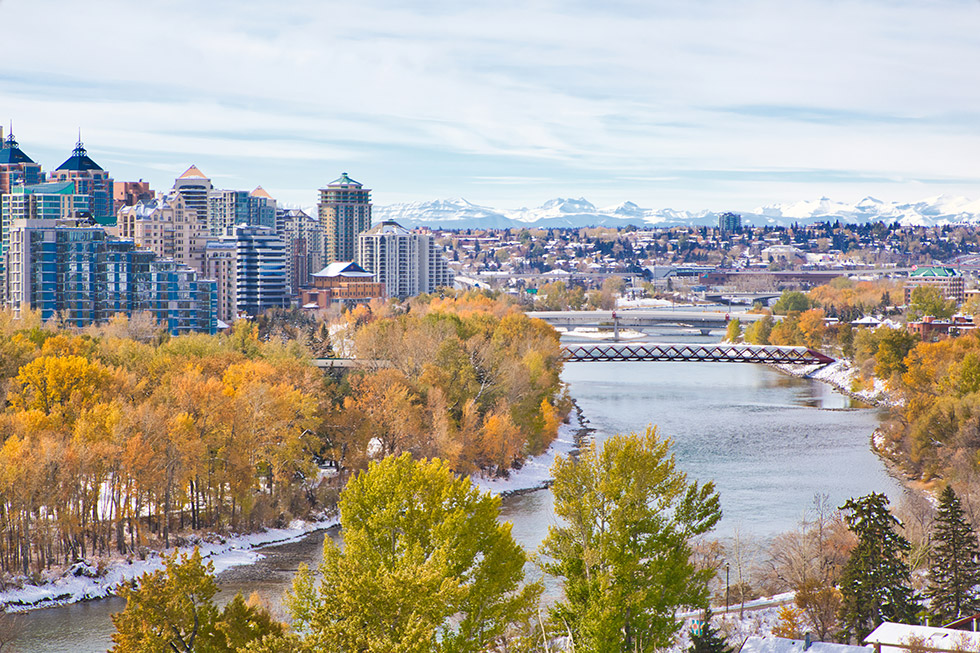
Sitting among the tall prairie grasses high on Nose Hill in the northwest corner of Calgary, you can see the peaks of the Rocky Mountains in the distance. In the early 70s, the summer air would be cool and clear. You could see the snow-capped mountains neatly drawn on the horizon, as if standing guard against whatever may come. Now, the summer air is often smoky. There is no longer any visible snow on the mountain peaks. And the hazy mountains on the horizon seem further away and less capable of protecting us from what lies ahead. The term “wildfires” has become part of our vocabulary, and its accompanying smoke, part of our summers and our lungs.
Rapid rise of wildfires
As of mid-August this year, Alberta has recorded nearly
700 wildfires
, burning over 44,000 acres. And this was a good year in Alberta because average rainfall was greater. But our neighbors to the west, British Columbia (BC), were hit harder, with some 960 fires burning nearly a million acres. Several years ago, the town of Lytton, where my father had driven us through as children, was burnt to the ground. This year, the town that most felt the heat was Summerland, the location of another childhood summer holiday and memories of buying peaches along the roadside — now associated with
images
of fires jumping highways and locals evacuating.
Other hard-hit regions this year have been northern Ontario, northern Quebec and the Northwest Territories. These northern regions have been disproportionately hit because the Arctic and sub-Arctic are warming up to four times faster than the global average, turning their vast boreal forests into massive tinderboxes.
In 2024, across Canada, there were under 6000 forest fires and some 12 million acres burned. In 2025, there were over 6000 forest fires and over 19 million acres burned. Statistics from the Canadian National Fire
Database
show a distinct upward trend over the past 20 years.
 Via Shutterstock
Wildfires are not just a Canadian problem; they are a global issue. During the summer in the Northern Hemisphere, wildfires threaten the US, many parts of Europe and the Arctic regions of Russia. During summers in the Southern Hemisphere, wildfires plague
Australia
, Chile, Argentina, Brazil, Bolivia and South Africa.
Causes of wildfires
While fire is a natural part of many ecosystems, modern wildfires have become far more destructive due to climate change, shifts in forest composition and
fire suppression
.
Climate change has given us more heat, less rain and, therefore, drier ground that often goes down several feet. Climate change has also increased the number and frequency of dry thunderstorms — lightning without rain. The lightning sparks the wildfires, and the dry grass and ground provide the ideal tinder.
Over the last century, industrial forestry has shifted forests from diverse, fire-resistant environments into uniform, highly flammable landscapes. Logged areas were often replanted with a single, fast-growing tree species of the same age. This resulted in uniform, dense plantations that lacked the natural gaps and varied moisture levels found in old-growth forests, allowing fire to spread rapidly. This monoculture has also encouraged insect infestations — such as mountain pine beetles — that have weakened trees, making them more flammable.
In Canada, over a century of strict, aggressive fire suppression has created a phenomenon known as the “fire paradox”; by putting out small fires immediately, humans have inadvertently caused today’s wildfires to burn larger, faster and with catastrophic intensity. By not allowing low-intensity fires to burn away the brush, dead wood and leaf litter on the forest floor, we’ve allowed the dense undergrowth to act as “ladder fuels,” carrying fires up to the treetops, resulting in more ferocious fires.
Fighting the fire
Canada spends over $1 billion each year in fighting wildfires. This investment includes 15,000 available firefighters, numerous aerial water tankers, several heavy lift helicopters, as well as “
early warning
technology, combining data from 2,500+ weather stations, satellites, fire behaviour models, and AI-enabled detection technologies, including cameras, drones, and thermal imaging, to provide near real-time wildfire detection, mapping, and situational awareness across Canada.” And in 2029, Canada plans to launch
WildFireSat
— a satellite “to monitor active wildfires across Canada on a daily basis.”
But perhaps it needs to also look to the ancient wisdom of its First Nations.
Indigenous wisdom
There is a myth among the Indigenous people of the Pacific Northwest of how
Coyote
— often characterized as a trickster — stole fire from powerful beings and brought it down to earth to the indigenous people.
The indigenous peoples used fire in many ways, including to manage their forests — a practice called
cultural burning
. These are intentional, controlled low-intensity burns conducted close to the ground. They are usually done in the cooler months, such as early spring or late fall. The dead grass and undergrowth are burned off in an effort to encourage new vegetation (in particular traditional foods and medicinal plants) and reduce wildfire risk “for decades to come.” Apparently in Australia, such cultural burning on
Aboriginal lands
has reduced wildfires by half.
Coyote should bring fire — again
The Canadian government
banned
the indigenous practice of cultural burning — beginning with BC in 1874 and nationwide by the mid-1900s. Ironically, it is now the indigenous people, often living in the northern forests, who suffer the most from the intense wildfires in their home regions. We would be wise to hear their wisdom once again and adopt their practice in looking after the land. Coyote may be a trickster, but he can also be characterized as a transformer. We need to allow Coyote to once again bring fire and revitalize our forests.
As we enter the fall season and the weather cools, the air will clear. The g
rasses on Nose Hill will turn different shades of yellow and red. Snow will return to the mountain peaks. And in the forests of Alberta, BC and other vast stretches of Canada, the wildfires will disappear — but not entirely subside. Each year, the fire season starts earlier and lasts longer, to the point that it’s now
year-round
. Some wildfires (nicknamed
Zombie fires
) will live on over the winter,
smoldering
quietly and unseen under the snowy ground — only to rise again next spring.
Until next time,
Ranjani Iyer Mohanty
Editor-at-Large














Comment