Summer 2026: fires, lost harvests, wild horses sold to slaughter
As I listened to various news sources talk about the International Monetary Fund, the World Bank and Swiss Re — which are still doing risk modeling, still protecting shareholder value, still treating “growth” as the fixed point around which everything else adjusts as if it were a law of nature — I got restless.
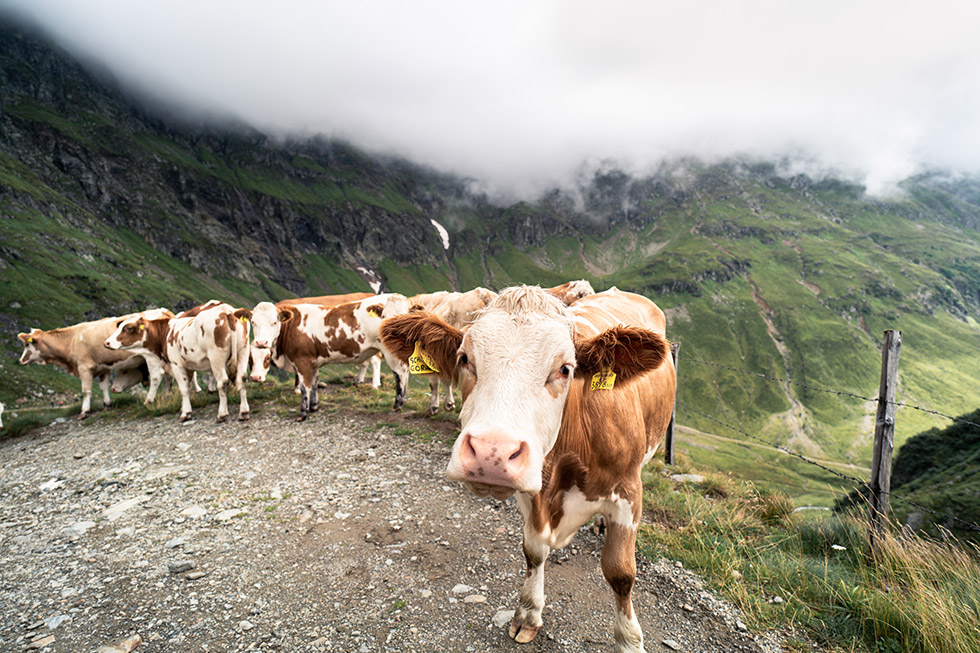
I just saw Swiss Alpine farmers who can’t feed their cows, and beware, bankers won’t get their fondue at a fair price this winter! Edgar Hertwich, a member of the EU’s climate advisory board, says the bloc’s own agricultural policy still subsidizes the most greenhouse-gas-intensive farming it claims to be moving away from. Climate scientist Bill McGuire, sketching where Britain’s harvests are headed, points to the three worst UK harvests in a generation all landing between 2020 and 2025 — together, a year’s worth of bread lost.
The EU’s own climate advisory board found that the Common Agricultural Policy (CAP) “subsidizes the most greenhouse-gas intensive practices, including cattle farming and the draining of peatlands,” undermining the bloc’s climate goals.
Kennedy saw this same kind of arithmetic 50 years earlier. Here are his words; read them out loud:
Our Gross National Product, now [March 1968], is over $800 billion dollars a year, but that Gross National Product – if we judge the United States of America by that – that Gross National Product counts air pollution and cigarette advertising, and ambulances to clear our highways of carnage. It counts special locks for our doors and the jails for the people who break them. It counts the destruction of the redwood and the loss of our natural wonder in chaotic sprawl. It counts napalm and counts nuclear warheads and armored cars for the police to fight the riots in our cities. It counts Whitman’s rifle and Speck’s knife, and the television programs which glorify violence in order to sell toys to our children. Yet the gross national product does not allow for the health of our children, the quality of their education or the joy of their play. It does not include the beauty of our poetry or the strength of our marriages, the intelligence of our public debate or the integrity of our public officials. It measures neither our wit nor our courage, neither our wisdom nor our learning, neither our compassion nor our devotion to our country, it measures everything in short, except that which makes life worthwhile. And it can tell us everything about America except why we are proud that we are Americans.
Now let’s translate that into worldwide terms.
From RFK and neoliberalism to Žižek
The holy GDP isn’t failing to predict this; it never was. It’s actively still, 50 years later, counting the crisis response as growth while the crisis itself scores zero. RFK saw it in 1968, and modern economists from Amartya Sen to Joseph Stiglitz have proved it mathematically ever since: GDP measures economic throughput, not human flourishing. It counts the timber cut and sold, not the forest which gives us oxygen and biodiversity; it books the hospital bill which will take you to your grave shrouded in debt, not the health to play with your grandkids; the power drawn by my fan blasting at 8 AM, not the stable climate we lost.
Slovenian philosopher Slavoj Žižek captured this fundamental absurdity by tweaking former US President Bill Clinton’s famous dictum: “It’s dignity, stupid.”
The neoliberal machine or system, engineered since Mont Pèlerin, assumed that as long as the market “wealth pump” kept moving capital around, mostly upward, human beings could be pacified by consumer options (remember panem et circenses? [“bread and games”]). But when the pastures dry up, when tiger mosquitoes reclaim your garden and when young people realize the future has been financialized away, the economic metrics reveal their total moral vacuum. Even Pope Leo in his 2026 encyclical Magnifica Humanitas mentions “humans reduced to projects to be optimized.” The crisis of the 2020s isn’t just a failure of resource distribution; it is a revealing structural assault on human dignity. (We’ll talk more about this in the interview with Jeremy Lent; he uses this as an example to learn from, both positive and negative.)
The survivalist detour, and why it fails
On the worst days, when the heat hangs heavy over Geneva, and the news cycle feels like an endless inventory of systemic collapse — including the zenith of a New York Times (NYT) investigation that found that the Trump administration was selling wild horses to slaughterhouses because they are expensive to maintain — the mind wanders toward absurd self-reliance extremes. Should I move to France where natural habitats are a bit wider? Hell no! They are burning right now. And then you catch yourself half-joking about piling 20 kilogram bags of flour and canned beans in the basement. But as a friend dryly reminded me: If things get bad enough that you need a bunker, the Wagner Group — or whatever local warlord fills the vacuum — will just come and take your flour anyway, possibly doing some damage so you can’t close your windows anymore. What’s best then? Learning to shoot or set up traps all around the house? What if a friend gets injured just because he was bringing a precious present, say a handful of seeds? (Most likely coffee in my case.)
As my colleague Cheyenne noticed, dark humor often carries some hard truths. Survivalism is an illusion — a hyper-individualized, consumerist reaction to a collective collapse. You cannot privatize a microclimate, and hoarding flour does not restore dignity; it just turns you into a target in a cellar. Individual lifeboats do not fix a broken ocean. Even the ultra-rich have hit this wall. Douglas Rushkoff — a media theorist — was flown out to a private resort to talk about “the future of technology” to five hedge fund billionaires, and the conversation drifted somewhere else entirely: one of them, mid-way through building his own underground compound, asked him how to keep his own security force from turning on him once the money stopped mattering.
Food is not enough
We won’t find security in a crowded basement, biting our own noses off. Security is built in community, in public planning, in shared resilience.
Žižek, working from French philosopher Louis Althusser’s old football analogy, makes the point better than I can paraphrase: Football (or soccer, as they call it in the US) underneath all of it, is the simplest and most dignified version of “communism” there is — everyone follows the same rules, no one takes advantage of anyone else. FIFA and other corrupt organizations grew on top of that. The corruption was never in the game; it was in the institution built to manage it.
GDP is our FIFA. Underneath it is the actual game — people growing food, raising cattle, keeping each other alive through a brutal summer and wildfires, playing by rules as basic and as fair as anything on a pitch. GDP doesn’t touch that fairness. It just counts what moves through the institution built on top of it, blind to whether the game underneath is still being played straight with sufficient resources.
The choice before us isn’t complicated: keep serving a framework that pumps wealth upward while the pastures burn and millions die of hunger, or start insisting on what actually keeps people whole. It is seemingly straightforward, but as history tells us, nothing is as simple as it seems. Let us know which choice you think we should make.
Roberta Campani
Communications and Outreach













Comment