



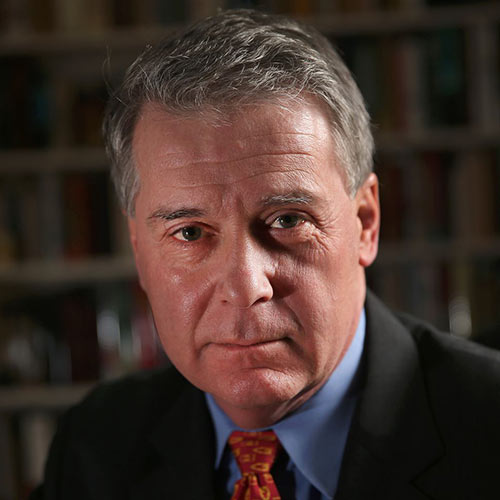

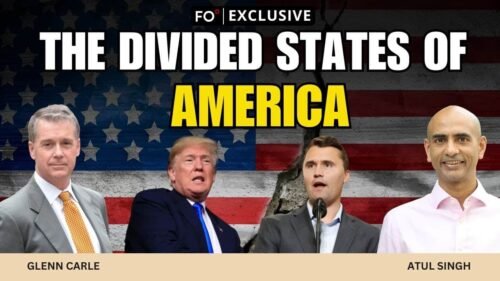
Editor-in-Chief Atul Singh and retired CIA Officer Glenn Carle discuss how the US dollar will continue to drop in value. They analyze the economic and political factors driving this decline, blending hard data with subjective judgments. Both highlight how fiscal irresponsibility, flawed policy and shifting geopolitics are putting pressure on the world’s dominant currency.
Debt, politics and paralysis
Atul argues that the combination of trade policy, monetary policy and a growing debt crisis will force devaluation. He stresses that the Trump administration’s faith in the dollar’s unassailability is not supported by data, adding to doubts about the dollar’s status as a safe haven.
US Treasury insiders, Atul reports, admit the US will eventually be unable to service government debt in its current form. Political leadership has stopped taking debt seriously: Republicans give tax breaks, democrats expand social programs, and both ignore structural problems. Glenn reinforces the point, noting that Republicans also spend heavily, just on different items like defense. Economists across the spectrum agree that America has shown both an inability and unwillingness to address debt, which is an existential issue for the global economy.
What Atul finds most worrying is policymakers’ indifference. Trump, Treasury Secretary Scott Bessent, Commerce Secretary Howard Lutnick and democratic figures such as New York State Representative Zohran Mandani show little concern. This complacency, he predicts, will encourage investors to shift away from the dollar.
The Dollar Milkshake Theory
Atul points to the popularity of the Dollar Milkshake Theory, coined by economist Brent Johnson. It claims the dollar acts like a straw, sucking up liquidity from the global “milkshake” into dollar-denominated assets and debt. The dollar’s strength, according to this view, comes from monetary distortions and financial arbitrage, not innovation or productivity. Geopolitical turbulence supposedly boosts demand for dollars because no other asset provides the same liquidity.
Atul warns that the real world tells a different story. The dollar has depreciated against nearly all major currencies in 2025, sliding from 109.39 to 97.61 on a standard basket. Against gold, the fall has been steeper, from 376 to 270, while gold itself surged past $3,500 per troy ounce. Atul suggests the Dollar Milkshake Theory may soon collapse under evidence, likening it to the geocentric model before Renaissance astronomer Nicolaus Copernicus.
Geopolitics and shifting assets
The freeze of $300 billion in Russian assets after the 2022 invasion of Ukraine continues to echo. Atul stresses that blocking sovereign reserves has made countries like China, India and Brazil wary of keeping money in dollars. Brazilian President Luiz Inácio Lula da Silva, already tense with Washington, is a case in point.
The administration of US President Donald Trump has exacerbated the problem by imposing tariffs on allies like the United Kingdom, further undermining confidence. Central banks are diversifying into gold and silver. The German investment company Deutsche Bank reports hedged positions in US assets now outstrip unhedged ones for the first time in four years. At the start of 2025, only 20% of foreign-domiciled US equity exchange-traded funds were hedged; in the last three months, 80% of $7 billion invested has been hedged.
Major financial hubs from New York to Singapore have reached a consensus: “The hedge dollar moment has arrived.”
Fed pressure and inflation risks
The FOI Geopolitical Risk Monitor indicates that Trump and Bessent are pressuring the Federal Reserve (or Fed) to cut interest rates. The recent appointment of US Chairman of the Council of Economic Advisers Stephen Miran to the Fed’s Board of Governors underscored this shift — he dissented at the last meeting, pushing for a larger cut. These moves, Atul says, will stoke inflation and further erode the dollar. Indian exporters, he adds, risk exchange losses unless they hedge carefully.
Glenn’s economic lens
Glenn offers an alternative view. He dismisses the notion of a malign plot implied by the Dollar Milkshake Theory, framing the dollar’s decline in classical economic terms. The problem, he says, is sheer incompetence.
Despite America’s strengths — superior productivity, unmatched research and the largest market — the administration has undermined them. Glenn lists the steps: attacks on Fed independence, higher tariffs, more spending and reduced revenues. Each erodes confidence, drives inflation and weakens the dollar. He judges that “almost literally every step has eroded or challenged or undermined” US economic strength. Trump’s United Nations claim that global warming is a hoax, Glenn adds, is so disconnected from reality that it threatens the coherence of governance itself.
China, meanwhile, is steadily encouraging global trade in non-dollar denominations. Glenn concludes that the dollar will keep weakening and inflation will rise at an accelerating pace.
The future of the dollar
Atul and Glenn converge on the view that the dollar’s decline is not temporary but structural. The debt crisis, complacency, tariffs and Fed pressure all point the same way. Investors are hedging, central banks are diversifying and rivals like China are building alternatives.
The US dollar has long seemed untouchable, but its fortress is cracking. Whether the fall comes suddenly or through steady erosion, Atul and Glenn both warn that it now seems inevitable.
[Lee Thompson-Kolar edited this piece.]
The views expressed in this article/video are the author’s own and do not necessarily reflect Fair Observer’s editorial policy.
























Comment