




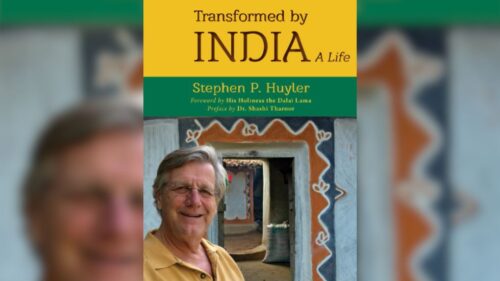
Fair Observer Founder, CEO & Editor-in-Chief Atul Singh and cultural anthropologist Stephen Huyler discuss Hinduism’s unique features and how it contrasts with Western religions like Christianity, Judaism and Islam. Huyler draws from decades of travel and immersion in India to present Hinduism as an experiential, flexible and diverse spiritual tradition.
An experiential approach to Hinduism
Huyler explains that his understanding of Hinduism comes from living inside Indian homes, shrines and temples. Rather than relying on scriptures or anthropological studies, he believes direct experience is essential. He recounts a transformative moment during a goddess invocation when he felt the divine presence so vividly that it shattered his sense of being an “objective outsider.” For him, “objectivity” is an illusion, and true comprehension must come from sincere participation.
Practical Hinduism, Huyler says, is rooted in the idea that the sacred permeates all life. Unlike Western religions such as Christianity, Judaism and Islam, which often divide the sacred from the secular, Hinduism accepts a wide range of practices, from rituals with bells and mantras to philosophical meditation, as equally valid. He finds it striking that one can be agnostic or even atheistic and still be Hindu. Hinduism, he stresses, is not a single codified religion but “a compilation of hundreds, perhaps thousands of smaller belief systems,” making it endlessly varied and engaging.
Community and the feminine divine
The very word “Hindu,” Huyler notes, originally meant simply “of India,” underscoring Hinduism’s geographical rather than doctrinal origins. In villages, identity is deeply tied to community and nature. Land, water, trees, crops and even houses are infused with sacredness, often personified as local deities. Many of these deities are female, reflecting a worldview where the divine feminine is central.
Huyler emphasizes that Hindu goddesses like Durga and Kali embody Shakti, the raw female energy that can defeat evil where male divinity cannot. In Indian systems, the feminine is often seen as stronger than the masculine, in sharp contrast to Western traditions that portray women as weaker. Singh suggests India may be “the one pagan society that survived the Abrahamic onslaught,” drawing parallels between Hindu goddesses and figures like the Greek goddess, Athena, in ancient Europe. Huyler agrees that this perspective underscores Hinduism’s resilience.
Everyday expressions of the sacred
A key distinction from Western monotheism is the absence of a strict divide between gods and humans. Deities, Huyler explains, are personifications of human archetypes, embodying light, dark and everything in between. The Christian and Islamic conceptions of sin are largely absent; instead of eternal damnation, Hinduism centers on rebirth and karmic cycles. Huyler finds this lack of guilt-based systems particularly appealing. Unlike the exclusivity of Christian sects, Hinduism allows multiple spiritual paths without condemning others as heretical.
For most Hindus, the home is the main place of worship, with women often leading rituals. Huyler describes everyday practices such as household altars to Lakshmi, goddess of wealth, or Ganesha, god of beginnings. Myths like Ganesha’s elephant head, which represents contradiction and interconnectedness, symbolize Hinduism’s acceptance of paradox. The image of Ardhanarishvara — Shiva as half-male and half-female — illustrates balance between masculine and feminine energies, contrasting with the exclusively masculine “God the Father” of Western traditions.
Rituals, symbols and meaning
Huyler points to festivals like Durga Puja and Ganesh Visarjan as examples of Hinduism’s cyclical worldview. Clay idols are worshipped and later immersed in water, symbolizing both reverence and return to nature. This ritual reflects the broader belief in rebirth and interconnection with the earth. At the same time, he acknowledges the paradox of modern India’s pollution, which he attributes to overpopulation and delayed modernization — though this remains his personal view.
He also addresses the often-misunderstood Shiva Lingam, an abstract representation of Shiva. Western scholars frequently interpret it as phallic, but Huyler insists most Hindus do not. He suggests Western views are shaped by puritanical backgrounds that exaggerate sexuality. While Hindu myths include sensuality, he stresses that sexuality is accepted as part of divinity rather than worshipped in itself.
The spirit of Hinduism
Huyler portrays Hinduism as an experiential, pluralistic and deeply interconnected tradition that honors the feminine, accepts contradictions and sees the sacred in every part of life. His personal journey from detached observer to participant shows how Hinduism’s openness can transform not only spiritual understanding but also one’s sense of identity.
[Lee Thompson-Kolar edited this piece.]
The views expressed in this article/video are the author’s own and do not necessarily reflect Fair Observer’s editorial policy.










































Comment