




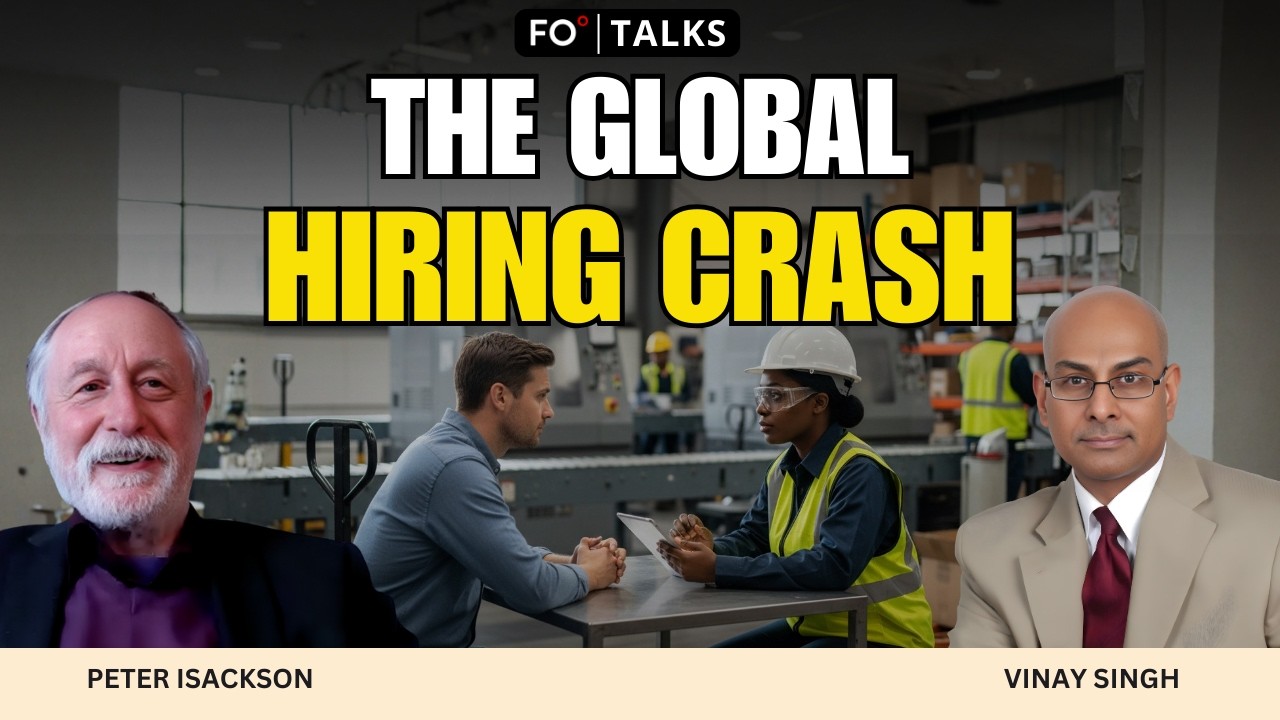
Fair Observer’s Chief Strategy Officer Peter Isackson and Global Civilization Dynamics Founder Vinay Singh to examine a silent breakdown in the modern white-collar economy. They begin with a striking anecdote: a software engineer claiming experience at Meta sends hundreds of applications and reaches out to more than a thousand recruiters without receiving a single offer. For Singh, the episode raises a disturbing possibility about today’s labor market. “When this top-tier engineer sends 1,000 signals into the market and gets back nothing but silence,” he says, “we have to ask: Is the hiring system broken or is it working exactly as designed?”
Their discussion widens from this example to a broader diagnosis of technological change, economic transformation and mounting worker burnout. Both speakers argue that artificial intelligence, financialized markets and decades of economic restructuring may be redefining the value of human labor itself.
The “black hole” of hiring
Singh frames the engineer’s experience as evidence of what he calls the “black hole of human meritocracy.” Highly qualified candidates increasingly encounter opaque hiring systems dominated by automated screening tools. Resumes disappear into applicant-tracking systems, while recruiters struggle to distinguish genuine candidates from automated applications generated by AI tools.
The phenomenon, Singh suggests, echoes earlier labor shocks. He points to similarities with the aftermath of the 2008 financial crisis, when job seekers reported submitting hundreds of applications with little response. The difference today is the scale and persistence of the problem, which now spans multiple economic cycles.
The result may be a profound misallocation of human effort. Millions of workers spend vast amounts of time tailoring resumes and applications that are processed almost entirely by algorithms. Singh characterizes this as a massive extraction of human productivity from the economy without producing meaningful output.
From postwar inclusion to financialized capitalism
Isackson situates the present moment within a longer historical arc. In the decades following World War II, Western economies cultivated a strong sense of social participation. Programs such as the US GI Bill and New Deal institutions created relatively stable employment and reinforced the idea that society needed the contributions of ordinary citizens.
That sense of belonging, he argues, gradually eroded over the past half-century. Economic thinking increasingly prioritized shareholder returns and financial markets over employment and social stability. This has resulted in a system that measures value almost exclusively through financial outcomes.
“We’ve seen a long trend going in the direction of devaluing human presence,” he says. Human worth, once embedded in institutions and communities, is now assessed primarily through economic productivity.
The rise of agentic AI
They then turn to the accelerating development of artificial intelligence. Singh distinguishes between the generative AI that became widely visible in recent years and a newer phase known as agentic AI — systems capable of performing complex tasks autonomously.
Recent partnerships between technology companies and research organizations illustrate the shift. AI systems are now being deployed to analyze biological data, design pharmaceutical compounds and carry out tasks that once required large teams of human specialists.
Singh describes a rapidly emerging “bot-versus-bot” economy in which automated systems apply for jobs while other algorithms evaluate applications. “Human beings’ souls are being lost,” he warns, arguing that the decoupling of labor from value creation threatens the foundations of the modern workforce.
Isackson agrees that the economic logic driving automation is powerful. Yet he stresses that production alone cannot define human activity within an economy. Businesses and institutions, he argues, are not merely technical systems but social environments shaped by human interpretation and meaning.
Burnout in the global workforce
Evidence is mounting of global worker burnout. Singh cites workforce surveys reporting that more than 80% of employees experience some level of exhaustion or disengagement. Younger workers appear particularly affected, with high levels of reported stress and declining engagement.
The phenomenon extends beyond white-collar sectors. Labor unrest across Europe, including widespread strikes in Italy’s transportation sector, reflects similar frustrations among blue-collar workers facing stagnant wages and rising costs of living.
Isackson believes burnout reflects more than excessive workloads. Many workers are experiencing a deeper loss of purpose within economic systems that no longer recognize their broader human value. When individuals feel interchangeable or invisible within automated systems, they can experience severe psychological consequences.
A civilizational turning point
Singh points to the growing recognition among global economic leaders that technological change may be reshaping capitalism itself. Some figures within finance and industry have warned that AI-driven productivity gains could deepen inequality and destabilize consumer economies.
Isackson sees these concerns as signs of a larger historical transition. The transformation now underway may force societies to rethink the relationship between technology, labor and human identity.
“We’re in a great transformation,” he says. Whether political and business leaders can adapt to that transformation remains uncertain. Yet both speakers agree that the scale of the changes now unfolding suggests that the future of work, and perhaps the meaning of human contribution within modern economies, is entering a decisive new phase.
[Lee Thompson-Kolar edited this piece.]
The views expressed in this article/video are the author’s own and do not necessarily reflect Fair Observer’s editorial policy.











































Comment