





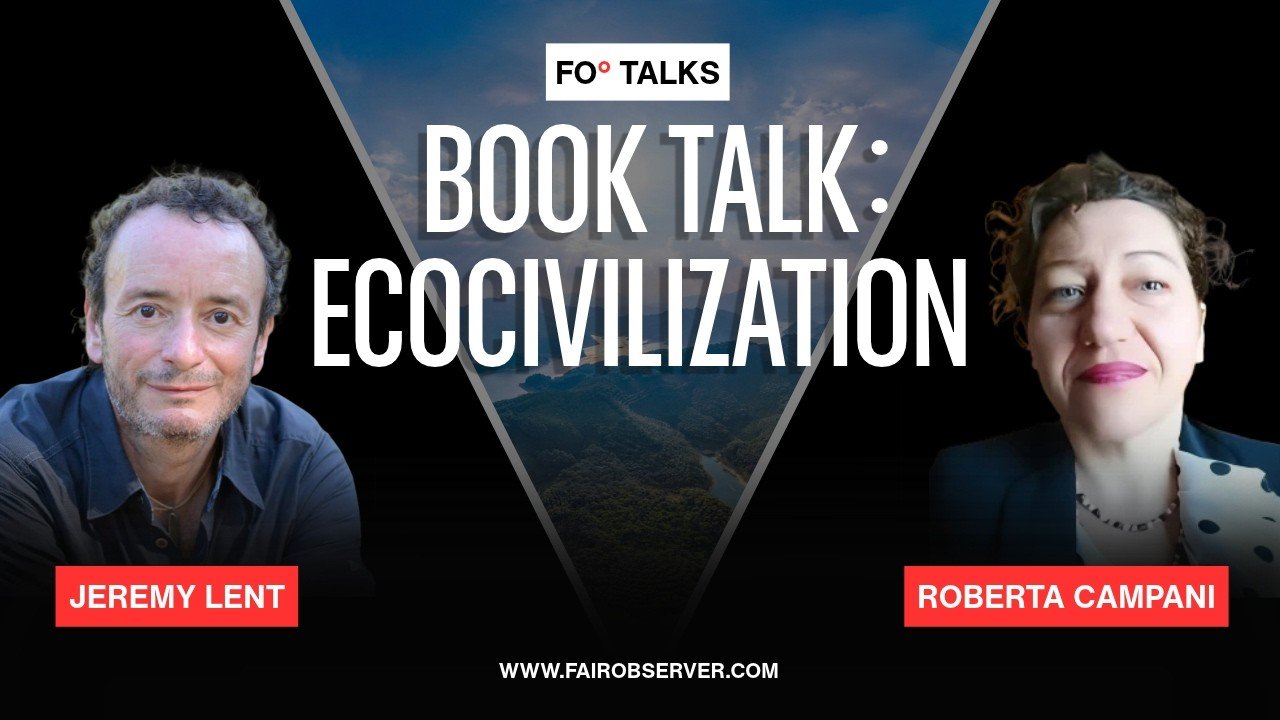
Fair Observer’s Communications and Outreach officer, Roberta Campani, speaks with author Jeremy Lent about ecological civilization, a framework for organizing society around the flourishing of life. Drawing on systems science, history and economics, Lent challenges the assumptions that make exploitation appear inevitable. Campani asks how this vision can move beyond an appealing ideal to become a practical alternative.
Lent’s personal search becomes a civilizational question
Lent’s intellectual journey begins with the collapse of his business career. After earning a Master of Business Administration at the University of Chicago, he founded the Internet company NextCard and took it public. When his wife became seriously ill, he stepped down to care for her. The company subsequently collapsed during the burst of the dot-com bubble.
That upheaval prompted his commitment to pursue work he found truly meaningful. His search took him through cognitive science, evolutionary biology, history and spiritual practices.
The resulting book trilogy moves from humanity’s cultural search for meaning to the relationship between science and traditional wisdom. His latest book, Ecocivilization: Making a World that Works for All, asks what civilization might look like if institutions reflected the interdependence of living systems. For Lent, changing economics alone cannot resolve a crisis rooted in how people understand themselves and their relationships.
Beyond capitalism or communism
Lent defines ecological civilization as a system designed to enable all beings to thrive on a regenerating Earth. He contrasts this goal with an economic order that rewards extraction and concentrates wealth.
Its foundations, he argues, lie in a worldview that separates humans from nature and individuals from one another. Nature becomes a resource, while competition and exploitation look like common sense.
Campani identifies a central obstacle: Economic debate remains trapped between capitalism and communism. Lent traces this constraint to the triumphalism surrounding communism’s collapse, when claims that no alternative existed narrowed people’s political imagination.
His alternative begins with individual dignity and community autonomy. Smaller communities would gain greater power to determine their needs, drawing on humanity’s long experience of cooperation and shared resources. The task is to design institutions that support collaboration across communities rather than domination by markets or states.
Cooperation offers another model
Campani questions the use of evolutionary theory to justify violence and neglect. Lent argues that reducing evolution to relentless competition obscures the importance of mutually beneficial symbiosis.
Drawing on biologist Lynn Margulis, he emphasizes how cooperation helped produce biological complexity. Human beings also developed capacities to collaborate beyond immediate family groups. These capacities, he suggests, offer foundations for social organization.
Campani introduces ant colonies as an example of ecological integration. Their discussion turns to the circular economy: Instead of extracting resources, consuming products and discarding waste, production would return materials to useful cycles.
Lent envisions industry whose outputs help regenerate ecosystems. This requires redesigning production around the relationships that sustain life.
Scarcity has a history
Campani asks why fertile countries depend on distant food suppliers. Lent connects these vulnerabilities to colonial systems that displaced local agriculture and redirected production toward exports.
Colonial taxes, imposed in currencies subsistence farmers could not readily obtain, pushed people into mines and cash-crop production. In India, he points to the coexistence of devastating famines and grain exports as evidence of an economy organized around imperial interests.
Present dependencies reflect this history of “artificial scarcity.” Restoring food sovereignty therefore requires confronting inherited inequalities alongside changing agricultural practices. Campani’s gardening example underscores the contrast: Nature produces abundant seeds, while systems pursuing maximum efficiency can strip away the reserves that provide resilience.
Connecting alternatives already at work
Lent identifies existing alternatives, including Spain’s Mondragon cooperatives, cooperative networks in northern Italy and the international peasant movement La Via Campesina.
He calls such initiatives “islands of coherence.” The Ecological Civilization Coalition he founded seeks to connect them, amplify their work and encourage cooperation instead of competition for resources.
The coalition invites volunteers to join working groups, turning a broad vision into opportunities for people to contribute skills, share experience and support organizations pursuing common goals.
Lent acknowledges profound fear about the future. His hope rests on collective action within unpredictable systems. Campani suggests independent journalism can help by making these initiatives visible. They close their conversation with a practical challenge: to build connections among existing alternatives so they can influence the wider system.
[Lee Thompson-Kolar edited this piece.]
The views expressed in this article/video are the author’s own and do not necessarily reflect Fair Observer’s editorial policy.


































Comment