


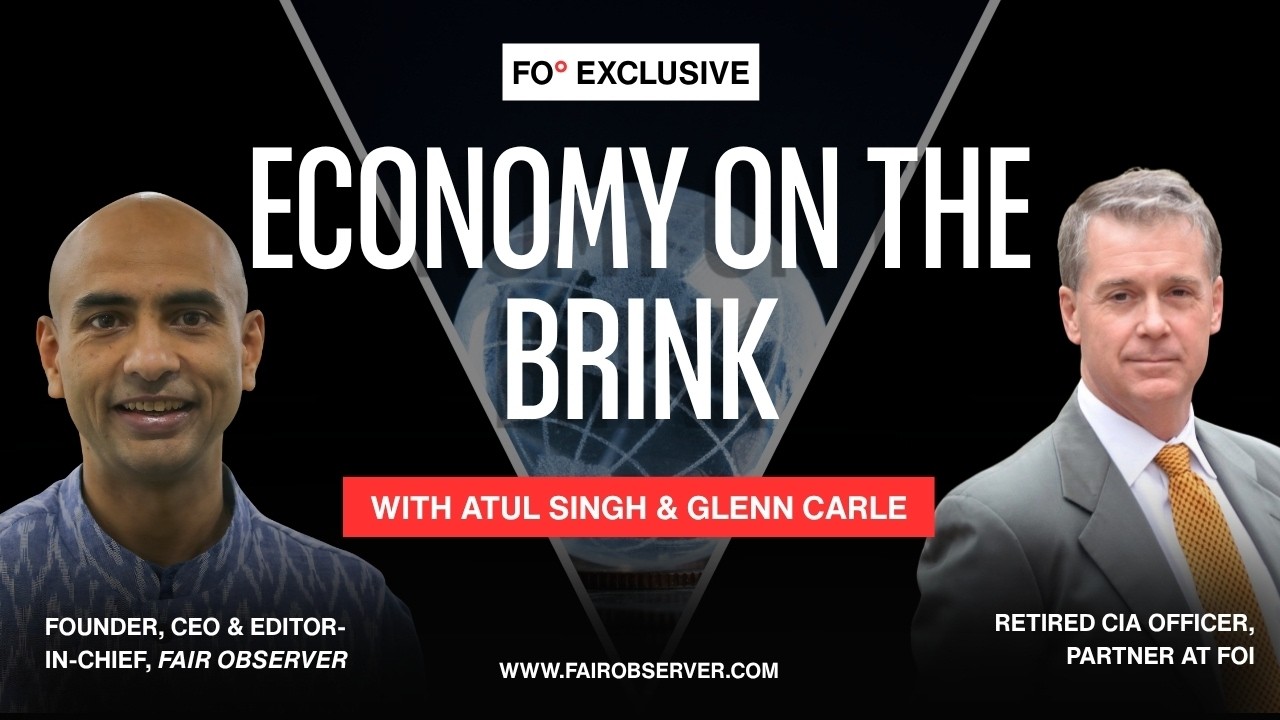
Editor-in-Chief Atul Singh and FOI Senior Partner Glenn Carle, a retired CIA officer who now advises companies, governments and organizations on geopolitical risk, examine September 2026’s most notable developments.
They go through the key developments of the month before they dive into their three major issues for the month: Saudi Arabia’s Prince Mohammed bin Salman (MBS) troubles, Canada turning to the EU amidst a trade war with the US and the space race.
Two summits, neither quite victorious
On September 23–25, US President Donald Trump and Chinese President Xi Jinping met for an important summit. We have strategic stability for now. China's primary political gathering in 2027 will be the 21st National Congress of the Chinese Communist Party, scheduled for the autumn of 2027 in Beijing. Xi wants stability until then. Midterms are around the corner in the US. So, Trump wants stability too. Trump has delayed a $14 billion arms package for Taiwan. No agreement on AI, and none is likely to come either. In addition, Trump has delayed a $14 billion arms package for Taiwan even though the package had already been awaiting approval for months.
On September 22, the US, Denmark and Greenland signed a deal. The US now has guaranteed, long-term access, basing, and overflight rights. It excludes Russia and China from operating in Greenland. The Trump administration congratulated itself for “executing a master move of geopolitical chess in the Great Arctic Game” and following the Trump Corollary to the Monroe Doctrine to a “T.”
Glenn is not convinced, though. He argues that, like the Trump–Xi summit, the Greenland deal really didn’t change anything. The Danes simply repackaged the status quo in a pretty enough package to allow Trump to claim another victory.
Iran war causes economic pain and political trouble in Europe
Unfortunately, Trump can only claim victory over Greenland. The US/Israel–Iran War is causing global economic pain. As FOI Geopolitical Risk Monitor predicted on May 12, the supply shock has led to massive inflationary pressures.
Central banks are having to react, while governments are running up against the narrowed financial straits caused by long-term structural deficits and debt among the US and Europe. The European Central Bank raised interest rates for the second time this year, lifting its deposit facility from 2.25% to 2.5%. The Federal Reserve (Fed) raised interest rates by 0.25 percentage points (25 basis points) during the third quarter. The Fed has moved the benchmark federal funds rate to a target range of 3.75% to 4.00%, hiking rates for the first time since July 2023.
Political trouble is accompanying economic pain in Europe. The rise of the Alternative for Germany (AfD) has weakened German Chancellor Friedrich Merz and caused panic. The far-right party secured a historic first-place finish in the eastern state of Saxony-Anhalt with 43.8% of the vote in the September 6 election. It followed up its Saxony-Anhalt breakthrough by winning the northeastern coastal state of Mecklenburg-Western Pomerania with 38.2% of the vote on September 20.
Indeed, the ascent of the far right, or at least the rise of populist leaders, continues across Europe and the US. Deputy of the French National Assembly Marine Le Pen is leading in presidential polls for the 2027 presidential election. An Ipsos-BVA poll published by Le Monde placed her ahead in all tested first-round scenarios, despite her being a convicted felon. But then, if one wishes to evaluate the effects of criminality on political success, one need only look to the White House, where a man convicted of 34 felonies, and indicted for yet more, sits in the recently-gilded Oval Office.
On September 28, Swedish Social Democrats leader Magdalena Andersson said she was unable to secure enough support despite the center-left bloc winning a narrow majority in the September 13 election. Glenn posits that the global phenomenon driving this political shift is a dramatic social transformation stemming from increased immigration. The mass migration of people has led to divided and destabilized societies.
Serbia, Iceland and Russia–North Korea in the news
On September 7, thousands attended the funeral of Ratko Mladić, a Bosnian-Serb commander, in Belgrade, the capital of Serbia. He died in a UN hospital on August 27 while serving a life sentence. The fact that so many showed up is worrying. Mladić was convicted of overseeing the 1995 massacre at Srebrenica and conducting the 1992–1996 Siege of Sarajevo. These attacks killed 8,000 Bosnian men and boys and an estimated 11, 540 people, respectively.
Iceland voters rejected resuming EU accession negotiations by roughly 53%–47%. The referendum took place on August 29, with final results formally announced on September 22. Turnout was nearly 83%, and only the capital Reykjavik voted in favor.
On September 7, Russia and North Korea opened their first cross-border road link in the form of a bridge spanning the Tumen River. The bridge runs around 200 kilometers (125 miles) from Vladivostok, which is Russia’s main port on the Pacific Ocean.
China in Egypt and America in Venezuela
Before traveling to the US, Xi visited Egypt. During his September 2 meeting with Egyptian President Abdel Fattah el-Sisi, he called for a new security apparatus for the Middle East. Importantly, he said that China was ready to help protect strategic shipping routes in the region. Atul and Glenn’s two takeaways are as follows: “China’s influence in the Middle East is on the rise, and Egypt’s international partnerships amid regional turmoil in the Middle East are growing.”
Elsewhere, on September 2, the energy corporation Chevron promised to invest $7 billion and double oil production in Venezuela. Nicolás Maduro, the former president, is now in an American prison. The US has undermined Russian and Chinese influence in Caracas — Interim President Delcy Rodríguez is proving a good accomplice to Washington, DC. Opposition leader María Corina Machado is unhappy and says Venezuelans are feeling “sadness, anger and unease,” but she has no power.
Importantly, the Pentagon will take a 35% stake in a Venezuelan oil company. This is a success for the Donroe Doctrine, and an example of smash-and-grab FOI predicted last year. Perhaps, Glenn says with some irony, with the US military owning businesses now, this represents America’s newfound love of socialism and the emulation of the Chinese model of economic “development.”
Military upheaval in the US and China, and turmoil in American tech giants
The US military is going through upheaval. On September 1, Daniel Driscoll resigned as secretary of the army after clashing with Secretary of Defense/War Pete Hegseth over the sacking of senior commanders. Back in April, Hegseth fired several top-ranking officers, including General Randy George as army chief of staff.
Turmoil in the military is not limited to changes in the top leadership. After a record 286 consecutive days at sea, the USS Abraham Lincoln docked at Laem Chabang in Thailand. Pictures showed it was not in pristine shape by the end of its voyage and morale was reportedly running low.
A consolation for the US is that China is also experiencing military turmoil. On September 21, the Chinese Communist Party (CCP) expelled Zhang Youxia and Liu Zhenli, two generals, from the party and the armed forces for alleged disloyalty and corruption. They had been under investigation since January. This makes 158 senior military leaders that have either been expelled, imprisoned or disappeared in Xi’s various purges.
Finally, America’s tech giants were in the news this month. On September 2, Uber announced that it was cutting 3,300 people, about 10% of its global workforce, mostly in management. The company is going through a major restructuring. Uber was not the only company that attracted attention. On August 31, the Federal Trade Commission and 22 states filed a lawsuit against Amazon. They claim the company secretly rigged ad auctions on its site and app, illegally taking $20 billion from 1.2 million advertisers. Amazon denies the claims, calling the lawsuit misguided. Time will tell who prevails in this titanic legal battle.
[Lee Thompson-Kolar edited this piece.]
The views expressed in this article/video are the author’s own and do not necessarily reflect Fair Observer’s editorial policy.



































Join the conversation
Share your perspective
Log in to share your thoughts and take part in the discussion.