





Editor-in-Chief Atul Singh and FOI Senior Partner Glenn Carle, a retired CIA officer who now advises companies, governments and organizations on geopolitical risk, examine how the US/Israel–Iran war has entered a dangerous new phase. As the conflict spreads beyond Iran and Israel into the wider Middle East, they explore the strategic, economic and military consequences of an expanding regional war.
The war expands across the Middle East
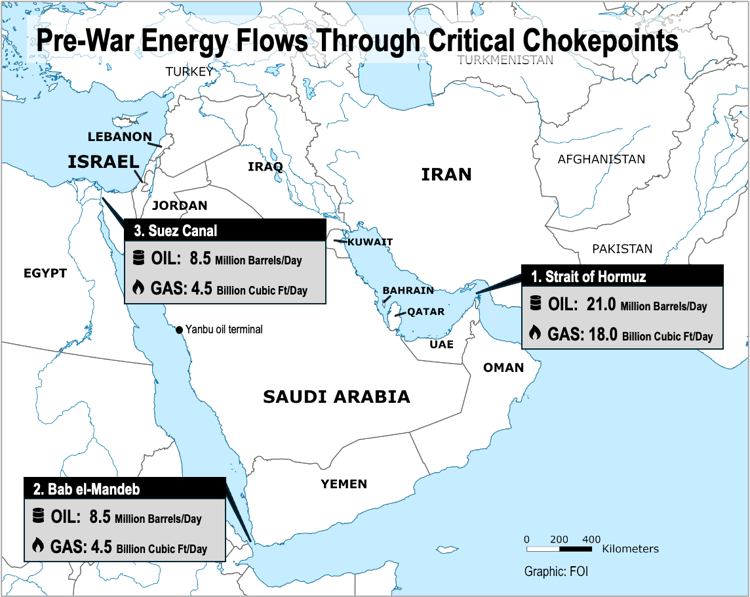
In July, the US/Israel–Iran War widened into a regional war with new non-state and state actors. On July 20, the Houthis declared a maritime embargo against Saudi Arabia. They control the Bab el-Mandeb, a strait that connects the Red Sea and the Gulf of Aden, which leads into the Indian Ocean. The Houthis have tried this before. In 2023, the Houthis attacked merchant ships passing through Bab el-Mandeb. In early 2024, the US and UK, along with other countries, struck Houthi targets in Yemen. After a few months of quiet, the Houthis have opened another front in the war and are considering charging fees for ships sailing through the Red Sea.
In addition to Hezbollah in Lebanon and the Houthis in Yemen, Iran has activated Shia groups in Iraq. In response, Saudi Arabia has joined the US in striking Iranian-backed targets in Iraq. Apparently, the UAE has also struck targets in Iran. The conflict is widening into a regional war.
Iran changes the tempo
Iran is increasingly feeling emboldened. Iran’s Islamic Revolutionary Guard Corps (IRGC) claimed that it had targeted a US air base and a command center in Jordan “in response to the acts of aggression of the American child-killing army.” The IRGC also said that naval forces had struck three oil tankers in the Strait of Hormuz after they “ignored warnings” and sailed along what it described as an “unsafe and illegal route” through the vital Gulf waterway.
When asked by a Fox News correspondent on Wednesday about the Iranian attack on Jordan, Trump said in an expletive-laden response that US forces would be “hitting them hard,” adding: “They're going to get a beating.”
In a nutshell, the war shows no signs of ending. Attacks and counterattacks continue. Iran is using asymmetric warfare and decentralized decision-making brilliantly. The US is now locked into an expensive war that is costing a lot and unleashing inflation worldwide, including at home. For Iran, this war is existential. In the US, this war is unpopular. Tehran is trumping Washington for now.
Chokepoints deliver a supply shock to the global economy
As the FOI Geopolitical Risk Monitor May 2026 predicted, the war has unleashed a massive supply shock to the global economy. Over 20% of oil and gas, as well as 33% of fertilizers for the entire world, pass through the Strait of Malacca. The Iranians have closed off this strait.
As in the 1970s, inflation threatens to rip through the global economy. There is a shortage of fuel and fertilizers. Their prices will rise. This will cause a rise in food prices because agriculture needs both fuel and fertilizers. In fact, the intensifying El Niño pattern this summer, in addition to the shortage of fertilizers, will lead to a shortage of food. The poor in developing countries will go hungry. Even Americans will pay more for their food.
Bab el-Mandeb and the Strait of Hormuz have made maritime chokepoints central to global geopolitics. The 20 million barrels of oil that pass through Hormuz every day have no effective alternative route. Even the pipeline that takes some of this oil to the Red Sea port of Yanbu on the western coast of Saudi Arabia is now less effective because the Houthis have closed Bab el-Mandeb.
The Suez Canal carries approximately 12–14% of world trade, Bab el-Mandeb another 10–12% and the Panama Canal around 6%. Traffic through Bab el-Mandeb had already fallen by roughly 55% even before the Houthis intensified their attacks. Now, the Bab el-Mandeb and Suez Canal route from Europe to Asia is blocked, increasing the time and money it takes to get cargo between the two continents. Now, ships will have to sail all around Africa.
The character of war changes
Glenn goes on to point out that the character of war has changed. The US dominates the air but does not enjoy the same dominance at sea. Sending expensive naval vessels through the Strait of Hormuz is too much of a risk for the US Navy. A cheap drone could damage a multimillion-dollar machine. The US/Israel–Iran War is making it painfully obvious that asymmetric warfare now defines the nature of war.
Glenn argues that legacy systems such as aircraft, ships, armored vehicles and massed soldiers are increasingly more vulnerable to drones. Furthermore, like Germany in World War II, the US finds itself making extremely expensive weapons systems that take a while to build. In World War II, the US churned out tanks in great volume, which overwhelmed the far fewer, though better built German Panzers. Today, the US is running out of expensive military materiel.
Atul supports Glenn’s point with numbers. Per the CSIS Cancian and Park accounting of April 24, Operation Epic Fury has led to the loss of the following kit:
- 1,000-plus Tomahawk cruise missiles — approximately 27% of the US inventory, on a ten-year reconstitution timeline;
- Approximately 23% of JASSM inventory;
- Approximately 33% of SM-6 and 50% of SM-3 interceptors;
- 1,430-plus PAC-3 interceptors — more than 50% of inventory;
- Approximately 150 THAAD interceptors — up to 80% of the theatre-available stock;
- The entire fielded PrSM inventory.
- Aircraft losses in the Iran theatre total 39 airframes: 24 MQ-9 Reapers, four F-15Es, two MC-130s, and one KC-135.
In a nutshell, Iran is producing cheap weapons at scale while the US is running short of expensive kit. Glenn points out that all war is fundamentally about logistics and supply chains. Yes, the US has ferocious strike capability, but Iran can produce drones in garages and drain American resources. The US no longer has the industrial strength it had, which led to its victory in World War II. The ability to replenish weapons and equipment matters more than the power of the initial strikes or even the killing of top leadership.
Also, Iran could expand the battlefield even further. So far, Iran has been striking American allies in the region. Iranian allies have entered the war, forcing Saudi Arabia and the UAE to reluctantly respond. Also, Iran is inflicting great pain by hitting financial centers, oil refineries and industrial production sites of American allies.
American companies are also now targets. As the Modern War Institute observes, “Cloud geography became campaign geography.” Companies such as Google, Microsoft, Palantir, Amazon, Nvidia and Oracle, together with regional digital infrastructure, are becoming part of the battlespace.
US wages unpopular war, Iran sees conflict as existential
While the war is increasingly unpopular in the US, Iran sees the war as existential. Israeli strikes killed the then-Supreme Leader Ayatollah Ali Khamenei on the first day of the war along with many of the regime’s top leaders. Yet Iran has demonstrated the ability to continue fighting. It has blocked the Strait of Hormuz, activated allies and made this war a regional conflict.
In doing so, Iran has increased the costs of war on its enemies and adversaries. The mullahs running the country have also activated Shia mythology to rally the people. Per Shia tradition, Imam Hussain ibn Ali, the grandson of Muhammad himself, led his band of 72 followers and family members to battle against thousands of troops dispatched by Umayyad Caliph Yazid I. Khamenei referred to Hussain’s sacrifice in his last address to the nation, and the dead ayatollah has become a martyr for the Shia pantheon.
Khamenei’s son Mojtaba is supposedly the new supreme leader of Iran. Yet no one has seen him since the war began. Apparently, he was injured in the strikes and might very well be dead. More importantly, the brief pause in fighting allowed the Iranian regime to conduct a spectacular funeral for Ali Khamenei. His coffin traveled more than 2,600 kilometers (over 1,615 miles) across five cities in Iran and Iraq over six days. Public mourning is a key part of the Shia tradition, and the mass hysteria on display in Khamenei’s funeral certainly boosted Iranian religiosity, nationalism and the regime.
In contrast, Americans are having growing misgivings about the war. Secretary of Defense Pete Hegseth told Congress that the conflict has already cost America $37.5 billion. He requested an additional $67 billion for operations in the region, although some analysts believe the true cost is considerably higher once they include reconstruction of damaged American military facilities. There is no clear path to victory for the US, and another forever war in the Middle East is giving many Americans a sense of deja vu after the disasters in Iraq and Afghanistan.
In a nutshell, Iran is winning, and the US is losing in this war so far.
[Lee Thompson-Kolar edited this piece.]
The views expressed in this article/video are the author’s own and do not necessarily reflect Fair Observer’s editorial policy.

































Comment