


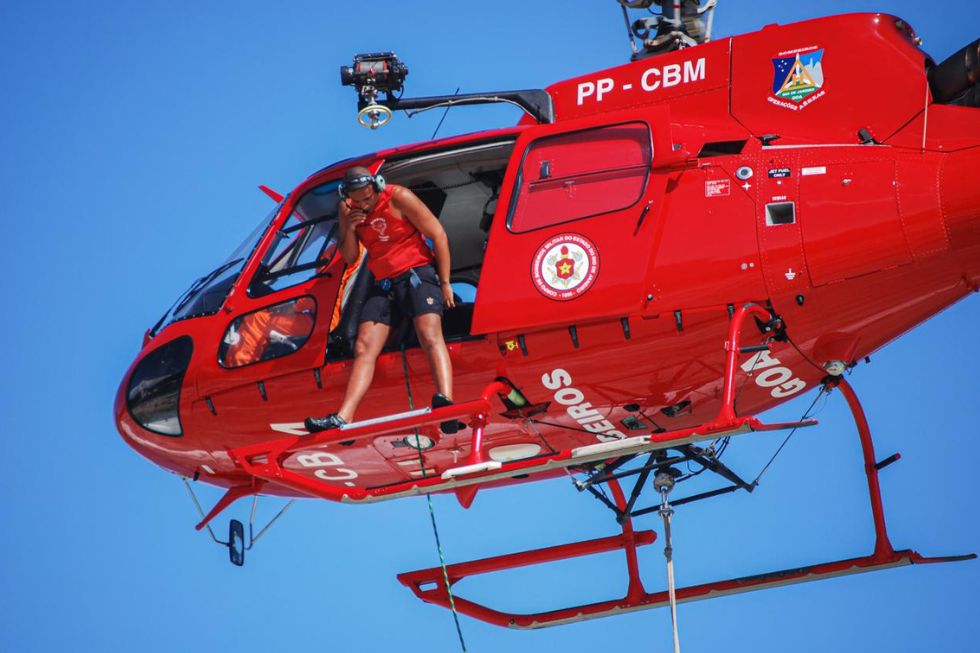



Shortly before 9:00 AM on Sunday, June 14, Rio de Janeiro went about its usual routine. Cars puttered along the seaside avenues. Tourists shuffled through the city. The sea held on the horizon like a kind of permanent promise. Above it all, however, was another kind of traffic most people don’t notice: a stream of helicopters.
It was in this airspace that two helicopters met in a tragic collision. They crashed mid-flight, plummeting toward the Recreio dos Bandeirantes neighborhood in Rio’s West Zone. Six people died, including the pilots and passengers of both aircraft. The accident made the skies a national headline and raised a question that extends far beyond the technical investigation: What does this disaster reveal about contemporary Brazil?
Part of the case’s national significance stems from the identities of some of the victims. Aboard one of the helicopters were American singer Oliver Tree, an artist with millions of listeners on streaming platforms; Argentine influencer and YouTube content creator Gaspar Prim Díaz, known as Gaspi; music video director Lucas Vignale; and Brazilian music producer Lucas Brito Chaves, known as Lucas Frota. The presence of internationally recognized figures amplified media coverage and transformed a local tragedy into global news.
But we must not reduce the incident to a mere reflection of our contemporary fascination with celebrities. What happened over Recreio dos Bandeirantes sheds light on the silent transformations of Brazilian urban life: the growing occupation of airspace, the extreme prioritization of speed and the inequalities that shape mobility in large cities. The tragedy is a window into understanding today’s Brazil.
We often treat accidents as isolated events — a human error, an operational mistake, a mechanical glitch. But major tragedies also serve as social x-rays, illuminating normally invisible structures.
Rio’s helicopter collision is not merely a matter for aviation investigators. It occurs at the intersection of trends that have been reshaping Brazil’s major cities: the proliferation of private air travel, the strain on urban traffic systems and the constant effort to save time in increasingly congested metropolises.
Brazil’s crowded skies
For decades, the helicopter symbolized the exceptional. It was the aircraft of choice for rescue operations, police work and medical emergencies. Today, in cities like Rio and São Paulo, it has also become an everyday means of transportation for businesspeople, artists, executives and people seeking to escape ground traffic jams.
The Brazilian landscape has created a peculiar situation. While millions spend hours each day riding buses, trains and cars, a small portion of the population uses air corridors to cross the city. Brazilian inequality was long evident in the geography of cities, but now we see it high above them. Traffic jams still exist, they’ve just shifted to a different altitude.
The accident exposes a Brazilian contradiction. The country has one of the largest helicopter fleets in the world and simultaneously grapples with overburdened public transportation systems. While one segment of the population jostles for space on buses, trains and subways, another turns the sky into a daily route.
The Recreio collision brings to light this rarely discussed reality: The skies over Brazil’s major cities have grown increasingly crowded.
Rio, especially its coastal areas and regions with intense business activity, sees constant aircraft traffic. Anyone observing the horizon of Copacabana or Barra da Tijuca can see this easily. Helicopters appear, disappear, cross paths and follow invisible corridors. Airspace is an urban infrastructure just as important as avenues and tunnels.
According to experts interviewed on Brazilian television network TV Globo, helicopter operations do not function exactly like those of commercial airplanes. For most flights, pilots operate under visual flight rules. This means they must maintain visual contact with their surroundings, identify obstacles, monitor other aircraft and make decisions in real time. One of the experts compared this system to car traffic on a highway.
This helps dispel a widely held misconception. The sky is not an empty space where aircraft fly in isolation. It has traffic flows, preferred routes, crossing points and areas of higher operational density. In cities with intense air traffic, constant coordination is essential for safety.
Selling speed to the wealthy
There is also a cultural dimension to this incident. In recent decades, speed has ceased to be merely an advantage. It has become a commodity; companies, services and apps alike sell it. Private air travel has come to market with exactly the same promise: the possibility of escaping delays, traffic jams and the limitations imposed by the city. The helicopter has become one of the most visible symbols of this logic.
The separation between poorer ground-commuters and wealthier air-fliers creates a radically unequal urban experience. Those who depend on public transportation measure the city in hours. Those who cross Barra by helicopter measure the same distance in minutes. These two groups have unequal access to time.
When two helicopters collide, it is not merely an aviation accident. A symbolic rupture also occurs. The space that usually represents efficiency, exclusivity and speed shows its own limits.
The footage and images of the tragedy are shocking for this reason. Viewers can see scattered debris, fire, downed wreckage and aircraft fragments striking nearby areas. The sky, usually associated with the idea of technological freedom, suddenly becomes a scene of vulnerability.
The investigation ahead
The Center for Investigation and Prevention of Aviation Accidents (CENIPA) is investigating the crash. The causes remain unknown. Certain hypotheses naturally come to the investigators’ attention: communication problems, limited visibility, failures in situational awareness or specific operational circumstances.
However, aviation experience shows that accidents rarely result from a single cause. They most often arise from a combination of factors that, taken individually, would seem insufficient to produce a tragedy. A decision made under pressure, a misinterpretation, an unexpected operational condition — disaster usually stems from the convergence of these elements.
The six deaths have devastated families and made for a complex investigation. In the coming months, experts will reconstruct flight paths, examine equipment, analyze communications and attempt to determine why those aircraft were in the same spot in the sky at the exact same moment.
When CENIPA concludes its investigation, it is likely to reveal which technical factors brought the two aircraft catastrophically close together. It is unlikely, however, to answer why the skies over Brazil’s major cities have become an increasingly contested space.
This is less an aeronautical question than a social one. Perhaps it makes the accident more than an aviation tragedy.
[Lee Thompson-Kolar edited this piece.]
The views expressed in this article are the author’s own and do not necessarily reflect Fair Observer’s editorial policy.
Brazil at a Crossroads: The Farce of Amnesty and the Battle for Democracy
Supporters of former President Jair Bolsonaro demand amnesty for the January 8 rioters, while civil society rallies against it and...

Celebrities and Money Laundering Make Brazilian Gambling a Popular Laundromat
The recent arrests of celebrities Gusttavo Lima and Deolane Bezerra highlight Brazil’s financial crime. Since the country’s bookie boom in...

Surging Violence and Corruption Poison the “Marvelous City” of Rio
Carioca militias have committed acts of terrorism on Rio de Janeiro’s streets in response to the killing of a high-ranking...
The Amazon Rainforest Fires Are Worse Than You Think
The fires burning in Brazil will affect the entire world, making the Amazon rainforest a truly global issue.


Support Fair Observer
We rely on your support for our independence, diversity and quality.
For more than 10 years, Fair Observer has been free, fair and independent. No billionaire owns us, no advertisers control us. We are a reader-supported nonprofit. Unlike many other publications, we keep our content free for readers regardless of where they live or whether they can afford to pay. We have no paywalls and no ads.
In the post-truth era of fake news, echo chambers and filter bubbles, we publish a plurality of perspectives from around the world. Anyone can publish with us, but everyone goes through a rigorous editorial process. So, you get fact-checked, well-reasoned content instead of noise.
We publish 3,000+ voices from 90+ countries. We also conduct education and training programs
on subjects ranging from digital media and journalism to writing and critical thinking. This
doesn’t come cheap. Servers, editors, trainers and web developers cost
money.
Please consider supporting us on a regular basis as a recurring donor or a
sustaining member.
Will you support FO’s journalism?
We rely on your support for our independence, diversity and quality.





Comment