



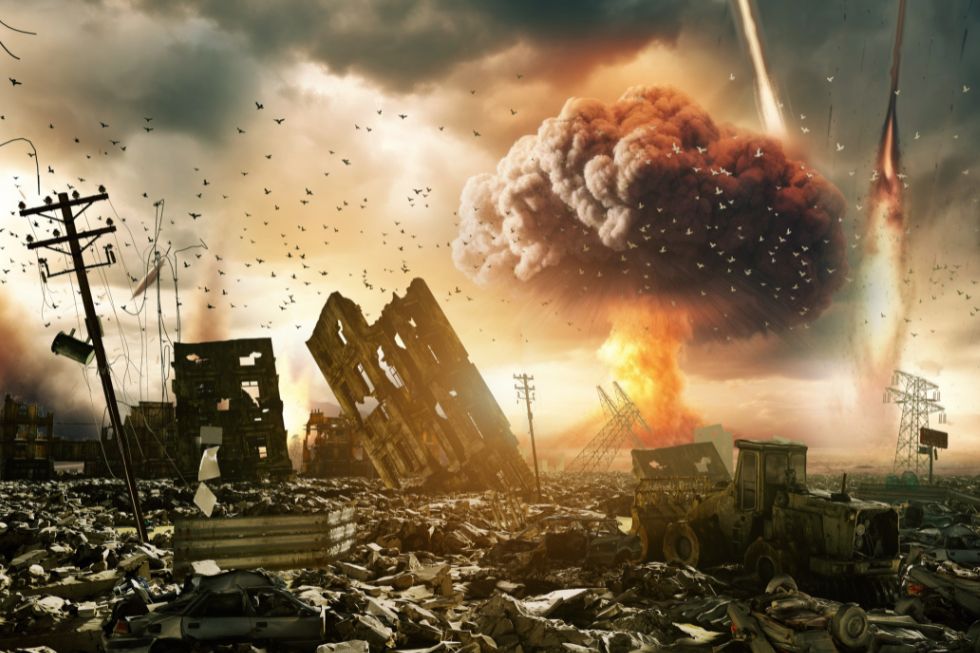


In his dark 1964 comedy, Dr. Strangelove, Stanley Kubrick anticipated it, but Kim Jong Un has apparently given it a new reality. Not in the form of cinema, though I think the world could use an updated remake of Kubrick’s film, were there a director of his genius to accomplish the task. Kubrick’s plot turned around the revelation that the Soviet Union had perfected the ultimate tool of deterrence: a “Doomsday machine.” The modern version of which, no longer belongs to the world of cinema fiction, is referred to as the “Dead Hand.”
The plot of Kubrick’s film turns around the acts of an unhinged and out-of-control air force base commander, General Jack D. Ripper, who possesses a pathologically paranoid mindset not dissimilar in many ways to that of the current US secretary of defense (aka secretary of war), Pete Hegseth. They both share a taste for celebrating real or (more likely) imaginary manly virtues and their expression through war.
Fiction may seek to appear credible by imitating reality, but just as often reality imitates fiction, even the most extravagant fiction. Could that be the case today? When weighing up the apparent psychological dysfunction discernible not just on the part of the man who runs the Pentagon but also of his boss — US President Donald Trump himself — one may legitimately wonder whether we are today not on the cusp of a Dr. Strangelove moment.
Kubrick originally began working on the plot with the idea of crafting a political drama meant to awaken the public to a specific danger. Struck by the moral absurdity of a system that could, in a single stroke, move from the noble purpose of defending civilized values to destroying civilization itself, Kubrick chose to turn the same serious plot into a black comedy. He did so by simply following the internal logic of a system former President Dwight D. Eisenhower, two years before the film’s production, denounced as dangerous: America’s growing military-industrial complex.
The logic of Kubrick’s Doomsday Machine came neither from the director nor the screenwriter, Terry Southern. It came from physicist, mathematician and futurologist Herman Kahn, who founded the Hudson Institute and author of the book, Thinking About the Unthinkable, published in 1962: the year that preceded the production of Dr. Strangelove. 1962 was also the year of the Cuban Missile Crisis in which the entire global population realized humanity was poised on the brink of extinction.
According to researcher Seong-Whun Cheon, the “Doomsday Machine is a conceptual device of Herman Kahn in the late 1950s, which can be considered an imaginary weapon system capable of annihilating humanity… linked to a computer connected to hundreds of sensors and communication networks across the United States.” At the time, there was no Internet, computers were cumbersome and AI was little more than an abstract idea about the future of computing. Things moved quickly however.
“In the early 1980s, concerned that a preemptive U.S. strike could eliminate them before they could properly retaliate, the Soviet leadership decided to develop a system that could guarantee a retaliatory strike.”
They designed a fully automated retaliatory system, which they called Dead Hand. It ensured that “retaliation would be carried out entirely under computer command, without human intervention. However, the Soviet military opposed the idea, citing the risks of a fully automated system devoid of human control, and as a result, the Dead Hand remained at the conceptual level.”
When the Soviets finally did deploy it, in 1985, they built human judgment into it as it could only be triggered by “a small number of agents, sheltered in deep underground bunkers” who “assess the situation in the event of an enemy attack and guide missiles deployed on the surface to launch.”
Now the only significant difference from the Strangelove scenario is that the “small number of agents” trained for the job exercise the responsibility that Kubrick left in the hands of a single sociopathic, suicidal general. A fully automated system is a frightening prospect. Few people today would trust even the best AI today or in the near future to be in charge of the decision making that could make the Earth uninhabitable.
The deterrence dilemma
Kubrick was so personally affected by the prospect of nuclear war and so concerned about the ease with which it might be accidentally provoked that he subtitled his comedy: “How I Learned to Stop Worrying and Love the Bomb.” It’s Kubrick’s application of the logic of what psychologists call the Stockholm Syndrome, when a hostage develops positive feelings toward their captor as a survival strategy. It is unlikely that the great director ended up loving the bomb, but it’s important to note that in the following decades, the population of the US appears to have stopped worrying, if not quite reaching the point of loving the bomb. During his first term, Trump is alleged to have “asked three times in an hour briefing, ‘Why can’t we use nuclear weapons?’” Given the risks of escalation in two conflicts involving nuclear powers Trump appears powerless to rein in combined with the pathologically bellicose rhetoric of his own team, one wonders whether Trump hasn’t begun his own love affair with the bomb.
In the early phases of the Cold War, the rhetoric associated with the notion of deterrence produced reams of reflection by experts in politics and technology on how to use the promise of unlimited destruction to serve the objective of world peace. They came up with Mutually Assured Destruction (MAD) as the ultimate geopolitical safety blanket: a foolproof security strategy where two nations guarantee peace by promising to murder everyone on Earth if anyone blinks. In hindsight, the doctrine appears foolproof since there has been no nuclear attack since Nagasaki in August 1945. But there have been some real scares along the way. And, though few people in power seem to be overly concerned, there’s good reason to think that the danger has never been greater. That, in any case, appears to be the judgment of the United Nations. Let’s look at the latest instance.
The Ukraine war has reached a point at which Russia perceives Europe and NATO not just as willing suppliers of Ukraine but as direct participants in drone and missile attacks on Russia itself. The current version of MAD strategy adopted by Russia authorizes it to use nuclear weapons in the face of an existential threat. Insiders in Moscow have made it known that Russian President Vladimir Putin’s reluctance to escalate and deploy the means Russia has held all along of neutralizing Ukraine is currently hotly contested by members of the government and military eager to put a quick end to the four-year-old war.
Are we all going MAD?
How likely is escalation? In an article that appeared in Advance with the title, “The Baltic Detonator: If Either of Two Conflicting Claims Is True, Full-Scale Escalation Is Inevitable,” the probability is high. It speculates on why the Europeans would push in that direction. “The goal may be to catch Trump before he truly runs away from the whole NATO story and shuts himself inside his fortress.”
The MAD doctrine came into being in a period when leaders had names like Eisenhower, Khrushchev, Kennedy, Adenauer, De Gaulle, Brandt, Macmillan Tito, Nehru and even Nixon. They all made mistakes and found subtle ways abusing their power. All were capable of promoting imperfect policies in a variety of domains. But everyone recognized that to be the elected leader of a democracy or even a people’s republic you were expected to have a sense of reasonable limits that relate to your sense of ethics, laws, protocols, relationship management and rules of engagement. Can the same be said today in a world in which some of the most active personalities have the psychological profile of a Trump, Netanyahu or Kim Jong Un?
Speaking of the North Korean leader, he has apparently reacted to Trump’s abduction in January of Venezuelan President Nicolás Maduro and the concerted Israeli and US decapitation bombing that killed Iran’s Supreme Leader on February 28. Pyongyang has revised its nuclear policy to reaffirm its Dead Hand strategy. According to Banking News, “based on the amended constitution, North Korea will launch an automatic and immediate nuclear strike in the event of Kim Jong Un’s death or the assassination of the country’s top leadership. The retaliation will be carried out against pre-designated targets in South Korea, Japan, and the United States.”
Just this week, Chinese President Xi Jinping described the state of things in these words: “The international situation is marked by intertwined turbulence and transformation, while unilateral hegemonic currents are running rampant.”
Whether you agree with his formulation or where to place the guilt, the idea of “running rampant” appears to be an accurate description of what we are living through today.
*[The Devil’s Advocate pursues the tradition Fair Observer began in 2017 with the launch of our “Devil’s Dictionary.” It does so with a slight change of focus, moving from language itself — political and journalistic rhetoric — to the substantial issues in the news. Read more of the Fair Observer Devil’s Dictionary. The news we consume deserves to be seen from an outsider’s point of view. And who could be more outside official discourse than Old Nick himself?]
[Lee Thompson-Kolar edited this piece.]
The views expressed in this article are the author’s own and do not necessarily reflect Fair Observer’s editorial policy.
Why America’s Destruction of the World Order Could Be Disastrous
The US built the post-1945 rules-based order, gaining economic, financial and security advantages. The Trump administration’s erosion of this system...
Singularity and the Doomsday Clock
The Singularity marks a profound shift where AI surpasses human intelligence, threatening to render humanity obsolete and powerless. Experts warn...

Apocalypse, Not Now, But Soon!
In a world teetering on the brink of chaos, from “apocalyptic” elections to endless wars, democracy demands rethinking.

Daniel Ellsberg: A Fearless Revolutionary Whose Causes Endure Now
Daniel Ellsberg, the man who controversially revealed the US’s secret Pentagon Papers, passed on June 16, 2023. A year later,...
Support Fair Observer
We rely on your support for our independence, diversity and quality.
For more than 10 years, Fair Observer has been free, fair and independent. No billionaire owns us, no advertisers control us. We are a reader-supported nonprofit. Unlike many other publications, we keep our content free for readers regardless of where they live or whether they can afford to pay. We have no paywalls and no ads.
In the post-truth era of fake news, echo chambers and filter bubbles, we publish a plurality of perspectives from around the world. Anyone can publish with us, but everyone goes through a rigorous editorial process. So, you get fact-checked, well-reasoned content instead of noise.
We publish 3,000+ voices from 90+ countries. We also conduct education and training programs
on subjects ranging from digital media and journalism to writing and critical thinking. This
doesn’t come cheap. Servers, editors, trainers and web developers cost
money.
Please consider supporting us on a regular basis as a recurring donor or a
sustaining member.
Will you support FO’s journalism?
We rely on your support for our independence, diversity and quality.





Comment