


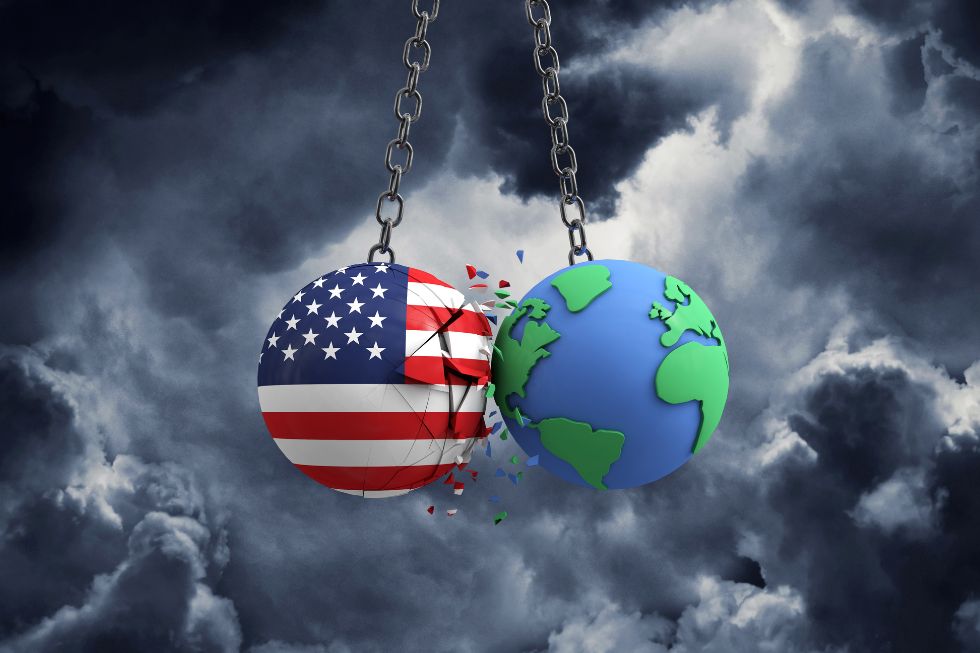


The US was the chief architect, leader and beneficiary of the rules-based world order — until now. Established after 1945 primarily to prevent repeating catastrophes like the Great Depression and the two World Wars, it laid the groundwork for trusted institutions that fostered international cooperation, supported open markets and evolved into one of the most successful economic, financial and security arrangements in history.
Nevertheless, the Trump administration appears dedicated to its destruction. And this could have disastrous consequences for the US.
The benefits of rules, predictability and reliability
At the foundation of this international order stand sound global institutions — the UN, the World Bank, the International Monetary Fund, and the General Agreement on Tariffs and Trade, which became the World Trade Organization (WTO). Referred to as the liberal international or world order, it succeeded for eight decades because it established rules and conditions that generated shared growth and prosperity.
The international order, combined with American institutions — an independent judiciary, sound property rights, a free press, and a government with effective checks and balances — supported the development of stable, efficient and predictable markets that became fundamental to US economic prosperity. But that was only the beginning.
This system positioned the US dollar as the world’s reserve currency, generating enormous advantages. These included inexpensive financing for the US government and American consumers, as well as the world’s trust and reliance on the American financial system for the vast majority of global transactions. It helped propel the US to become the most attractive destination for foreign direct investment — global investors chose America not just for its market size, but for its institutional reliability. It also promoted US-written technical and legal standards that advantaged American producers, and persuaded other nations to join US sanctions and export-control regimes.
Importantly, these factors created an environment that attracted the world’s most brilliant minds to American universities and corporations. The result: The US became the most innovative country in the world.
The economic and security umbrella
This international order was not merely an economic arrangement — it was also a security umbrella that extended US protection to allies through 750 American military and naval bases in friendly countries. This has provided the US with unmatched global reach, empowering it to offer security guarantees that converted adversaries into customers while eliminating piracy and keeping sea lanes open.
This economic-security umbrella benefited our allies. But it helped the US perhaps most of all by granting American producers secure access to 8 billion global consumers, not just 345 million at home. And it enabled US multinationals operating abroad to produce and sell more than twice the value of goods exported from the homeland annually. On the import side, it benefited American manufacturers and consumers by providing access to the world’s best inputs at competitive prices, suppressing inflation and boosting living standards.
The results of this arrangement are impressive. According to the World Bank, since 1990, global trade has increased incomes by 24% worldwide and lifted more than 1 billion people out of poverty.
China presented challenges to the order
Although problems periodically emerged within the international order, multilateral dispute mechanisms generally found workable solutions. China proved a more persistent challenge.
To join the WTO in 2001, China voluntarily undertook significant domestic economic reforms, including substantial reductions in tariff levels, and opened its markets to become the world’s second-largest importer. This benefited many countries, including the US, which saw its exports to China grow by 455% from 2001 through 2019 — compared to only 130% growth in exports to the world overall.
Yet as China rapidly accumulated economic advantages and technological knowledge, serious tensions emerged. The rise of a politically independent entrepreneurial class threatened Communist Party control. The 2008 global financial crisis and a 2015 stock market plunge accelerated China’s selective exploitation of international rules. Its unwillingness to reduce subsidies to state-owned enterprises, its dependence on exports and its failure to stimulate domestic demand continued to generate friction with trading partners worldwide.
Throwing the baby out with the bathwater
To steer China toward a more accommodating path, the US could have worked more closely with allies to press China more forcefully to play by the rules — and, if unsuccessful, pursued a more targeted decoupling strategy with allied support. Instead, US President Donald Trump appears to have decided to gut the entire international order.
This is the equivalent of throwing the baby out with the bathwater — discarding enormously valuable elements in an attempt to eliminate unwanted ones. On April 2, 2025 — what he called Liberation Day — President Trump imposed sweeping tariffs not on the countries that had violated international rules, but across the board on adversaries and allies alike. He even announced higher tariffs on Vietnam, a key strategic partner to which many US firms had recently relocated production from China, than on China itself.
If the goal was to encourage allies to open their markets further or meet their defense commitments, this could have been accomplished through diplomatic engagement, new trade agreements, security incentives and joint investment in defense technologies. It was not.
The Trump administration’s disdain for international agreements and global institutions — as well as for American institutions at home — is rapidly transforming the global environment. President Trump’s insults and threats have sparked deep resentment among America’s closest allies: suggesting Canada should become the 51st US state, threatening to annex Denmark’s Greenland territory, and expressing questionable commitment to NATO and to Ukraine in its war with Russia.
The result? America’s traditional allies are increasingly describing the US not as an indispensable partner, but as an unpredictable adversary. A Politico survey conducted in March 2025 found that more than half of Europeans considered President Trump an “enemy of Europe.” By March 2026, a follow-up survey of nearly 6,700 people across six European nations found that many Europeans now view the US as a bigger threat than China.
As allies scramble to reduce their dependence on US markets, inputs and weapons systems, the international order — once built on trust, cooperation, predictability and shared security — is becoming a remnant of the past.
“President Trump is destroying the order that made the United States and its allies safe and prosperous,” said Kori Schake, Senior Fellow and Director of Foreign and Defense Policy Studies at the American Enterprise Institute. “Alliances are America’s superpower. They magnify our own strength, and they are the basis of our security and our prosperity.” Trump and his team, she warns, “are destroying everything that makes the United States an attractive partner.”
The US alone is weaker; China is stronger
Emerging from the decline of the US-led world order is a new kind of globalization — one that proceeds without American leadership but remains deeply interconnected among the rest of the world. Europeans are moving toward alternatives to US financial platforms and are opening up more to China. China, meanwhile, is actively filling the vacuum, writing the next generation of rules with no obligation to reflect American interests.
Since Liberation Day, the US has concluded only skeletal, short-form trade agreements with a handful of countries — a far cry from the comprehensive, thousands-of-pages agreements that defined the postwar trading system. Our allies and China, on the other hand, are forging new free trade zones at a quick pace.
For example, in January 2026, the EU concluded free trade agreements with both Mercosur — which includes Argentina, Brazil, Paraguay and Uruguay, creating a trading zone of more than 700 million consumers — and with India, now the world’s largest free trade zone encompassing 2 billion consumers and approximately 25% of the world’s gross domestic product.
Canada, America’s closest neighbor and largest trading partner, struck a preliminary trade arrangement with China in January 2026, slashing tariffs on electric vehicles, canola and other agricultural goods.
These are just a few of the numerous new trade deals concluded or under negotiation without US involvement. As a result, the US likely will find itself increasingly bypassed in global commerce and technology, while its former influence over allies’ investment and security decisions continues to erode.
Growing concerns that the US is losing its status as the world’s safe haven are beginning to show in financial markets. The US dollar’s role as the world’s reserve currency — long the foundation of American financial power — is gradually eroding. Countries are diversifying away from the dollar and into other currencies and assets, including gold. If this trajectory continues, American households will no longer be able to borrow so cheaply, and the US government will face significantly higher costs to finance its national debt — costs that could crowd out spending on defense, infrastructure and the programs that sustain the middle class.
China is actively working to expand the international role of its currency, the renminbi, and to build financial infrastructure as an alternative to the dollar-centered system. While the renminbi is unlikely to displace the dollar, the euro and other currencies stand to gain — and any meaningful erosion of dollar primacy will diminish American financial power in ways that will be difficult to reverse.
The new international system is not yet fully defined. But it is already becoming clearer that it will be less stable, less predictable, more turbulent and more prone to conflict than the order America built — and is now abandoning. The war with Iran, launched on February 28, 2026, illustrates with painful clarity what a more unstable world looks like. Preventing more such conflicts and restoring America’s standing in the world will require urgent and deliberate action.
What must be done
The US may still be able to course-correct, but the window is closing.
Rebuilding American global leadership demands more than rhetoric. It requires restoring respectful, reliable relations with allies whose cooperation remains essential to US economic strength, technological leadership and national security. Allies and investors alike must again believe that the US is stable, predictable, and committed to the institutions and alliances that underpinned shared prosperity and security for eight decades.
America’s commitment to the WTO, other core international institutions and NATO is paramount. As Michael McFaul, Senior Fellow at the Hoover Institution and former US Ambassador to Russia, has warned, a US withdrawal from NATO would make conflict between Russia and NATO allies significantly more likely. It is far better to strengthen deterrence now than to be dragged into a far more dangerous and costly conflict later.
On trade, the US has 14 free trade agreements with 20 countries. These partners represent only 6% of global consumers yet account for about 45% of all US goods exports — powerful evidence that when trade barriers are lowered, American businesses and workers can compete anywhere in the world. The US must urgently pursue comprehensive agreements with major partners beyond this group — not the skeletal, short-form frameworks signed since Liberation Day.
The US must also successfully complete the mandatory 2026 joint review of the US-Mexico-Canada Agreement — America’s most important trade relationship. Failure to confirm renewal would inject enormous uncertainty into North American supply chains and could ultimately lead to the agreement’s expiration in 2036.
The shift from efficiency-first to resilience-first supply chain strategy is now inescapable. American and multinational corporations must diversify their global supplier networks and strengthen co-production capacity in semiconductors, pharmaceuticals, rare-earth processing, energy infrastructure, artificial intelligence and advanced defense technologies. This is not a retreat from globalization — it is a smarter, more secure form of it.
The US must also recognize that legitimate grievances with China exist. Beijing’s failure to comply with international trade norms and its growing use of economic coercion cannot be ignored — but confronting these challenges effectively requires coordinated action with allies, not economic warfare against them.
Restoring the credibility and independence of American institutions — especially the Federal Reserve — is equally critical. Its independence is a foundational pillar of dollar credibility and American financial power. Undermining it accelerates the global diversification away from dollar-denominated assets already underway.
The international order was not a burden imposed on America — it was America’s greatest strategic achievement, designed by Americans, run by Americans and profitable for Americans in ways no other arrangement in history has matched.
The world is not waiting. New rules are being written, new alliances are forming and new trade architectures are taking shape — none of which include the US. If America does not re-engage with consistency, reliability and genuine commitment to the rules-based order it created, it will find itself increasingly bypassed — not just economically, but strategically and diplomatically as well.
The question is no longer whether the international order will continue to evolve. The question is whether the US will be at the table helping to shape what comes next — or watching from the outside as others write the rules.
Destroying that system without constructing a credible replacement risks leaving the US weaker, poorer, more isolated and far more vulnerable in an increasingly unstable and dangerous world.
[Kaitlyn Diana edited this piece.]
The views expressed in this article are the author’s own and do not necessarily reflect Fair Observer’s editorial policy.
America Once Sold “Democracy” to the World — Now It’s Undermining Its Own Message
The monopolization of US media and diplomacy by corporate and political elites has eroded global trust and weaponized soft power...
FO° Talks: End of American Global Leadership? Trump, Tariffs and the Rise of a Multipolar World
In this episode of FO° Talks, Atul Singh and Evan Munsing examine whether America can continue leading the world after...
How Donald Trump Will Unravel the Global Order and Weaken America
Donald Trump returned to the presidency in 2024 with backing from a Republican base that opposes global institutions and supports...
Support Fair Observer
We rely on your support for our independence, diversity and quality.
For more than 10 years, Fair Observer has been free, fair and independent. No billionaire owns us, no advertisers control us. We are a reader-supported nonprofit. Unlike many other publications, we keep our content free for readers regardless of where they live or whether they can afford to pay. We have no paywalls and no ads.
In the post-truth era of fake news, echo chambers and filter bubbles, we publish a plurality of perspectives from around the world. Anyone can publish with us, but everyone goes through a rigorous editorial process. So, you get fact-checked, well-reasoned content instead of noise.
We publish 3,000+ voices from 90+ countries. We also conduct education and training programs
on subjects ranging from digital media and journalism to writing and critical thinking. This
doesn’t come cheap. Servers, editors, trainers and web developers cost
money.
Please consider supporting us on a regular basis as a recurring donor or a
sustaining member.
Will you support FO’s journalism?
We rely on your support for our independence, diversity and quality.





Comment