





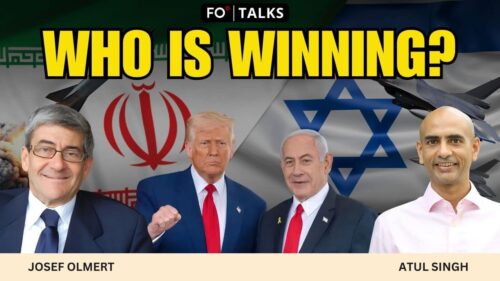
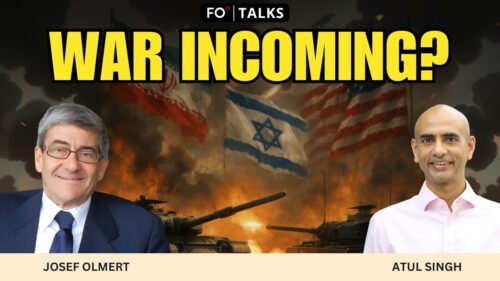
Editor-in-Chief Atul Singh and Josef Olmert, a former Israeli government official and Middle East scholar, discuss the fragile ceasefire between Israel and Hezbollah, and the unresolved questions it leaves behind. The truce may reduce immediate fighting in southern Lebanon, but Olmert argues that it has not settled the strategic contest. Instead, the discussion moves from Hezbollah’s origins and Iran’s regional strategy to Israel’s military dilemmas, Lebanon’s humanitarian crisis and the changing nature of US–Israel relations.
A ceasefire under pressure
Olmert begins by stressing how precarious the situation remains. Just before the discussion, Israeli forces killed more than 20 Hezbollah members in an encounter several miles from the border. Hezbollah then announced that it no longer recognized the ceasefire, though it would decide its response according to circumstances.
For Olmert, this shows that the truce is not a stable political settlement. He argues that the ceasefire was forced on Israeli Prime Minister Benjamin Netanyahu by the United States as part of broader negotiations with Iran. In his view, Israel was close to weakening Hezbollah more decisively but stopped too soon. The result is a pause that may allow Hezbollah to recover rather than a turning point that changes Lebanon’s security landscape.
Hezbollah and Iran’s regional strategy
Singh asks Olmert to explain Hezbollah’s history from an Israeli perspective. Olmert responds that while the name Hezbollah emerged after Israel’s 1982 invasion of Lebanon, the movement’s roots go back earlier, particularly to Shia factions influenced by Iran’s 1979 revolution. He accepts that Israel’s occupation of southern Lebanon gave Hezbollah momentum, but insists that Iran would have backed a radical Shia movement regardless.
Singh offers a counternarrative often heard from critics of Israel: Hezbollah grew from the marginalization of Lebanon’s Shia community, the failures of the Lebanese state and the group’s provision of social services. Olmert does not deny Hezbollah’s civic role, but says that these services are funded and shaped by Iran. For him, the organization’s defining function is not Lebanese representation but Iranian strategy. He calls Hezbollah “a division in the Iranian army which is based in Lebanon.”
That framing shapes his entire analysis. Olmert sees Hezbollah as part of Iran’s plan to pressure Israel through multiple fronts. Its role in the Syrian Civil War showed that the group was willing to sacrifice Lebanese lives for Tehran’s objectives. In this view, Hezbollah’s conflict with Israel is not primarily about Lebanese sovereignty, but Iran’s regional confrontation with Israel.
The limits and purpose of force
Singh presses Olmert on what a “final blow” against Hezbollah would actually mean. Olmert clarifies that he does not believe Israel can eliminate an ideology. His goal is more limited: to weaken Hezbollah’s armed wing so thoroughly that it can no longer dominate Lebanon or determine whether the Lebanese state goes to war.
Olmert rejects the idea that Israel can dismantle every Hezbollah structure or erase its political identity. But he believes Israel can reduce its military power to the point where it no longer controls Lebanon’s strategic choices. “You can’t kill an ideology,” he says, “but you can weaken the people who bear arms in support of that ideology.”
Singh also raises the humanitarian toll in Lebanon, noting that roughly 1.2 million people have been displaced and thousands have been killed or injured. He asks whether some critics are right to see Hezbollah as a pretext for broader Israeli ambitions, including control of southern Lebanon and the Litani River. Olmert dismisses that argument, saying Israel’s desalination capacity has solved its water needs. He argues instead that Hezbollah created the crisis by attacking Israel after October 7, 2023, and that democracies must be strong enough to defeat forces that threaten their existence.
Lebanon after Hezbollah
The discussion turns to what a durable settlement would require. Singh states that many Israelis privately believe the way forward must combine military neutralization of Hezbollah with reconstruction of the Lebanese state. Olmert agrees.
In his view, Israel should withdraw fully to the international border once Hezbollah is no longer able to dictate Lebanon’s security policy. He also calls for a stable buffer zone up to the Litani River, monitored by forces more effective than the United Nations Interim Force in Lebanon. Beyond that, Lebanon would need international support and, potentially, Israeli cooperation to rebuild.
Yet Olmert sees a central obstacle: Lebanon remains difficult to govern because of corruption, sectarian patronage and Hezbollah’s power. Singh emphasizes that elite politics and dysfunction also predate Hezbollah. Olmert accepts this but insists that no serious peace is possible while Hezbollah retains the ability to prevent Lebanon from making sovereign decisions.
The old US–Israel relationship is gone
The conversation ends by widening the frame to US–Israel relations. Singh notes growing Democratic opposition to Israeli military action and changing attitudes among younger Americans. Olmert agrees that the old bipartisan consensus has eroded. He points to demographic changes, social media, the rise of Muslim political influence and polarization inside both US parties.
Olmert is especially critical of Netanyahu’s relationship with US President Donald Trump. He argues that Netanyahu has become too personally dependent on Trump, weakening Israel’s strategic autonomy. Trump’s public demand that Israel stop bombing Lebanon, Olmert says, exposed a troubling imbalance between the two leaders.
Still, Olmert does not reduce the problem to Netanyahu alone. He argues that the broader US–Israel relationship must be rebuilt for a new political era. “The old relationships are dead,” he says. A different Israeli government, he suggests, would find it easier to negotiate that new formula, though he acknowledges that if Netanyahu wins again, that too is democracy at work.
For Singh and Olmert, the ceasefire is therefore only one piece of a larger puzzle. Hezbollah remains powerful, Lebanon remains fragile, Israel remains divided and Washington is no longer the partner it once was. The truce may hold, but the conflict’s deeper causes remain unresolved.
[Lee Thompson-Kolar edited this piece.]
The views expressed in this article/video are the author’s own and do not necessarily reflect Fair Observer’s editorial policy.






























Comment