


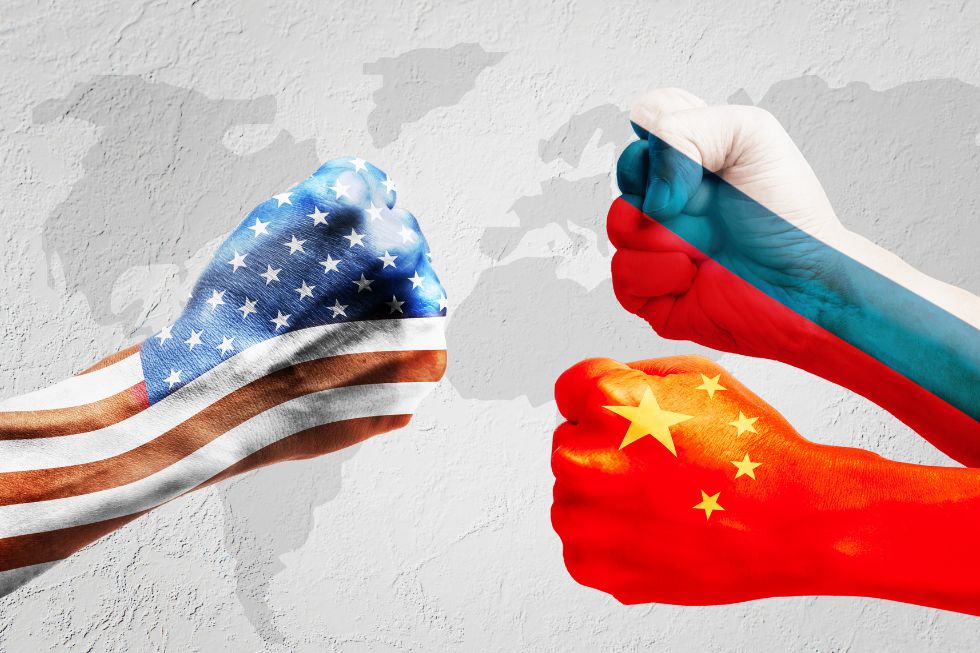




In the 21st century, great power competition increasingly resembles a vast fortress. The stability of this fortress does not depend solely on the strength of its walls, but on control over the gates through which resources, capital, ideas and military power flow. For much of the post-Cold War era, the US stood at the center of this structure, managing the principal entrances to the global system through its alliances, trade networks and the infrastructure of the US dollar-based financial order.
Today, however, rival powers are probing those gates. Rather than attempting to overthrow the system directly, China and Russia are expanding influence along their strategic corridors — regions where multiple interests and means intersect, e.g., energy, maritime routes, military positioning and financial networks. The emerging rivalry between the US and the China–Russia partnership is therefore less a single confrontation than a distributed competition unfolding across multiple regions simultaneously.
Understanding this competition requires looking beyond traditional geopolitical maps. The international system now operates through interconnected physical and financial infrastructures: shipping lanes, commodity supply chains, payment systems, energy corridors and technological networks. But these networks are inseparable from military strategy; naval deployments protect sea lanes while air and missile defenses secure regional balances. Strategic basing and force projection shape the security of trade routes and energy infrastructure.
Power increasingly flows through these interconnected channels. The states that influence them shape not only regional politics but the broader architecture of the global order.
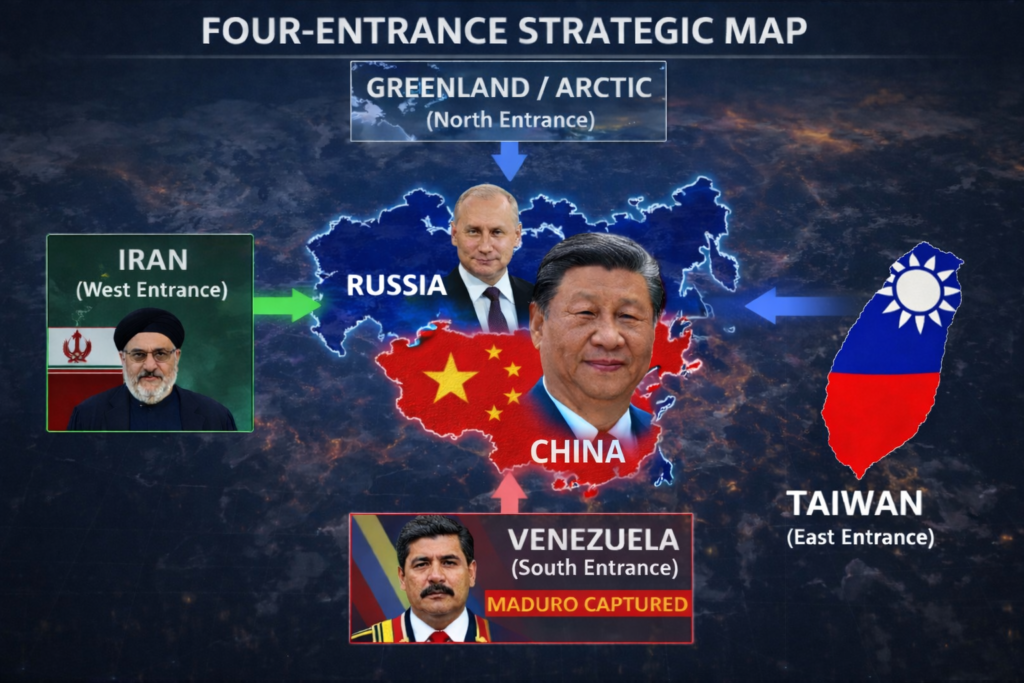
One way to understand this evolving contest is through what might be called the Four Gateways Strategic Framework. This framework identifies four regions where geopolitical competition, economic infrastructure and military positioning converge: the Western Hemisphere, the Middle East, the Arctic and the Indo-Pacific. Each of these strategic gateways functions as a corridor through which rival powers can project influence across the international system.
For the US, these gateways represent critical pressure points. Securing them requires more than military power alone. It demands a coordinated strategy combining alliances, economic statecraft, energy diplomacy, financial leadership and credible military deterrence.
The architecture of power
For decades, the US has occupied a uniquely central position in the international system. Its influence rests not only on military strength but also on the institutional infrastructure of global finance. The US dollar serves as the dominant currency for international trade, financial reserves,and cross-border settlement. American capital markets remain the deepest and most liquid in the world. Global banks rely heavily on dollar clearing and correspondent banking relationships tied to US financial institutions.
This architecture gives Washington powerful tools of economic statecraft. Financial sanctions, for example, derive their strength from the ability to restrict access to dollar transactions and the institutions that support them.
Yet the architecture of dollar power is layered rather than monolithic. It consists of multiple components: safe assets, liquid capital markets, correspondent banking networks, derivatives markets, reserve holdings and global payment systems. Because of this layered structure, rival powers do not need to overthrow the dollar system outright in order to weaken American leverage. Instead, they can attempt to bypass or erode specific operational layers — especially those linked to sanctions enforcement and cross-border payments.
China and Russia have increasingly explored such alternatives. These include local-currency energy trade, bilateral financial arrangements and alternative payment systems designed to reduce dependence on Western-controlled financial infrastructure. These efforts remain limited compared to the scale of the US dollar-based system, but they illustrate how geopolitical rivalry increasingly intersects with financial architecture.
But the same layered logic applies to military strategy. Just as the financial system operates through interconnected infrastructures, so too does military power rely on logistics networks, forward bases, naval chokepoints and alliance structures. The strategic gateways of the international system are therefore not merely economic corridors — they are also potential theaters of military competition.
The four strategic gateways illustrate where these dynamics are most visible:
What makes a strategic gateway?
Not every region of the world functions as a strategic gateway. A gateway emerges where multiple systems of power intersect, and typically includes four elements: geographic access, economic infrastructure, military positioning and financial connectivity. Regions that combine these characteristics become corridors through which global influence can be projected.
Geographically, strategic gateways sit along major transportation routes or chokepoints that shape the movement of goods and energy. Economically, they connect key resource flows, supply chains or financial networks that sustain the global economy. Militarily, they often host forward bases, naval routes or strategic terrain that enables states to project force across regions. Financially, they intersect with global trade settlement systems, energy markets and sanctions regimes that structure the operation of the international economic order.
The strategic logic of gateway control is not entirely new. One of the earliest examples appears in the Monroe Doctrine of 1823, which asserted that external powers should not expand their political influence in the Western Hemisphere. Although framed as a defensive principle, the doctrine effectively defined the Western Hemisphere as a strategic gateway region whose political alignment and security were considered vital to the US. By discouraging European intervention in the Americas, the Monroe Doctrine sought to prevent rival powers from gaining footholds near US territory that could threaten the country’s long-term strategic position.
In the 21st century, elements of this logic have reappeared in contemporary US strategic thinking and actions. Based on policy discussions and reporting from late 2025 and early 2026, the administration of President Donald Trump — following his return to office — advanced what some observers described as the “Donroe Doctrine,” or the Trump Corollary to the Monroe Doctrine. This approach is widely interpreted as representing a modern reinterpretation of the original doctrine, aimed at reasserting American strategic primacy in the Western Hemisphere in the face of growing Chinese and Russian influence.
Unlike the 19th-century Monroe Doctrine, which focused primarily on preventing European colonization, this updated doctrine emphasizes preventing rival powers from establishing strategic footholds through infrastructure investment, energy partnerships, financial networks or military cooperation within the region. In practice, this approach reflects a broader recognition that great power competition increasingly unfolds not through direct territorial conquest but through control of critical corridors (or the strategic gateways) that shape global trade, energy flows and financial systems.
More broadly, what some analysts also describe as the Trump Doctrine emphasizes economic sovereignty, great-power rivalry and the use of sanctions, tariffs and military pressure to defend American strategic interests. This perspective recognizes that geopolitical competition increasingly occurs along the infrastructure networks that sustain globalization — shipping routes, energy pipelines, financial systems and technological supply chains.
The concept of strategic gateways builds on this logic. Certain regions become critical not merely because of their geographic location but because they sit at the intersection of military strategy, economic infrastructure and financial power. Control over these corridors enables states to influence the flow of global commerce, the security of energy supplies and the stability of financial systems.
The four regions examined in this article — the Western Hemisphere, the Middle East, the Arctic and the Indo-Pacific — represent areas where all of these dimensions converge. Each functions not only as a geographic space but as a strategic corridor linking military power, economic infrastructure and financial influence within the international system. Together, they form the principal gateways through which contemporary great-power competition is increasingly being conducted.
The Southern Gateway: Venezuela and strategic competition in the Western Hemisphere
The first gateway lies in the Western Hemisphere, where Venezuela has become an important node in the geopolitical relationship between China, Russia and the US.
Over the past two decades, China has provided Venezuela with substantial financial support through oil-backed loans and infrastructure investment. These arrangements allowed Beijing to secure long-term access to energy supplies while expanding its presence in Latin America. Russia reinforced this relationship through military cooperation, intelligence ties and investment in Venezuela’s energy sector.
For the Maduro government, these partnerships provided crucial support during periods of economic crisis and diplomatic isolation. For China and Russia, Venezuela offered a strategic foothold in a region historically dominated by the US.
The Venezuelan case also illustrates the limits of economic sanctions. Despite extensive restrictions imposed by Washington, Venezuelan oil exports continued through complex networks of intermediaries, shadow shipping fleets and indirect trading channels. These mechanisms demonstrated how sanctions can be partially circumvented when targeted states retain access to alternative markets and logistical support.
Yet Venezuela also illustrates the continuing role of military power in shaping geopolitical outcomes. On January 3, 2026, US forces executed Operation Absolute Resolve, a covert military operation in Caracas that resulted in the capture of Venezuelan President Nicolás Maduro and his wife, Cilia Flores, on charges related to narcotics trafficking and narcoterrorism. The raid, conducted by US special operations forces after months of planning, removed one of Washington’s most entrenched regional adversaries and underscored the US’s continued willingness to employ direct military force in the Western Hemisphere.
The episode demonstrates that the Southern Gateway remains both a geopolitical and military arena. Influence in the Western Hemisphere depends not only on economic engagement and political partnerships but also on the credibility of US security capabilities in the region.
The Western Gateway: Iran and the Middle Eastern strategic corridor
A second gateway lies in the Middle East, where Iran occupies a central position in the evolving geopolitical alignment between China and Russia.
Iran sits at the crossroads of multiple strategic systems: energy production, maritime trade routes, regional security dynamics and Eurasian connectivity. It also remains one of the most heavily sanctioned economies in the world.
China has emerged as Iran’s largest trading partner and a major purchaser of its oil. Russia has deepened military cooperation with Tehran, particularly following the war in Ukraine. These relationships illustrate how geopolitical alignment can reinforce economic resilience under sanctions pressure.
Recent developments have further intensified the region’s strategic volatility. As of March 2026, Iranian Supreme Leader Ayatollah Ali Khamenei was killed in a joint US-Israeli air strike targeting senior Iranian leadership during a period of escalating regional conflict. The operation triggered a succession process that elevated Mojtaba Khamenei as the new Supreme Leader, while retaliatory actions across the region produced more than a thousand casualties and heightened instability across the Middle East.
These events underscore the military dimension of the Western Gateway. The Middle East remains a region where energy markets, naval chokepoints such as the Strait of Hormuz, missile and drone warfare, and great-power competition intersect. Control over these corridors affects not only regional security but also global energy flows and financial stability.
The Northern Gateway: the Arctic and the future geography of trade
The third gateway lies in the Arctic, a region whose strategic importance is growing as climate change accelerates the retreat of polar sea ice. The opening of Arctic shipping routes could significantly shorten transit times between Asia, Europe and North America. At the same time, the Arctic contains substantial deposits of oil, natural gas and critical minerals increasingly important for advanced manufacturing and energy technologies.
Recent geopolitical developments have highlighted the region’s growing strategic value. In 2019, and again during his second presidency, Trump proposed that the US acquire Greenland, arguing that control of the island was vital for US national security and Arctic strategy. The proposal intensified in 2025–2026, with Washington pressing Denmark and Greenland while framing the acquisition as necessary to counter the expanding Russian and Chinese influence in the Arctic.
Russia has already moved aggressively to expand its presence in the region, reopening Soviet-era military facilities and strengthening its control over the Northern Sea Route. These deployments include new Arctic brigades, expanded air defense systems and upgraded naval infrastructure.
China, while geographically distant from the Arctic, has pursued a strategy of economic engagement through research programs, investment projects and partnerships tied to resource development.
The Arctic, as the Northern Gateway, therefore represents an emerging frontier where logistics, resource extraction and military reach intersect. Control over Arctic infrastructure — including strategic territories such as Greenland — could gradually reshape global shipping patterns and supply chains while altering the strategic balance of naval power in the Northern Hemisphere.
The Eastern Gateway: Taiwan and the Indo-Pacific balance
The fourth gateway lies in the Indo-Pacific, where Taiwan remains one of the most consequential flashpoints in global politics. China views Taiwan as a breakaway province and has intensified military pressure through naval exercises, air incursions and gray-zone operations designed to test the island’s defenses and the credibility of American security commitments.
US policy debates have also reflected the possibility of direct military escalation. During private remarks reported in the media, President Trump claimed he warned Chinese leader Xi Jinping that the US would “bomb Beijing” if China invaded Taiwan, framing the threat as a deterrent against a potential attack.
At the same time, Taiwan occupies a central position in the global technological economy. The island produces a large share of the world’s advanced semiconductors, which are essential for everything from consumer electronics to artificial intelligence and advanced weapons systems, largely through firms such as Taiwan Semiconductor Manufacturing Company.
A crisis in the Taiwan Strait would therefore have global consequences. It would disrupt maritime trade routes, trigger economic sanctions and export controls, and potentially fragment financial and technological supply chains. Military escalation could also draw in regional allies and reshape the security architecture of the Indo-Pacific.
The Eastern (Taiwan) gateway thus represents the most advanced form of geopolitical convergence — where military operations, technological supply chains, financial sanctions and maritime security all interact simultaneously.
Distributed competition in a fragmenting world
Taken together, the four gateways reveal how contemporary great power competition differs fundamentally from earlier eras. During the Cold War, strategic confrontation was concentrated largely in Europe, where the geopolitical divide between NATO and the Warsaw Pact defined the central theater of global rivalry. Although conflicts occurred in other regions, the strategic balance of power was primarily determined by military deployments and political alignments on the European continent.
Today, however, competition among major powers is geographically dispersed and functionally interconnected. Rather than focusing on a single strategic theater, rivalry now unfolds simultaneously across multiple regions and domains. China and Russia increasingly pursue influence through coordinated diplomatic, economic, technological and military initiatives that span across the world. By expanding their presence across the Strategic Gateways, they create a pattern of distributed pressure against the US and its alliance network. These actions do not necessarily aim at immediate territorial conquest; instead, they seek to gradually reshape regional balances of influence, secure access to strategic resources and weaken the cohesion of US-led institutions.
The result is a form of competition more diffuse and multidimensional than the bipolar confrontation of the 20th century. Infrastructure investments, energy diplomacy, arms transfers, technological supply chains and military deployments now operate together as instruments of geopolitical influence. Developments in one region can quickly reverberate across others — for example, shifts in Arctic shipping routes can affect global trade patterns, while tensions in the Taiwan Strait could disrupt semiconductor supply chains and financial markets worldwide.
This evolving landscape significantly complicates American policymaking. Each gateway presents a distinct set of challenges requiring different policy tools and institutional responses. In Latin America, the US may emphasize economic engagement and protection of critical infrastructure such as maritime transit routes. In the Middle East, sanctions enforcement and energy security remain central. In the Arctic, military presence and infrastructure development intersect with environmental change and emerging shipping routes. In the Indo-Pacific, deterrence and alliance coordination play a central role in maintaining regional stability.
Managing these simultaneous pressures requires the US to coordinate across diplomatic, economic, technological and military domains while maintaining strong partnerships with its allies. The effectiveness of American strategy will therefore depend not only on military capabilities but also on the ability to sustain a resilient network of alliances and institutions capable of responding to a geographically dispersed and strategically interconnected form of great-power competition.
Securing the gates
The emerging geopolitical contest is therefore not only about territory or military balance; it is about control over the corridors through which the global system operates.
Energy shipments pass through maritime chokepoints. Financial transactions move through payment networks and banking systems. Commodity supply chains depend on shipping routes and logistical infrastructure that link regions across the world.
For the US, maintaining leadership in this system requires more than defending the center of the international order; it requires securing the Strategic Gateways themselves.
In the Western Hemisphere, that means strengthening partnerships and maintaining credible regional security capabilities. In the Middle East, it requires managing the intersection of energy markets, military deterrence and regional stability. In the Arctic, cooperation with allied states will shape the governance of emerging shipping routes and strategic resources. In the Indo-Pacific, maintaining credible deterrence around Taiwan remains essential to preserving regional balance.
At the same time, safeguarding the integrity of the US dollar-based financial system requires continued confidence in American institutions, transparent capital markets and resilient global payment networks.
The future of the international order will depend not only on who occupies the center of the fortress, but on who secures its gates. In an era when power flows through shipping lanes, financial networks, energy corridors and technological supply chains, the gateways of the global system may prove just as decisive as its walls.
[Kaitlyn Diana edited this piece.]
The views expressed in this article are the author’s own and do not necessarily reflect Fair Observer’s editorial policy.
Taiwan, China and the US: Not Playing a Tit-For-Tat Game
The Pentagon forecasts a Chinese invasion of Taiwan by 2027. Taiwanese President Lai Ching-te has thus proposed massive defense spending...
FO° Talks: Great Power Competition Is Back: How the US Plans to Deter China and Russia
In this episode of FO° Talks, Atul Singh and Evan Munsing discuss why US national security is tightening around two...
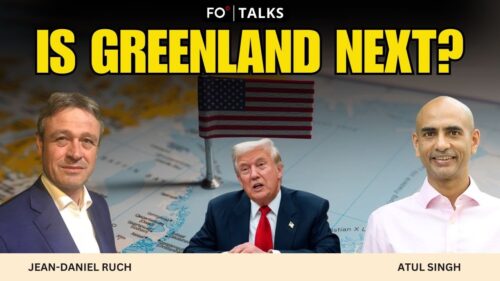
FO° Talks: Trump’s Art of the New Deal: Greenland, Russia, China and Reshaping Global Order
In this episode of FO° Talks, Atul Singh and Jean-Daniel Ruch explore US President Donald Trump’s “Art of the New...
The Emergence of the New World Order and the Decline of the US
The current world order is undergoing several geopolitical upheavals that are reshaping world politics to carve out a new order...
Support Fair Observer
We rely on your support for our independence, diversity and quality.
For more than 10 years, Fair Observer has been free, fair and independent. No billionaire owns us, no advertisers control us. We are a reader-supported nonprofit. Unlike many other publications, we keep our content free for readers regardless of where they live or whether they can afford to pay. We have no paywalls and no ads.
In the post-truth era of fake news, echo chambers and filter bubbles, we publish a plurality of perspectives from around the world. Anyone can publish with us, but everyone goes through a rigorous editorial process. So, you get fact-checked, well-reasoned content instead of noise.
We publish 3,000+ voices from 90+ countries. We also conduct education and training programs
on subjects ranging from digital media and journalism to writing and critical thinking. This
doesn’t come cheap. Servers, editors, trainers and web developers cost
money.
Please consider supporting us on a regular basis as a recurring donor or a
sustaining member.
Will you support FO’s journalism?
We rely on your support for our independence, diversity and quality.





Comment