





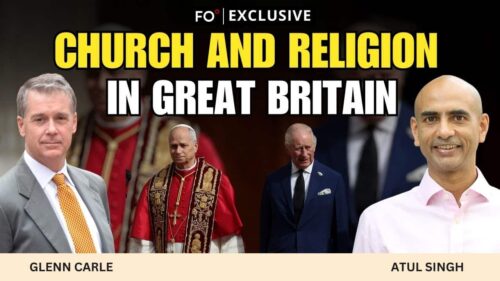
Editor-in-Chief Atul Singh and FOI Senior Partner Glenn Carle, a retired CIA officer who now advises companies, governments and organizations on geopolitical risk, dissect the Israel–Hamas ceasefire and US President Donald Trump’s 20-point “Comprehensive Plan to End the Gaza Conflict.” They weigh whether this represents genuine progress or only a temporary pause in a generational struggle.
Old patterns, new variables
Middle Eastern crises often repeat themselves: change the dates and the story stays largely the same. However, this conflict is different. After two years of fighting following the October 7 attacks in Gaza, Israel and the Sunni Palestinian group Hamas have reached exhaustion. Hamas, which won a single disputed election back in 2006, has been battered, while Israel’s politics have drifted further right. Glenn quips, “They probably won the election the way Stalin did — which was at the end of a gun … well, not probably, they did.”
The conversation turns to history. In 1993, Israeli Prime Minister Yitzhak Rabin and Palestinian leader Yasser Arafat signed the Oslo Accords for peace, but within months, Hamas carried out its first suicide bombing. Two years later, Rabin’s assassination by Jewish extremist Yigal Amir killed the peace process. Neither Hamas nor Israel’s religious right wings have changed since then.
Trump’s 20-point plan
Glenn describes Trump’s peace initiative as “imposed rather than negotiated,” but concedes that “the prospects … for a lasting peace between Israel and the Palestinians … are greater today than at any time since the Oslo Accords.” With characteristic irony, he adds that US President Woodrow Wilson’s plan had only 14 points against Trump’s 20, so we know Trump’s is the biggest and best.
Four provisions form the plan’s immediate backbone: a fragile ceasefire, Israeli troop withdrawal from half of Gaza, reciprocal hostage releases and humanitarian aid flows that Israel had long restricted. These changes are meaningful in themselves. After all, in war, an absence of casualties is typically better than mounds of them.
Trump’s approach is not diplomatic but transactional — an imposition shaped by leverage and timing. Exhaustion, public fatigue and shifting alliances created a rare window, one Trump exploited effectively, even if unintentionally. His unpredictability, often condemned by critics, paradoxically gave him the flexibility to push both Israel and Hamas when conventional leaders would have hesitated.
The new Middle East
Israel’s war effort has decimated Hamas’s fighters and tunnels, eliminating as many as 20,000 Hamas fighters and destroying 80% of the group’s vast underground network. The campaign has crippled the Lebanese Shia paramilitary group Hezbollah and accelerated Syria’s collapse. Now, Syria’s new leader, former al-Qaeda fighter Ahmed al-Sharaa (now known as Abu Mohammad al-Julani), is a proxy for the Turkish intelligence agency Millî İstihbarat Teşkilatı, or MIT. Syria is now “pockmarked like Swiss cheese,” Atul states. Glenn agrees, citing jubilant Israeli officers who told him that they’ve destroyed the whole air force.
In Israel, two-thirds of citizens now support ending the fighting. In July, the Arab League for the first time urged Hamas to disarm. This is a historic first; the Arab capitals that once tacitly supported Palestinian militancy are now openly urging restraint. Yet the real shift lies in Washington: Trump’s tight grip over Congress, unlike any president before him, lets him override the traditional pro-Israel consensus. Further, his dominance of the Republican Party enabled him to pressure Israeli Prime Minister Benjamin Netanyahu to accept a peace deal, something no previous US president managed.
Netanyahu ignored warnings from Israeli intelligence chiefs not to strike Hamas in Qatar. Far-right Minister of National Security Itamar Ben-Gvir and Minister of Finance Bezalel Smotrich pushed him to act, triggering Trump’s intervention. The result was a ceasefire that both sides accepted out of exhaustion, not reconciliation.
Domestic currents and lingering dangers
Israel’s demography is tilting power toward the ultra-Orthodox right. The secular Jewish Ashkenazi elite that once led Israel’s Mossad intelligence and the Israel Defense Forces’ special operations has fewer children and diminishing political power. Israel’s domestic politics now point further right. The ceasefire will likely prove to be a mere prelude to another round of fighting.
The plan’s second phase — lasting peace — faces towering obstacles. Hamas refuses to disarm, twisting the agreement’s language to its advantage. A proposed international stabilization force has no firm backers, and Israel rejects Turkish participation outright. Governance of Gaza is also unresolved: Hamas insists on inclusion, while Israel wants it excluded.
The reconstruction effort, projected at $50–70 billion, hinges on Saudi Arabia and other Muslim states’ cooperation — and on a “Grand Bargain” linking Saudi normalization with Israel–US guarantees against Iran and a two-state solution. Glenn warns that this would demand “years of daily cajoling, harassing, imposing,” something he doubts Trump can sustain. That vision faces hurdles at home, too, as both conservative Republicans and progressive Democrats in Congress oppose extending nuclear cooperation or security guarantees to the Saudi capital of Riyadh.
The ceasefire’s endurance will depend less on written agreements than on political will. Without consistent US engagement, regional mediation and trust-building on the ground, even the best plan risks unraveling. For now, the guns are silent, but history suggests silence rarely lasts for long. And in the Middle East, every lull risks becoming a moment of calm before the next storm.
[Lee Thompson-Kolar edited this piece.]
The views expressed in this article/video are the author’s own and do not necessarily reflect Fair Observer’s editorial policy.



























Comment