






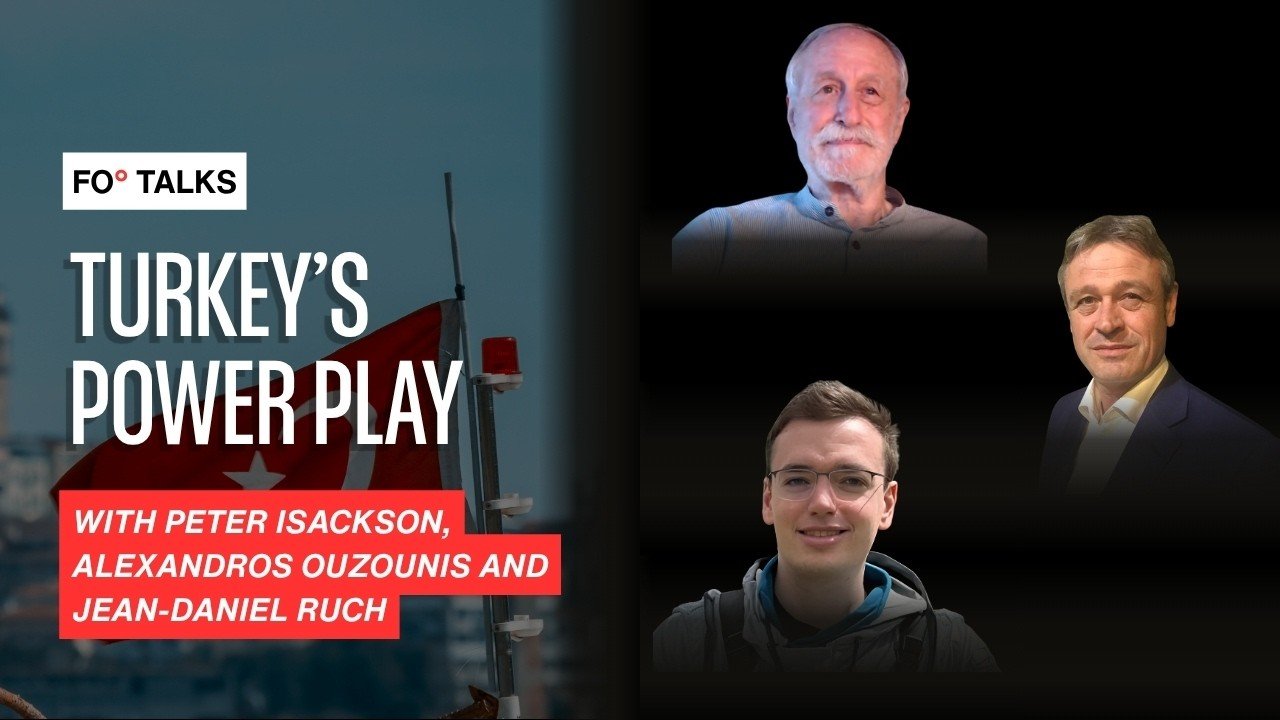
Fair Observer’s Chief Strategy Officer Peter Isackson, Editorial Assistant Alexandros Ouzounis and former Swiss diplomat Jean-Daniel Ruch discuss Ankara’s growing geopolitical influence. They examine relations with Europe and Israel, Kurdish reconciliation and maritime disputes. Ruch argues that Türkiye’s geography and diplomatic flexibility strengthen its position in a multipolar world, while domestic repression limits its appeal.
Geography gives Türkiye leverage over Europe
Drawing on Robert Kaplan’s 2012 book, The Revenge of Geography: What the Map Tells Us About Coming Conflicts and the Battle Against Fate, Ruch places Türkiye among the influential powers immediately below the United States, China and Russia. President Recep Tayyip Erdoğan has used its location to expand influence, although significant problems remain.
EU accession negotiations opened in 2005, yet Ruch sees little prospect of membership. European governments nevertheless rely on Ankara to host refugees and restrain migration. He attributes part of their resistance to anxieties about admitting a large Muslim population.
Energy adds another source of leverage. Türkiye’s pipelines and potential overland connections between the Gulf and Europe offer alternatives to vulnerable maritime routes through Hormuz and Bab el-Mandeb. For Ruch, these interests make Western cooperation with Ankara strategically necessary despite political disagreements.
Hostility does not make war inevitable
Isackson asks whether Israeli warnings about Türkiye reflect domestic political incentives rather than preparations for war. Ruch recalls longstanding commercial, tourism and intelligence connections, alongside their deterioration following the 2010 Mavi Marmara flotilla confrontation.
Türkiye’s purchase of Russian S-400 systems also damaged relations with Washington and helped its critics secure its exclusion from the F-35 program. Erdoğan’s denunciations of Israel, however, coexist with continued oil shipments through the Baku–Tbilisi–Ceyhan pipeline.
Ruch considers direct military confrontation unlikely. Competition in Syria creates friction, but Ankara values its relationship with Washington and practices “strategic patience.” Its restrained response to Israeli strikes on Syrian military facilities demonstrates that approach.
He portrays Syrian leader Ahmed al-Sharaa as heavily dependent on Ankara. In his assessment, Washington underestimates that dependence when seeking Syrian cooperation against Hezbollah. Israel’s expanding military positions around Mount Hermon and southern Syria remain a deeper concern.
Kurdish reconciliation creates an uncertain opening
Ouzounis asks how renewed negotiations with the Kurdistan Workers’ Party, or PKK, affect southeastern Türkiye and northeastern Syria. Ruch emphasizes that Ankara treats the conflict primarily as a domestic security issue.
He traces restrictions on Kurdish language and culture to earlier Kemalist governments, while crediting Erdoğan’s initial years with expanding cultural rights and pursuing peace. That process collapsed amid renewed violence and Turkish concerns about Kurdish armed organizations in Syria.
The present opening rests on disarmament in exchange for amnesty, supported by imprisoned PKK leader Abdullah Öcalan’s call to end armed struggle. Ruch says the momentum is positive but warns that reconciliation remains unfinished and reversible.
Kurdish voters also have divergent allegiances. Conservative religious voters support Erdoğan’s party, while others favor leftist Kurdish movements. Ruch therefore rejects treating Kurdish politics as a single bloc, and considers maritime disputes more pressing for Ankara today.
Maritime compromise requires political security
For Ouzounis, disputes with Greece involve both maritime boundaries and dangerous encounters in the air. Ruch expects NATO membership and American intervention to help contain escalation.
Unresolved exclusive economic zones and competing drilling claims present the larger diplomatic challenge. He views Türkiye’s sweeping maritime agreement with Libya partly as bargaining tactics designed to strengthen Ankara’s negotiating position.
Historical trauma, including population exchanges associated with the Treaty of Lausanne, makes compromise politically hazardous. Ruch believes an agreement requires leaders with secure mandates, credible mediation and arrangements allowing all parties to benefit from energy resources.
US President Donald Trump’s rapport with Erdoğan could help, although Washington has competing priorities. Ruch criticizes US Special Envoys Jared Kushner and Steve Witkoff’s diplomatic record and sees greater potential in experienced regional representatives.
Regional power cannot erase democratic failures
Regarding Gaza, Ruch sees stalled political arrangements and insufficient humanitarian relief. He doubts that changing Israel’s leadership alone will produce Palestinian sovereignty. Türkiye’s role in Somalia also creates another arena of competition as Israel develops ties with Somaliland.
Proposals for a Palestinian administration and an international stabilization force remain blocked. Ankara’s willingness to contribute troops meets Israeli resistance. Ruch argues that progress requires sustained American pressure, while refusing to predict the outcome of Israel’s next uncertain electoral contest.
Looking ahead, he identifies Saudi Arabia, Iran and Houthi activity in the Red Sea as potential drivers of regional change. Isackson questions America’s remaining soft power; Ruch counters that its films, universities and brands retain influence, even as its ability to dictate outcomes declines.
He closes by calling Türkiye “far from a perfect democracy.” Imprisoned political figures and Ankara’s refusal to implement European Court of Human Rights rulings concerning Turkish economist Osman Kavala undermine relations with Europe. Türkiye’s geopolitical gains cannot substitute for domestic credibility.
[Lee Thompson-Kolar edited this piece.]
The views expressed in this article/video are the author’s own and do not necessarily reflect Fair Observer’s editorial policy.




























Comment