






[This is the first part of a five-part series adapted from Dr. Noa Gafni’s report, The New Five Forces: A Blueprint for Business in an Uncertain World.]
We are living in an era defined by volatility. The frameworks we rely on in boardrooms were built for a different era, one that assumed markets were stable, competition had clear boundaries and the forces shaping industries moved slowly enough to be planned around. The forces of technology, geopolitics, society, environment and economy are disrupting all organizations, and their convergence is creating an increasingly complex operating environment.
But technology is no longer a function. Geopolitics is political alignment material. Society is holding institutions accountable in new ways. The environment has moved from corporate social responsibility to core business risk. And the economy is increasingly volatile. But executives do not have a systematic method to navigate this complexity.
In 1979, Michael Porter published a framework, the Five Forces, which was considered the benchmark for how to “win” in business. It claims that there are five forces that determine how value is captured. Those forces are the threat of new entrants, the bargaining power of suppliers, the bargaining power of buyers, the threat of substitute products or services and the intensity of rivalry among existing competitors.
The five forces framework was transformative. It simplified and streamlined how organizations perceived their market positioning, and enabled them to act accordingly. For a generation of CEOs, it became the foundational lens for understanding competitive strategy.
Over the years, some have critiqued Porter’s framework. But many more are realizing that companies with dominant market positions have been failing. In many cases, the cause was not pressure from within the industry but a force from outside it. Lehman Brothers did not fail because a rival investment bank outcompeted it, but because its models grossly underestimated macroeconomic shifts. Nord Stream’s natural gas pipeline from Russia to Europe was profitable and strategically positioned, but the Russia–Ukraine war made it politically untenable. And BuzzFeed did not lose to better journalism, but because its dependency on Facebook meant that the company lost its edge when the algorithm changed.
Macro factors have been impacting companies more than industry competition. This is the observation from which the “New Five Forces” emerged. Winning within a particular industry is important, but no longer sufficient. Executives must rethink how a company survives and thrives when the forces most likely to threaten it come from outside its industry.
The New Five Forces, outlined here, is a strategic framework for the defining pressures of this moment. They are Technology, Geopolitics, Society, Environment and Economy. Unlike frameworks that map competition within industries, this new framework maps the macro forces reshaping all industries concurrently.
This is not the first framework to explore macro implications. But analyses such as PESTLE (Political, Economic, Sociological, Technological, Legal, Environmental) break down these elements in discrete and disconnected ways. Macro forces do not operate in isolation. And the organizations navigating this era well are the ones that understand how they interact and compound.
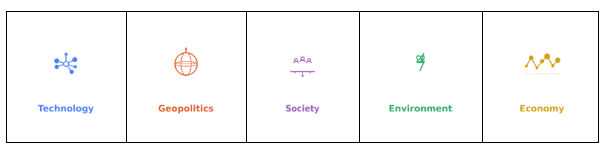
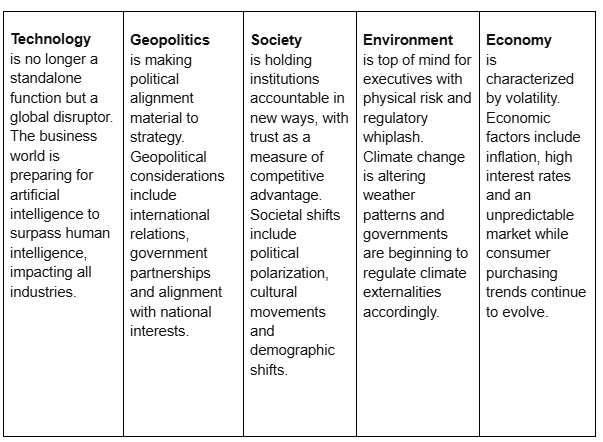
This series examines each of the New Five Forces in order to illustrate their strategic implications. Along the way, it draws on cases ranging from the geopolitical exposure that reshaped Taiwan Semiconductor Manufacturing Company to the supply chain collapse that caught Shein and the force convergence that e.l.f. Beauty navigated into a position of strength. It draws from their experience to highlight principles that are applicable across industries, geographies and audiences.
Each case is born from the question, “How can leaders prepare for an increasingly volatile world?” This series argues that it is a framework problem. Leaders who look inward at their industries are missing the forces reshaping their future from outside them. Porter gave us a framework for winning within a stable world. The New Five Forces is a framework for navigating the turbulence of our current age.
We will begin exploring these forces with Technology.
The first force: Technology
Technology has always been a competitive variable. Prior technological shifts unfolded over decades, which gave organizations time to adapt. The Industrial Revolution took over a century to integrate. The shift from mainframes to personal computing took roughly 20 years. The shift from desktop to mobile took approximately ten. The current AI shift is moving across industries in mere months. The current wave of AI-driven transformation is compressing that timeline.
Organizations that survived previous waves of technological disruption were flexible enough to absorb change when it arrived. They excelled at rebuilding their value propositions around what the new technology made possible, by redeploying people and reconfiguring processes. The organizations that did not survive had optimized so thoroughly for the systems, workflows and models they already had that absorbing new ones felt impossible.
This matters at a time when AI capabilities are advancing faster than regulatory frameworks, talent pipelines or organizational governance. And it is the primary differentiator between organizations that will lead this transition as opposed to being absorbed by it.
Technological upheaval in the legal industry
Entire professional categories are being redefined by capabilities that endanger cost structures, delivery models and value propositions. This is not incremental, but a structural repricing of what knowledge is worth. Unlike previous technological waves, which disrupted manufacturing and logistics, this one has arrived first at white-collar industries.
Few industries highlight the challenges presented due to the forces of Technology as much as the legal sector does. Large law firms have been operating on billable hours for decades. The labor intensiveness of legal research and document review created a structure in which revenue aligned with hours worked. Disruption from within the industry was cosmetic, like digitizing records or building online libraries. They made the industry more efficient but did not impact the underlying business model.
Generative AI, with tools capable of legal research, contract analysis and due diligence, undermined the economic logic of the billable hour model. In mere hours, these LLMs could complete tasks that previously required a team of associates working for two weeks. It suddenly compressed the unit of value for the legal industry.
The firms that recognized this quickly integrated AI into workflows while reframing their value proposition towards transparent client relationships and sound judgment. Several leading firms formalized partnerships with AI providers to support document review, legal research synthesis and first-draft contracts. The early signal from those integrations was that lawyers could use AI as a thought partner, not a substitute.
Firms that did not adapt quickly experienced challenges. Corporate legal departments began building more in-house capacity as AI compressed the time legal work required. The traditional relationship with firms faced a model where the client could do more themselves.
The competitive threat came not from another law firm, but from underestimating the abilities of today’s technologies. Although AI will not eliminate law firms, this is a prime example of how the organizations that integrate technology thoughtfully will emerge stronger, and those that try to defend existing models will not.
Every sector that generates value primarily through knowledge workers, from accounting and consulting to medicine and education, is facing a version of this transformation. These sectors must reflect on their unique human contribution and focus on it rather than the tasks that technology now performs more effectively. The Technology force rewards the organizations that most clearly understand how they can collaborate effectively with AI, now that it has arrived.
Key takeaways
- AI is a structural disruptor. The legal industry case shows that AI can make existing business models, like billable hours, economically untenable. Companies that utilize AI as a productivity tool are missing the bigger picture.
- Proactive adaptation has a short window. Unlike previous technological waves, the current AI shift is moving in months. Delaying integration could have dire consequences for your business.
- Identify your organization’s uniquely human contribution. Every knowledge-worker industry must ask what value it delivers that AI cannot replicate and rebuild its value proposition around that.
- Integrate AI as a thought partner. The firms that will thrive are ones who will use AI to client relationships and strategic thinking. This means using good judgment and not just taking AI output at face value.
- Ensure talent stays current. Organizations need to build AI fluency at every level, not just within technical teams. All employees must be skilled, reskilled and upskilled on an ongoing basis.
Anthropic: the New Five Forces converge
The New Five Forces both converge and compound. Strategic failures are almost never the result of a single force impacting a well-prepared organization. They are the result of two or more forces arriving simultaneously in ways that the organization could not absorb. The biggest challenges emerge when a geopolitical disruption amplifies an economic one, or a societal shift accelerates a technological one, or an environmental event exposes a supply chain under geopolitical pressure.
The good news is that force convergence is a source of opportunity in addition to risk. For organizations that recognize and respond to it in real time, the New Five Forces framework can support competitive advantage. When an organization addresses multiple forces simultaneously, it creates value that single-force competitors cannot easily replicate. The organizations examined in this and similar sections across these articles have done exactly that. They successfully navigated force convergence and turned it into a source of strength.
Anthropic was founded in 2021 by former OpenAI researchers who believed the most important aspect of building AI was to do so safely. The founding thesis that safety and capability are complementary has positioned Anthropic at the intersection of all the New Five Forces. As the company moves towards an IPO, each force is simultaneously accelerating its strategic importance and increasing its operational complexity, creating force convergence at scale.
Anthropic operates at the bleeding edge of the Technology force as one of the most consequential companies shaping the future. The Claude model is known for its more “human” and “approachable” style. The company’s enterprise product suite is being deployed across legal, healthcare and financial services sectors. This demonstrates that Anthropic’s safety-first approach is commercially viable as it delivers that promise alongside a superior product.
No company in the private sector has fought the Geopolitics force head-on more than Anthropic. In early 2026, Anthropic clashed with US intelligence and defense agencies over the use of its technology in war. The Pentagon subsequently designated Anthropic as a “supply chain risk” and terminated its $200 million defense contract. At a time when most tech CEOs accompany US President Donald Trump on engagements with China, the United Kingdom and others, Anthropic took a remarkably different approach.
While viewed by some as “woke,” many others saw Anthropic as taking a stand and doubling down on its founding ethos. That founding premise is a commitment to building AI without prioritizing safety. Anthropic’s safety-first brand is a genuine competitive moat. And trust, as the New Five Forces framework argues, is now a unit of competitive advantage. The Society force enabled Anthropic to survive the Geopolitics force backlash.
But AI model training and usage carries an extraordinary Environment force footprint. As regulators, investors and enterprise customers increase scrutiny on data center energy sourcing, Anthropic faces material Environment force exposure. This gap between stated values and operational impact is visible. It is in direct tension with the Economy force, as enterprise AI adoption is accelerating with significant tailwinds and Anthropic must continue to invest in superior training models.
Force convergence at scale
What makes Anthropic a compelling force convergence case is not that it is managing five separate risks but that the New Five Forces need to both be reinforced as well as managed. The Technology force creates the product. The intersection of the Geopolitics and Society forces enables Anthropic to highlight its differentiation. The Economy force creates the model, with recurring revenue and resilience ahead of a public listing. And the Environment force creates the next test. Will Anthropic be able to close the gap between its values-forward identity and the actual carbon cost of frontier AI? As it prepares to go public, it will remain an Achilles heel.
That is the pattern the New Five Forces framework consistently reveals: Organizations that build from a clear, principled thesis tend to find that the forces reinforce rather than contradict each other. The challenge for Anthropic as a public company will be whether it can sustain that coherence under the scrutiny, short-termism and capital pressure that public markets bring.
Beyond Technology
Organizations that focus only on competitors within their industry risk missing the forces reshaping their future from outside it. Technology is no longer merely a source of efficiency. It is a force capable of redefining business models, industries and competitive advantage itself.
Yet technology does not operate in isolation. As organizations adapt to AI and other emerging innovations, they must also navigate a world in which political considerations increasingly shape markets, supply chains and strategic decisions.
The next entry in this series will examine the force of Geopolitics.
[Lee Thompson-Kolar edited this piece.]
The views expressed in this article are the author’s own and do not necessarily reflect Fair Observer’s editorial policy.
The Velocity of Violence: How Technology Is Outpacing Human Command
The US/Israeli–Iran War is outpacing intelligence. Assumptions about missile ranges, stockpiles and tactics are proving wrong as strikes extend farther,...

FO Talks: Work, Identity and the Job Crisis No One Wants to Fix
In this episode of FO Talks, Peter Isackson and Vinay Singh examine how artificial intelligence, layoffs and wage stagnation are...
Can AI Take Control of Human Economic Development and Replace Humans?
Artificial intelligence drives a new industrial revolution as governments and companies compete to capitalize on its economic potential. Economists and...

Why 95% of Enterprise AI Projects Fail: The Pattern We’re Not Breaking — Part 3
The Massachusetts Institute of Technology (MIT) found 95% of corporate AI initiatives fail to deliver profit, but the real scandal...

Cyber Inflection Point: Teetering on the Edge of Technological Transition
Generative AI has accelerated the period of technological transition from a mechanical society to a cyber one. This stage of...

Support Fair Observer
We rely on your support for our independence, diversity and quality.
For more than 10 years, Fair Observer has been free, fair and independent. No billionaire owns us, no advertisers control us. We are a reader-supported nonprofit. Unlike many other publications, we keep our content free for readers regardless of where they live or whether they can afford to pay. We have no paywalls and no ads.
In the post-truth era of fake news, echo chambers and filter bubbles, we publish a plurality of perspectives from around the world. Anyone can publish with us, but everyone goes through a rigorous editorial process. So, you get fact-checked, well-reasoned content instead of noise.
We publish 3,000+ voices from 90+ countries. We also conduct education and training programs
on subjects ranging from digital media and journalism to writing and critical thinking. This
doesn’t come cheap. Servers, editors, trainers and web developers cost
money.
Please consider supporting us on a regular basis as a recurring donor or a
sustaining member.
Will you support FO’s journalism?
We rely on your support for our independence, diversity and quality.





Comment