






The 80th United Nations General Assembly (UNGA) marked a historical moment for the Israel-Palestine conflict. On September 22, France recognized the state of Palestine, following the UK and Portugal, who formally stated their recognition the day before. Yet, the lack of unity behind this gesture left Europe with no voice in the Israel-Palestine peace process. Instead, the US-brokered ceasefire deal on October 8 has sealed European recognition of Palestinian statehood as a mere symbolic gesture, reinforcing European irrelevance in the Middle East.
While the recognition of the Palestinian state has reaffirmed the UK’s and France’s commitment towards a two-state solution, it has also evoked ire from Israel’s Prime Minister Benjamin Netanyahu, who called the recognition of a Palestinian state “disgraceful” and “sheer madness” on September 26.
If European leaders hoped to deliver powerful political pressure, their strategy failed on the world stage after a mere four-day momentum. This diplomatic failure has two clear forefathers: Europe’s lack of a common policy towards Israel and its inability to act out of the US shadow.
United in dismay, divided in action
Israel’s military operations in Gaza have united Europeans in dismay and condemnation, but their responses portrayed a divided continent. For instance, while France and the UK took charge to bring Europe a step closer to the two-state solution, Germany and Italy adopted more cautious approaches.
Due to Germany’s primary role in the Holocaust, the country identifies support for Israel as its “reason of state”, thus refusing to recognize the Palestinian state. However, this did not prevent the Merz government from expressing concern and taking steps to distance itself from Israel’s handling of the war in Gaza.
In August 2025, Germany suspended shipments of weapons to Israel for use in the Gaza Strip after Israel’s Security Cabinet approved the takeover of Gaza City. The decision sparked criticism in Germany, prompting Chancellor Friedrich Merz to assume personal responsibility for the decision.
The impact of this policy is unclear. While the original export ban should have been limited, between August 8 and September 12, Germany cut new approvals for arms exports to Israel to zero. Yet, in October, Haaretz reported that between September 13 and September 22, Germany approved shipments of military goods, excluding weapons, worth $2.9 million. Second only to the United States, Germany’s arms export to Israel rose roughly 33% between 2020 and 2024, with the majority reserved for Israel’s naval forces.
Still, not only did Israel conduct a speedy advance into Gaza City before the ceasefire deal, but recent calls by parliamentary leaders of Merz’s majority to lift the arms embargo have rendered this just another mere symbolic gesture.
Another European state struggling over Gaza is Italy. In her address to the UNGA, Italian Prime Minister Giorgia Meloni affirmed her commitment to the two-state solution only after the remaining 48 Israeli hostages are freed and Hamas is out of government. Yet, general strikes and protests across the country have put Meloni in a bind from which only the US peace plan has given her some respite. Though during her speech at the UNGA, Meloni had already acknowledged that Israel had “crossed the line” and Italy would back some EU sanctions against Israel, Meloni’s judgment on Israel disappeared at the Gaza ceasefire summit.
The Gaza ceasefire summit at Sharm el-Sheikh shed further light on European divisions over Gaza. While Germany and Italy joined France and the United Kingdom, other European powers maintained a tougher stance against Israel.
On October 8, the same day the ceasefire deal was announced, the Spanish parliament enshrined into law an arms embargo on Israel. The move came a month after Spanish Prime Minister Pedro Sanchéz announced new measures to increase pressure on Israel, including banning ships carrying fuel for Israel’s armed forces from Spanish ports and increasing humanitarian aid for Gaza.
Israel responded to the announcement by sanctioning two Spanish ministers. In a diplomatic tit-for-tat, Spain banned Israel’s far-right National Security Minister Itamar Ben Gvir and Finance Minister Bezalel Smotrich from entering the country.
Along with Spain, Ireland has emerged as another outspoken critic of Israel. In May 2025, Ireland became the first European country to ban trade with Israeli-occupied territories. Yet, opposition from business representatives has prompted the Irish government to curb its planned sanctions against Israeli settlements.
Home to some of the US’s largest companies, Ireland’s businesses have urged the government against unilateral sanctions to avoid alienating US corporate investors. Ireland’s change of heart reveals that European struggles in the Middle East go beyond the realm of history and fall in the shadow of the United States.
Between a rock and a hard place: Europe’s (un)safe Middle East play
The UNGA not only witnessed the profound split amongst Europeans over Gaza, but also the increased divergence between Europe and the United States. The widening gap between the two sides of the Atlantic is starkly evident in the Middle East. While European countries have stumbled over recognizing the Palestinian state, US President Donald Trump went into the UNGA with a clear mind. Although he sided with Netanyahu on the recognition of a Palestinian state, calling it a “reward” to Hamas, Trump maintained that the war in Gaza must stop “immediately.”
On the sidelines of UNGA, Trump also met with leaders from Saudi Arabia, Qatar, the United Arab Emirates (UAE), Egypt, Jordan, Türkiye, Indonesia and Pakistan to discuss his plan to end the war in Gaza. On September 29, just a few days after these fateful meetings, Trump announced his 20-point peace plan. A little over a week later, both Israel and Hamas signed the ceasefire deal that started the first phase of this plan.
Trump’s speed in delivering a peace proposal has shown that even recognizing the Palestinian state did not save Europe from irrelevance in the Middle East. This European failure is the last in a series of policy hit-and-misses that have left Europe soul-searching in the Middle East.
While Israel’s attack on Iran in June 2025 laid bare the divisions later on full display at UNGA, the Red Sea Crisis showed that even a united Europe can undermine responses to common transatlantic challenges. The Israeli bombing of Doha was the final turning point that Europe missed out on.
Trump seized the opportunity to use his leverage on Netanyahu to stop the war, but Europe limited its response to a symbolic condemnation. The Gaza ceasefire deal put a final nail in the coffin for Europe’s policy towards Israel. While EU members deadlocked on the EU sanction package and EU Commission President Ursula von der Leyen’s proposal to suspend the EU-Israel free trade agreement, the United States sorted it out for Europe. Now, the EU not only is unlikely to push any sanctions against Israel or its ministers, but also finds itself soul-searching for both credibility and relevance.
Europe’s symbolic recognition of Palestinian statehood reveals one final tragedy. Although European states still maintain key partnerships with Arab states, they failed to capitalize on them to gain a seat at the table of the Israel-Palestine peace process. While France and Saudi Arabia co-hosted a summit at UNGA focused on the question of Palestinian statehood, a rare show of unity by France, the United Kingdom, Germany and Italy lobbied Trump to accept an alternative Euro-Arab proposal for post-war Gaza instead of the international trusteeship touted by former British Prime Minister Tony Blair.
Needless to say, this alternative did not make it into Trump’s 20-point plan for post-war Gaza. This additional failure has left European states vying for a seat at the table from the back row of the Gaza ceasefire summit.
Even if Europe finally manages to gain its spot at the peace table, it will not be because of European recognition of a Palestinian state. Rather, it will be because the United States and the Arab states have said so.
[Kaitlyn Diana edited this piece.]
The views expressed in this article are the author’s own and do not necessarily reflect Fair Observer’s editorial policy.
Western Recognition of Palestine Challenges US-Israel Position
Western governments face mounting pressure over the Israeli-Palestinian conflict as public opinion hardens and alliances shift. The UK, France, Australia,...

Italy Stands Still: Nationwide Protests in Solidarity with Gaza
Italian unions and citizens in more than 75 cities protested government inaction on the humanitarian crisis in Gaza. Dock workers...
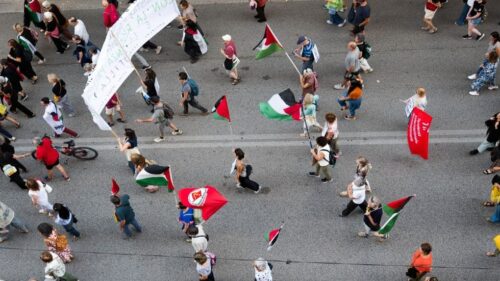
Spain Imposes Arms Embargo on Israel as Pro-Palestine Protesters Disrupt Vuelta
Pro-Palestine protesters disrupted the final stage of Spain’s Vuelta cycling race, prompting international debate about politics in sports. Spanish Prime...

Support Fair Observer
We rely on your support for our independence, diversity and quality.
For more than 10 years, Fair Observer has been free, fair and independent. No billionaire owns us, no advertisers control us. We are a reader-supported nonprofit. Unlike many other publications, we keep our content free for readers regardless of where they live or whether they can afford to pay. We have no paywalls and no ads.
In the post-truth era of fake news, echo chambers and filter bubbles, we publish a plurality of perspectives from around the world. Anyone can publish with us, but everyone goes through a rigorous editorial process. So, you get fact-checked, well-reasoned content instead of noise.
We publish 3,000+ voices from 90+ countries. We also conduct education and training programs
on subjects ranging from digital media and journalism to writing and critical thinking. This
doesn’t come cheap. Servers, editors, trainers and web developers cost
money.
Please consider supporting us on a regular basis as a recurring donor or a
sustaining member.
Will you support FO’s journalism?
We rely on your support for our independence, diversity and quality.





Comment