






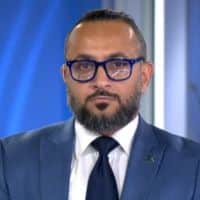

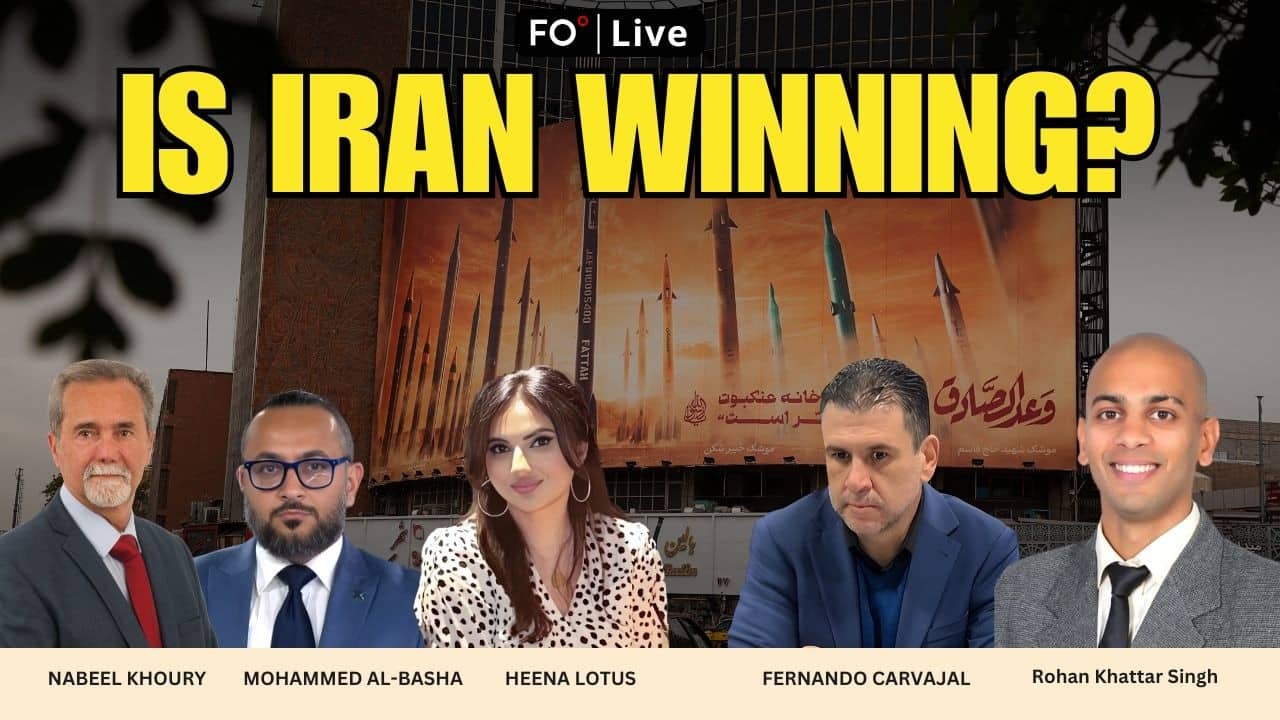
Fair Observer’s Video Producer Rohan Khattar Singh moderates a fast-moving FO Live discussion on the widening war between the United States, Israel and Iran. He is joined by Dr. Nabeel Khoury, a former US diplomat; Fernando Carvajal, executive director of The American Center for South Yemen Studies; Mohammad Basha, founder of the Basha Report; and Heena Lotus, a geopolitical analyst. Khattar Singh asks whether Washington and Tel Aviv fundamentally misread Iran’s capacity to absorb a leadership decapitation strike and still fight back. Whatever military damage Iran has suffered, the war has already exposed the limits of coercion, deepened regional instability and raised the risk of a broader conflict that no side can fully control.
A war with shifting goals
Khoury begins by questioning the coherence of the American and Israeli approach. He notes that the stated goals keep changing, especially on the US side. US President Donald Trump’s rhetoric moves from promises of a quick end to talk of an open-ended campaign, making it difficult to know what Washington is actually trying to achieve. For Khoury, that inconsistency matters because it suggests that the war is not being driven by a stable strategic framework.
He argues that Israel’s goals are clearer and more expansive. The conflict is not really about an immediate Iranian nuclear threat, but about weakening any force capable of resisting Israeli regional dominance. He links the current war to the broader trajectory of Gaza, Lebanon and Syria, arguing that force is being used not simply to deter Iran but to reorder the region. From that perspective, he warns, military escalation may temporarily damage adversaries but will not remove the political anger that generates future resistance. Violence keeps reproducing new forms of militancy rather than ending them.
Iran’s response and the failure of expectations
Khattar Singh presses the panel on the central question: Did Trump and Israeli Prime Minister Benjamin Netanyahu expect a much faster collapse of Iranian resolve? The group suggests they did. Instead of mass unrest toppling the system after the killing of Iranian Supreme Leader Ayatollah Ali Khamenei and senior figures in the Islamic Revolutionary Guard Corps, the Iranian state continues to retaliate with drones and missiles across multiple theaters.
Carvajal argues that this is now a regime-survival war for Tehran, Iran’s capital. Iran appears to have prepared for exactly this kind of confrontation and is responding in calibrated ways, including strikes on infrastructure and military targets across the Gulf. He also raises the possibility that some apparently irrational moves make more sense if Iran’s leadership believes its neighbors are also part of the threat environment. If Iran is being pushed backward, it may seek to ensure that the states around it do not emerge untouched or stronger.
Lotus goes further, arguing that Iran was underestimated during the months between the earlier 12-day war and the present crisis. She believes many regional actors assumed the US security umbrella would protect them, only to discover that alignment with Washington now carries serious liabilities. As civilian infrastructure, shipping and energy systems come under pressure, Gulf states must reckon with the costs of being drawn into a confrontation they did not choose.
Why the Houthis are holding back
A major theme in the discussion is the relative silence of the Houthis. Khattar Singh asks why Yemen’s Houthis, who had previously attacked Israel and maritime targets, have not yet entered this round of fighting with the same intensity as Hezbollah.
Al-Basha offers the most detailed explanation. He argues that the movement’s restraint reflects a combination of political calculation, financial weakness and operational vulnerability. The Houthis, he says, are cash-strapped, under pressure and eager to preserve the fragile truce with Saudi Arabia. They also do not want to hand their enemies a pretext for a renewed US–Israeli strike package while anti-Houthi forces are more coordinated than before.
Just as important, Basha says, the group wants to preserve its own agency. “The Houthi don’t want to be seen as an Iranian proxy,” he explains. They want to appear capable of choosing their own timing rather than acting automatically on Tehran’s behalf. Even so, Basha and Khoury caution that this restraint may not last. If the war drags on and Iran faces a more existential threat, the Houthis may decide they can no longer remain on the sidelines.
Khoury adds another strategic point: The Houthis know that closing major waterways would damage their own access routes as well. For now, that creates an incentive to hold back. But if the conflict becomes all-or-nothing, those calculations could change quickly.
Gulf anxiety, Pakistan’s balancing act and the risk of widening war
Lotus describes a Gulf region increasingly anxious about the consequences of a war fought in its airspace and across its infrastructure. Gulf monarchies historically aligned with the Western bloc for security, she says, but now find themselves paying the price for that alignment. If the US cannot shield them from economic and military blowback, the value of that partnership comes into question.
The discussion then turns to Pakistan. Lotus sees its capital of Islamabad as trying to maintain relations with everyone at once: Iran, Saudi Arabia, the Gulf Cooperation Council and the US. Carvajal agrees that Pakistan is walking a narrow line, constrained by its own regional rivalries and unwilling to overcommit to any one side. Both suggest that this balancing act may work only for so long if the war expands.
Carvajal also highlights a growing divergence between Trump and Netanyahu. Trump, he argues, is transactional, while Netanyahu’s confrontation with Iran is ideological and long-running. That difference could matter if Washington seeks an exit while Israel wants escalation. He also warns that even if the US steps back, the conflict may continue through proxy networks, sleeper cells and asymmetric retaliation far beyond the immediate battlefield.
Can diplomacy still work?
Khattar Singh closes by asking the question only Khoury can answer as the diplomat on the panel: How does this end? Khoury insists that diplomacy remains possible because all wars eventually end in negotiation, however bitter the path there may be. Oman and Qatar, he says, are still the most plausible mediators when the fighting subsides.
But he also argues that diplomacy cannot succeed if the underlying injustices driving regional anger remain untouched. He rejects the idea that every armed actor in the region simply takes orders from Tehran, stressing that local groups often act from their own grievances, especially over Palestine, Gaza and repeated occupation. “There is always room for diplomacy,” he concludes, but diplomacy without justice will only postpone the next war.
[Lee Thompson-Kolar edited this piece.]
The views expressed in this article/video are the author’s own and do not necessarily reflect Fair Observer’s editorial policy.



























Comment