





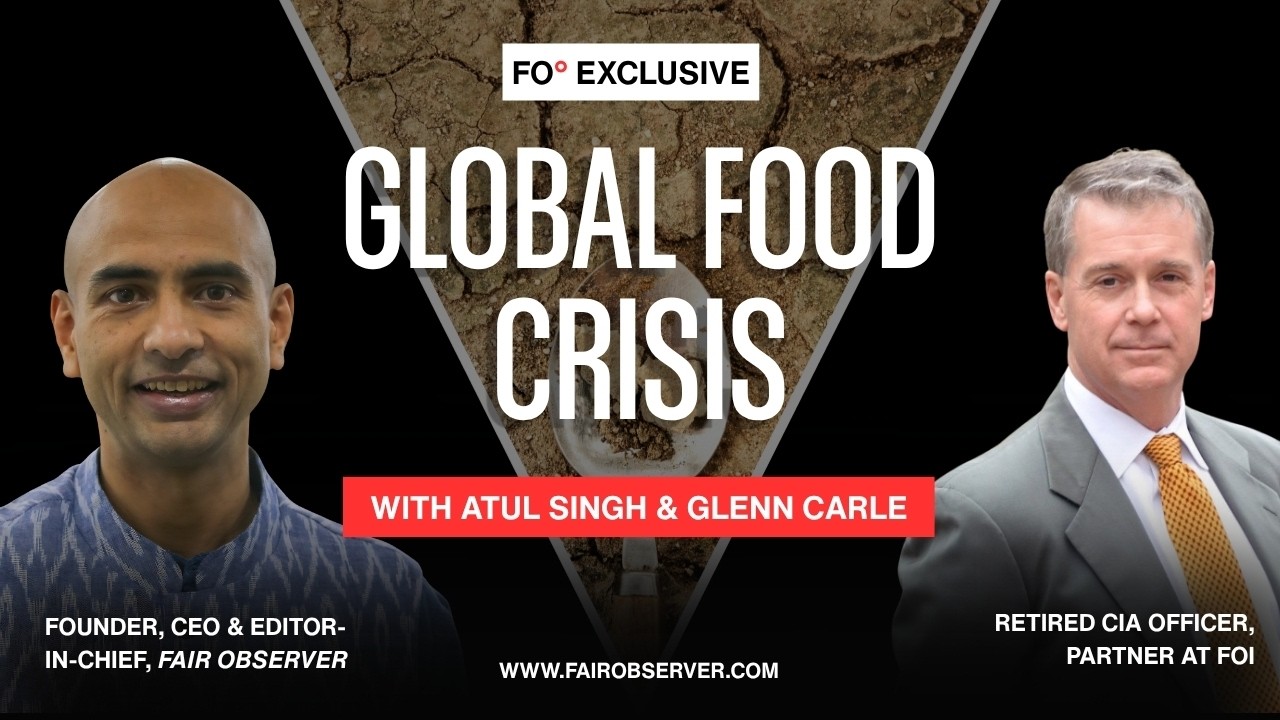
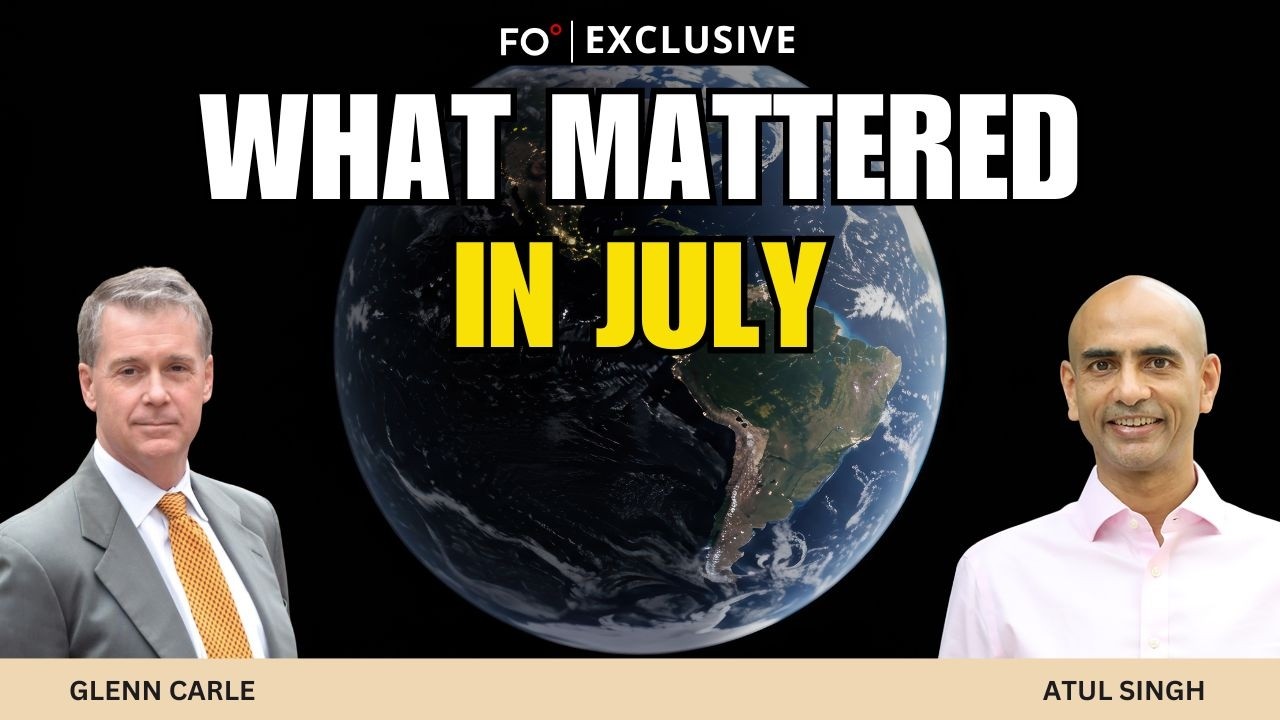
Editor-in-Chief Atul Singh and FOI Senior Partner Glenn Carle, a retired CIA officer who now advises companies, governments and organizations on geopolitical risk, examine how the US–Israeli war against Iran could precipitate a global food crisis. Disrupted energy and fertilizer supplies, rising shipping costs, weakening currencies and an exceptionally powerful El Niño threaten harvests around the world. Atul and Glenn warn that the resulting hunger could trigger social unrest, sovereign defaults and political upheaval, particularly across Africa, the Middle East and South Asia.
Food inflation threatens political stability
As pointed out repeatedly by Atul and Glenn, the Hormuz crisis has caused a massive energy and fertilizer crisis. This global crisis is increasing food inflation. Monetary policies are worsening this inflation.
International staples such as wheat, corn and soybeans are priced in dollars. As FOI has pointed out repeatedly, post-Covid monetary easing debased the dollar. As many have noticed, groceries cost far more than before.
In poorer countries, this inflation is a lot worse. Many currencies in emerging markets are depreciating against the dollar. Thanks to the exchange-rate multiplier effect, food prices are rising in many poorer countries even faster than in the US. Note that high food prices helped trigger the Arab Uprisings at the end of 2010.
Glenn emphasizes the political consequences of the upheavals in 2010. Food inflation did not single-handedly cause the Arab Uprisings. Corruption, unemployment, repression and political exclusion had already generated deep frustration. Yet rising prices transformed those grievances into household emergencies. Governments become far more vulnerable when families can no longer afford bread. As Atul says repeatedly, “revolutions depend on the price of bread.”
The same dynamic could recur. People in advanced economies will resent higher grocery bills and may vote against incumbent governments. In low-income countries, where households commonly devote around half their income to food, price increases can threaten their very survival. In such a situation, people are far more likely to take to the streets.
Hormuz disrupts fertilizers as well as fuel
With the US–Israeli war against Iran choking off the supply of fuel and fertilizers, harvests will inevitably suffer in many parts of the world. The war has caused a collapse in shipping through the Strait of Hormuz. Traffic initially fell by more than 95%. Although some vessels have resumed passage, tracked transits remain approximately 90% below prewar levels.
Many people normally associate Hormuz with energy. Around a fifth of the world’s oil and gas supply passes through the Strait of Hormuz. Disruption has raised energy prices and increased costs throughout the global economy. Diesel for tractors costs more and it costs more to transport or preserve food too.
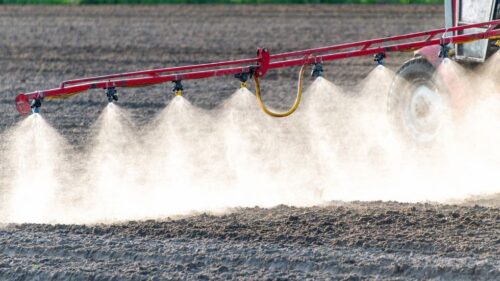
Additionally, Hormuz is also an agricultural chokepoint. Approximately one-third of the world’s seaborne fertilizer trade passes through the strait. This includes around a third of internationally traded urea and 20% of phosphate fertilizer supplies. Gulf producers also account for roughly half of global sulfur exports, which manufacturers need to transform phosphate rock into fertilizer that plants can absorb.
The loss of Gulf supplies has therefore affected both nitrogen and phosphate fertilizers. Natural gas is the principal feedstock for nitrogen-based products such as urea and ammonium nitrate. Higher gas prices make those fertilizers more expensive to manufacture even outside the Gulf. Simultaneously, lost sulfur exports constrain phosphate fertilizer production in other regions.
Global fertilizer costs have consequently risen by as much as 20%. The disruption is also forcing buyers into more expensive spot markets after suppliers canceled contracts under force majeure provisions.
Shipping expenses compound the problem. Before the war, insurance for vessels entering the Gulf could cost around 0.25% of a ship’s value. War-risk premiums later climbed as high as 10%. Insuring a $100 million vessel can therefore cost up to $10 million for a single voyage. Some insurers will not cover the journey at any price.
Glenn explains that higher energy and shipping costs affect every link in the food chain. Farmers need fuel for tractors, irrigation pumps and harvesting equipment. Producers need natural gas to manufacture fertilizer. Processors and retailers need energy for storage and refrigeration. Trucks and ships must then transport food to consumers. Energy is embedded in everything.
The Green Revolution created a new dependence
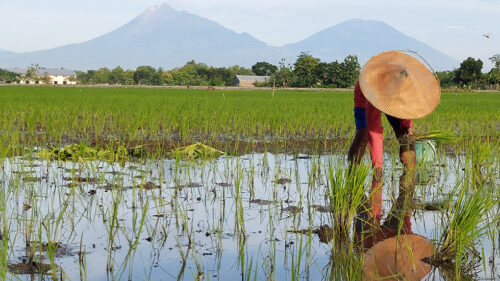
From the 1950s onwards, new high-yielding crop varieties, synthetic fertilizers, chemical pesticides and large-scale irrigation boosted the production of wheat and rice. This was called the Green Revolution, which staved off the Malthusian specter of hunger and starvation. India was a key center of this revolution and doubled its wheat production between the mid-1960s and early 1970s.
Before the Green Revolution, farmers in poorer countries relied on organic inputs such as manure and compost to maintain soil nutrients. Since this revolution, farmers have relied on large and repeated applications of industrial fertilizers, especially nitrogen-based products such as urea and ammonium nitrate. These come from natural gas. The US–Israeli war against Iran has disrupted not only their distribution but also their production. A significant part of the global fertilizer trade has come to a standstill.
Glenn observes that the Green Revolution produced an extraordinary increase in the global food supply. It enabled countries with rapidly expanding populations to avoid the famines that many experts had predicted. Yet its success also created dependence on an interconnected system of energy, fertilizer, water, credit and international transportation.
Modern agriculture can feed far more people than traditional farming, but only if those inputs remain available and affordable. When fertilizer becomes too expensive, farmers must reduce its use, switch to less fertilizer-intensive crops or absorb costs that could bankrupt them. Poorer farmers working with narrow margins have few good options.
The effects will emerge gradually. Fertilizer must be applied at particular points in the crop cycle. If it arrives too late, farmers cannot recover the lost yield. Consumers may initially continue eating grain planted before the disruption, creating the impression that the system has weathered the crisis. The damage becomes visible months later when reduced fertilizer use produces smaller harvests.
The Food and Agriculture Organization (FAO) estimates that cereal producers could lose up to 5% of their income in 2026. Lower income means less investment in seed, machinery, irrigation and fertilizer during subsequent planting seasons. Grain markets are therefore likely to remain tight through at least 2027.
The process is straightforward: Farmers use less fertilizer, yields decline, food supplies tighten and prices rise. Poor families then buy cheaper food, reduce portions or skip meals. Lower caloric intake and malnutrition appear before famine becomes widely visible.
El Niño adds another threat. The current event could become the strongest in living memory, producing drought in some regions and floods in others. India is already experiencing its weakest monsoon in nearly two decades. Crops including wheat, corn, soybeans and cotton are at risk, while poor soil moisture could affect the subsequent wheat harvest.
Africa and South Asia face huge food shock
The coming global food crisis will hit countries with heavy dependence on Gulf fertilizers particularly hard. Sudan obtained 54% of its seaborne fertilizer imports from the Gulf in 2024. The corresponding figures were 36% for Sri Lanka, 31% for Tanzania and 30% for Somalia. Kenya and Mozambique are also heavily exposed, receiving approximately 26% and 22% respectively from Gulf suppliers.
Large agricultural economies face risks as well. Saudi Arabia, Oman and Qatar supplied 70% of India’s ammonia imports. These three countries also supplied 30% of Morocco’s ammonia. This matters internationally because India must feed more than 1.4 billion people, while Morocco is a major fertilizer producer whose exports support agriculture elsewhere.
South Asia, North Africa and East Africa therefore stand at the center of the shock. A fertilizer shortage in one country does not remain local. Reduced Indian production can increase demand for imported grain. Disruption in Morocco can affect fertilizer availability across Africa, Europe and Latin America. The crisis spreads through trade networks as countries compete for limited supplies.
The World Food Programme (WFP) estimates that almost 45 million additional people could fall into acute food insecurity because of the war and the accompanying increases in food, oil and shipping costs. Nearly two-thirds of them live in Africa and Asia. This would add to the hundreds of millions of people already unable to obtain sufficient food.
Sudan faces the greatest risk. After more than three years of civil war, nearly 19.5 million people, or just over 40% of the population, already face acute food insecurity. Several areas remain at risk of famine. Violence, mass displacement and restrictions on humanitarian access make it difficult to reach affected communities, while Sudan’s extreme dependence on Gulf fertilizer threatens future domestic production.
Glenn warns that hunger can accelerate state failure. Armed groups can exploit desperation by offering food, employment or protection. Rural families may move into overcrowded cities or cross borders, increasing pressure on neighboring states. Competition over water, grazing land and food supplies can intensify existing ethnic and political conflicts.
Indebted governments have little room to respond
All of this is occurring at a time when governments have accumulated debt and have limited fiscal room to intervene to mitigate the effects of food inflation. People in advanced economies will suffer and vote out many governments. Poorer countries in sub-Saharan Africa and the Middle East and North Africa are likely to experience severe geopolitical destabilization, sovereign defaults and widespread social unrest in the coming months.
Note that many of these countries do not have the money to feed their people. Developing countries paid a record $921 billion in net interest on public debt in 2024, 10% more than during the previous year. Many already spend more on interest payments than on health, education or social protection. Higher energy prices could keep inflation elevated, place upward pressure on interest rates and make refinancing existing debt even more expensive.
Governments will face impossible choices. Food and fuel subsidies can protect consumers temporarily, but they are costly and often poorly targeted. Removing them can provoke demonstrations and riots. Retaining them can deepen fiscal deficits, weaken currencies and increase the risk of sovereign default.
Food-exporting governments may impose restrictions to protect domestic consumers. Such measures can reduce prices at home, but they tighten global supplies and push prices higher for import-dependent countries. Similar decisions during earlier food crises transformed localized production problems into international emergencies.
Humanitarian organizations will also struggle. They must purchase food, pay for fuel and transport supplies through dangerous shipping routes at precisely the moment when all three are becoming more expensive. Meanwhile, donor governments facing inflation and political dissatisfaction at home may become less willing to finance relief abroad.
Atul and Glenn conclude that this is not merely a forecast about commodity markets. It is a warning about the stability of governments and societies. The crisis links war, energy, agriculture, debt, climate and political legitimacy. A shock in the Strait of Hormuz can ultimately produce hunger in Sudan, unrest in North Africa, fiscal distress in South Asia and electoral upheaval in Europe.
[Lee Thompson-Kolar edited this piece.]
The views expressed in this article/video are the author’s own and do not necessarily reflect Fair Observer’s editorial policy.





































Comment