




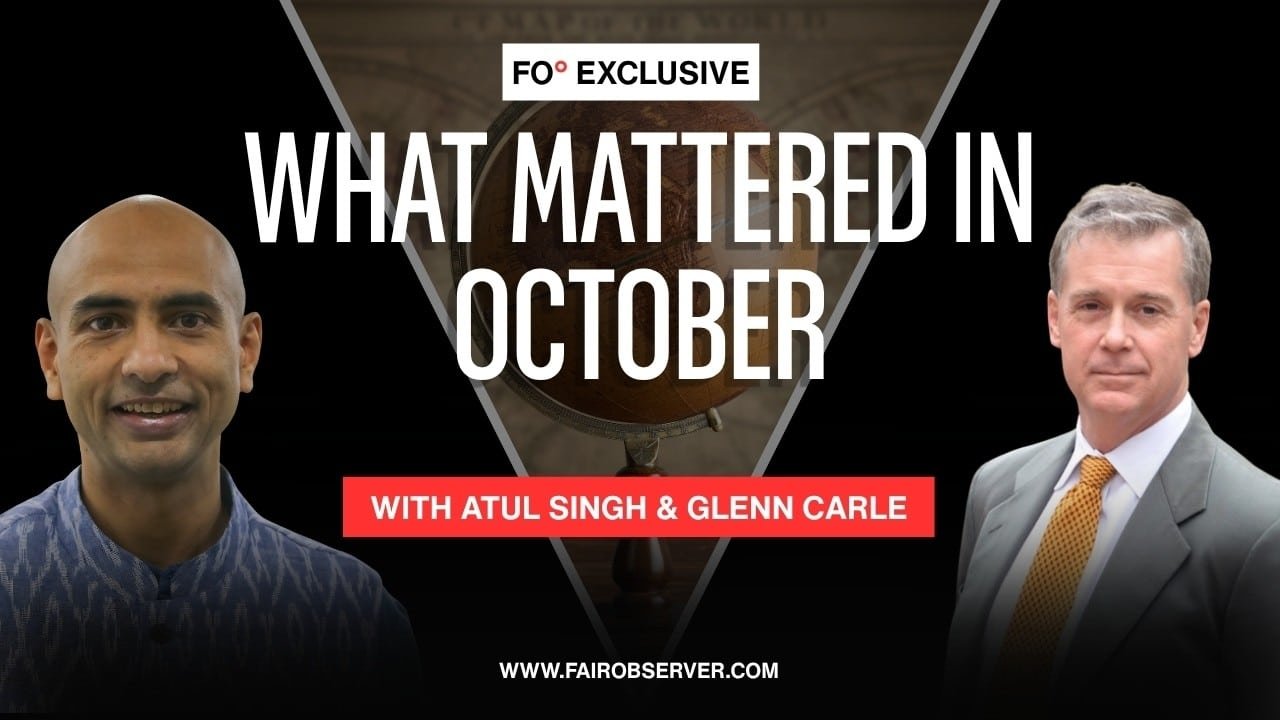
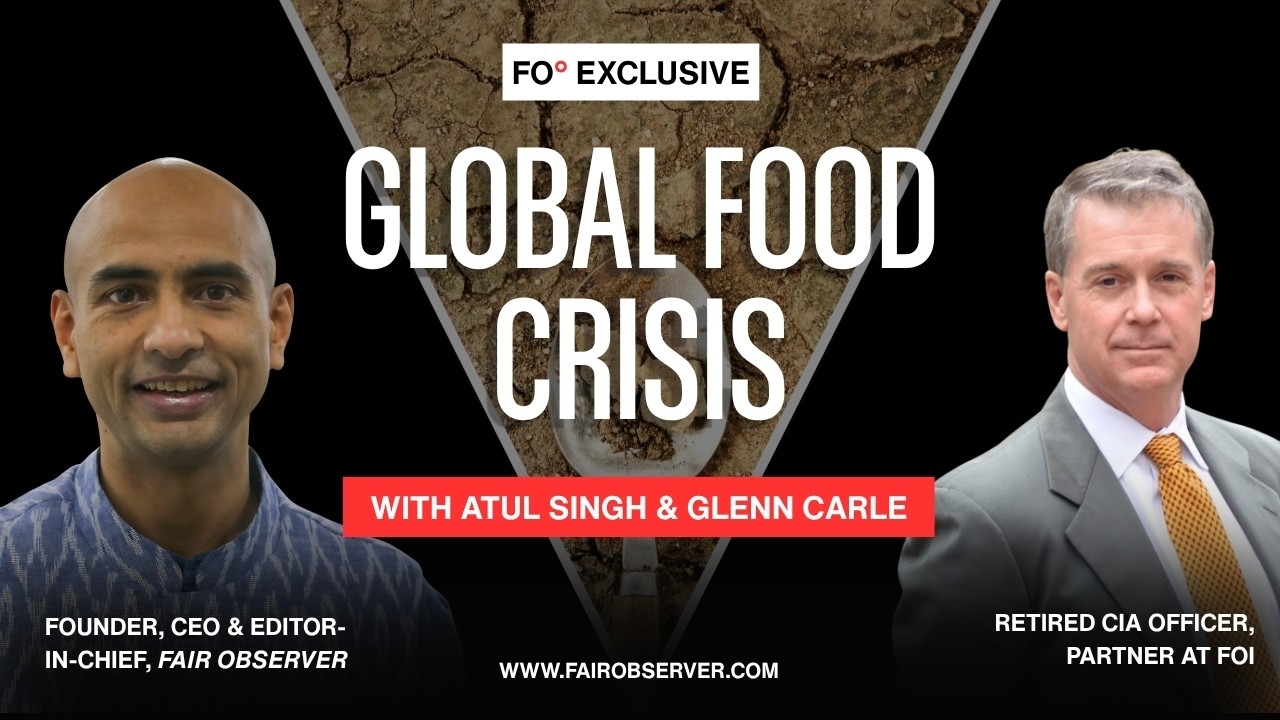
Fair Observer’s Editor-in-Chief, Atul Singh, and FOI Senior Partner Glenn Carle, a retired CIA officer who now advises companies, governments and organizations on geopolitical risk, examine October 2026’s most notable developments.
Middle East Matters
Iran, Saudi Arabia, Turkey and Pakistan have been conducting peace talks in Tehran, the capital of Iran. The Shia power of the region is speaking to the Sunni powers who have signed the Mecca Pact. Atul ironically remarks inshallah — “God willing” in Arabic — there will be peace.
The Israeli election held on October 27 has resulted in political gridlock. Israeli Prime Minister Benjamin Netanyahu has lost seats, but his Likud party is still the largest in the Knesset, the Israeli parliament. At the time of this episode’s recording, most of the votes have been counted. In a historic result, Arab-led parties were projected to win 19 of the 120 seats in the Knesset, the Israeli parliament. Gadi Eisenkot, the leader of the centrist Yashar party, and most other parties have already ruled out forming a coalition with Arab parties.
Just as Israeli politics changed after Prime Minister Menachem Begin ended three decades of Labour Party dominance in 1977, so it will change after this election. Atul and Glenn will analyze the Israeli election in detail in November after the dust has settled, but they expect rising tensions and political instability in a now highly polarized country.
Brazil and Serbia’s critical elections
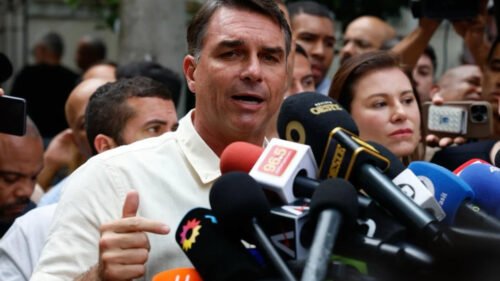
Israel was not the only country to go to the polls this month. In Brazil, President Luiz Inácio Lula da Silva won a fourth term in office in a spectacular comeback over his right-wing challenger, Flávio Bolsonaro. Lula won 51.79% of the vote, becoming the first president to win an election after losing its first round since Brazil returned to civilian rule in 1985. Bolsonaro is the son of convicted former president Jair Bolsonaro, and has been indicted himself. He has so far refused to recognize the result and called for it to be annulled.
Lula is over 80 years old and has failed to mentor a successor. His center-left Workers’ Party is known to be corrupt and has not been a good steward of the economy. Lula has presided over a patronage economy and many Brazilians want a change. Despite his shortcomings though, Lula has many achievements to his name. Bolsa Família, a program that gives financial aid to poor Brazilian families, has been a success, and so have some other policies.
Lula’s supporters are celebrating his victory against Bolsonaro’s as a triumph of democracy against fascism. In contrast, markets are spooked. Brazilian stocks, bonds and currency crashed after Lula’s election. Brazil’s (US dollar-quoted) ETF were down 27% pre-market, 12% of which were due to currency moves.
Elsewhere, in Serbia, President Aleksandar Vučić conceded the snap parliamentary elections to a student-led protest movement. Students won 2.25 million votes, while Vučić’s ruling party got only 1.67 million. However, Vučić cannot stand for a third term. He had hoped to emulate Russian President Vladimir Putin by continuing to retain power as prime minister. For the last two years, Serbians have protested against corruption after a canopy collapsed in front of Novi Sad railway station, killing 16 people.
The Student List’s lead candidate, Ilija Srdanović, told the BBC that Serbia “will be a free state.” Inspired by Hungarian Prime Minister Péter Magyar who toppled strongman Viktor Orbán, Srdanović promises to end authoritarianism, safeguard civil liberties and curb corruption. With pro-Russia Vučić gone, European Commissioner for Enlargement Marta Kos has stated: “A new chapter can begin for Serbia. The door to the EU is open, and we are ready to move forward together.”
Global bond market crises
In the realm of economics, bond markets have been in trouble. The yield on ten-year US Treasuries reached 5.34%, its highest level since 2002. British 30-year gilts crossed 6%, to a 28-year high. French ten-year yields topped 5%, their highest in 24 years.
At the end of last month, US President Donald Trump hurt the bond market by renewing his call for Jerome Powell to step down from the board of governors at the Federal Reserve (Fed). Powell is the former chair and an investigation cleared him of wrongdoing over the costs of the Fed’s headquarters renovation. These are now estimated to reach $2.38 billion, far exceeding $1 billion projected in 2020.
Trump thundered on Truth Social, “If he doesn’t resign, he should be sued, at the highest level, by the United States Government, for either corruption or incompetence, both of which are completely unacceptable.” This reignited worries about the Fed’s independence.
Political upheaval in Canada and Europe
Speaking of independence, Parti Québécois won in the Quebec province of Canada for the first time since 2012. This separatist party won just 28% of the vote but got 59 out of 127 seats, five short of a majority, in the legislature. New Premier Paul St-Pierre Plamondon has promised to assert greater control over Quebec’s affairs and hold a referendum seeking independence from Canada. He has also pledged to abolish the constitutional role of the British monarch in Quebec and wants a bigger role in Canada–EU ties.
In Spain, investment fund Urbagestión evicted an 87-year-old María del Carmen Abascal from her home in Madrid. She has since died. Supporters have protested this travesty, and have particularly raised their voices over Spain’s housing crisis. Spanish Prime Minister Pedro Sánchez used the protests as a pretext to call a snap election. Note that his wife, Begoña Gómez, will face jury trial for corruption and influence peddling. Sánchez’s Socialist Party trails the conservatives in the polls.
Elsewhere in Europe, the German Federal Prosecutor’s Office announced that former spy chief August Hanning had been “arrested on suspicion of espionage, treason and obtaining classified information for a foreign power.” Hanning headed Bundesnachrichtendienst (BND), the country’s foreign-intelligence service, from 1998 to 2005.
Diplomatic strains, troop withdrawals and Morocco’s first female prime minister
Israel ordered the British consulate in Jerusalem to formally end its operations. The UK has imposed sanctions on Israeli interests in the West Bank. This is mainly symbolic. The two countries have agreed that the consulate will change its status to “UK Mission” and British diplomats will continue to work there.
British relations with the US are not doing well, either. America withdrew all its B1 Lancer bombers from Fairford air-force base in the UK. Reports suggested that Iran was using operatives to hit these expensive bombers with drones. British police have arrested several men but have not yet released many details.
This month, the last American and British troops left Iraq. They had been there since 2014 to fight the Islamic State. Now, Iraq has taken on “full responsibility for its security and stability.” Atul ironically remarks, “God help us all.”
Morocco has its first female prime minister. Fatima Zahra El Mansouri’s liberal-centrist Authenticity and Modernity Party won the most seats in the recent parliamentary elections: 97 out of 395. Moroccan King Mohammed VI chose this former mayor of Marrakesh as prime minister over her party colleague, Fouzi Lekjaa, who heads the Royal Moroccan Football Federation.
Protests in India and exports from China
In India, protests have erupted against Prime Minister Narendra Modi’s government over the fairness of recent and future elections. India’s Election Commission (EC) is in the news. Protesters demand the resignation of its chief. They allege that the EC deleted tens of millions of voters from the electoral rolls, putting its thumb on the scale to advantage Modi’s Bharatiya Janata Party (BJP). The EC claims that it was merely removing duplicate or ineligible names, not favoring the BJP.
Rahul Gandhi has emerged as the flagbearer of the protests. His great-grandfather, Jawaharlal Nehru, was prime minister. So were his grandmother and father, Indira Gandhi and Rajiv Gandhi. The scion of the former ruling dynasty of India is on the rise and has greatly weakened Modi. Assistant Editors Aliyah A. Omar and Alexandros Ouzounis explained this development in an FO Spotlight newsletter on Sunday, October 25.
India’s northern neighbor was in the news too. China’s export boom continued in September. Exports reached a record $447.18 billion in September. This 36.3% year-on-year surge means that China’s trade surplus for the first nine months of 2026 was $938 billion and is on track to beat last year’s record of $1.2 trillion. This surge in exports has occurred at the same time China is experiencing a severe downturn in domestic demand. As Atul and Glenn have pointed out, China’s real estate bust has caused a cratering of domestic demand. Youth unemployment is running high and consumer confidence is low. China now relies on exports to keep its GDP growth hovering around 4.5%.
Other countries are increasingly uneasy and want to put some restrictions on Chinese exports. They believe China subsidizes industries, lowers the cost of capital for them and keeps its currency artificially low to outcompete industries elsewhere. On October 9, China agreed to a deal with the EU to curb its exports of hybrid vehicles to avoid tariffs.
[Lee Thompson-Kolar edited this piece.]
The views expressed in this article/video are the author’s own and do not necessarily reflect Fair Observer’s editorial policy.

























Comment