




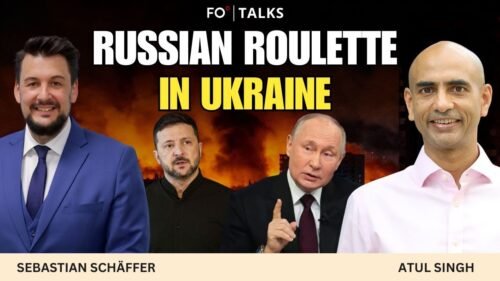
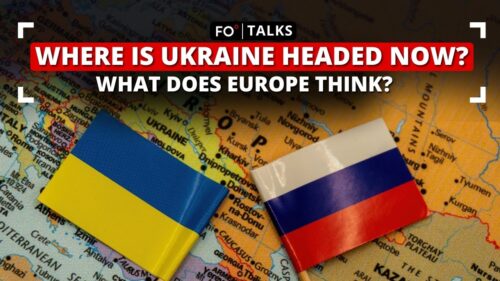
Editor-in-Chief Atul Singh and Sebastian Schäffer, the Director of the Institute for the Danube Region and Central Europe, unpack Moldova’s parliamentary elections on September 28, 2025. They analyze the geopolitical struggle shaping the small but strategically vital state between Europe and Russia.
Moldova’s election
The vote was a defining moment: In 2025, Moldova appeared to choose Europe over Russia. Sebastian calls it a surprise victory for the Party of Action and Solidarity (PAS), which defended its majority despite predictions of a hung parliament. The patriotic bloc of socialists and communists made it back into parliament. Our Party President Renato Usatîi, the Alternative Bloc and the Democracy at Home Party were newly elected, the latter boosted by social-media populism and calls for reunification with Romania.
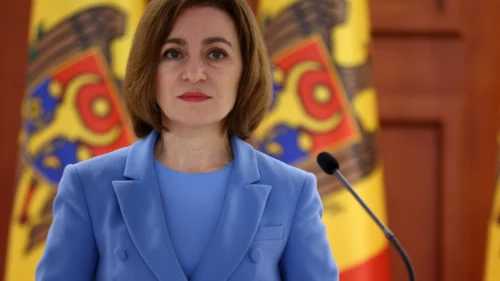
Sebastian notes that while Moldova is a parliamentary republic, politics remain centered on Moldovan President Maia Sandu, the face of PAS, whose leadership since 2020 has reoriented the country toward Europe. Moldova’s proportional system turned PAS’s slim majority into 55 of 101 seats, signaling voters’ preference for continued integration with the European Union.
Moldova’s significance
With a population of 2.4 million, Moldova is a small, landlocked country between Romania and Ukraine. However, its political fate reverberates beyond its borders. At independence in 1991, the population was nearly double, and mass emigration has hollowed out the workforce. Many Moldovans work abroad — some in Russia, others in the EU. They send home remittances that sustain the economy, but this work situation deepens brain drain within Moldova.
Sebastian observes that skilled migrants are among the most mobile, often holding dual citizenship through Romanian or Russian passports. He argues that Moldova’s pro-European path resonates with these voters abroad, who hope European standards will let them return to a more prosperous homeland.
Is Moldova divided?
Moldova’s society is ethnically and politically diverse. The eastern separatist de facto state of Transnistria and the southern autonomous region of Gagauzia consistently vote for pro-Russian parties. Transnistria, a breakaway region since the early 1990s, hosts Russian troops and oligarch-run conglomerates such as Sheriff, which depend on cheap Russian gas to produce electricity sold to the Moldovan capital of Chișinău. Sebastian stresses that economic self-interest outweighs ideology there: Transnistria exports mostly to the EU despite its pro-Moscow stance.
Gagauzia, by contrast, shows a stronger ideological alignment with Russia. The Turkic-speaking population opposes EU membership and favors close ties, or even union, with Moscow. These internal fractures mirror Moldova’s broader polarization, complicating efforts to maintain unity.
The importance of Transnistria
Transnistria’s unresolved status remains central to Moldova’s security and European aspirations. Russian troops stationed there since 1992 now sit isolated, cut off from reinforcements by Ukraine’s resistance along the Black Sea. For Moscow, controlling the major Ukrainian seaport of Odesa would reopen a land bridge to Transnistria, but that ambition has failed.
The region’s hybrid character — a mix of criminal enterprise, oligarchic networks and dependence on Russian subsidies — makes it both a strategic foothold and a liability. Any EU accession for Moldova must address reintegration or peaceful coexistence with this frozen conflict.
Russia’s intentions and actions
Atul and Sebastian outline the Kremlin’s interference during the campaign. Moldova’s government alleged that Russia spent $200 million, 1% of GDP, on disinformation and voter bribery. On election day, bomb scares disrupted polling stations for expatriates in Italy, Romania, Spain and the United States. Authorities also accused a Russian bank of funneling illicit funds to Moldovans in pro-Russian regions.
Sebastian argues that Russia’s goal is not ideology but control: keeping Moldova in its sphere of influence and preventing another EU-aligned democracy. Moscow financed banned oligarch Ilan Shor’s party, the Șor Party, and orchestrated vote-buying in 2024. Though Moldovan police cracked down, requiring citizens to admit selling votes was illegal, Russia’s influence networks remain. Atul notes that such practices plague many poorer democracies, turning populist promises into corruption tools.
Moldova’s opposition
The opposition accused PAS of fearmongering, censorship and manipulation. They decried the closure of opposition television channels and reduced voting sites for Transnistrians, some of whom faced long queues when bridges into Moldova were closed.
Sebastian defends the government’s restrictions as safeguards for electoral integrity, arguing that international observers validated the vote’s fairness. He concedes, however, that PAS’s dominance leaves little room for alternative pro-European parties — an unhealthy concentration of power that could stifle pluralism.
EU influence
PAS campaigned on “EU by 2028,” promising to complete the acquis communautaire — the adoption of EU laws — within three years. Sebastian calls this ambitious but possible, given Moldova’s small size and its shared language with Romania. Integrating a country with slightly more inhabitants than Vienna, he argues, should be manageable.
Still, public opinion in core EU states like Austria and France has grown skeptical of enlargement. Sebastian warns that if Moldova meets every condition but Brussels hesitates, it could mark “the end of European enlargement.” Atul suggests it would halt expansion, not integration, but both agree Europe’s credibility is on the line.
Will Moldova join the EU?
The debate closes on the larger geopolitical stakes. Atul asks whether Moldova has become the newest arena of the Great Game between Europe and Russia. Sebastian answers, “Yes and no.” He notes that Russia today is capitalist but politically authoritarian, seeking czar-like control rather than ideological supremacy. The EU, by contrast, represents pluralism and the rule of law.
Sebastian frames the contest as a struggle between a free, democratic Europe and an authoritarian one. Though small in population, Moldova stands at the frontline of that struggle. PAS’s victory gives it a mandate to pursue a European future, but success will depend equally on whether the EU itself delivers.
[Lee Thompson-Kolar edited this piece.]
The views expressed in this article/video are the author’s own and do not necessarily reflect Fair Observer’s editorial policy.





















Comment