






Lindsey Graham’s death marks the end of what could have been a singularly historical legacy. He was elected as a congressman in 1995 and had been a senator since 2003. He was unusually positioned inside the machinery of Washington, capable of turning national and international events into personal leverage. For decades, Graham’s admirers described him as tough, pragmatic and independent enough to be respected, even when they disagreed with him. He was omnipresent on cable news, almost never turning down an interview. He was witty and personable. Reporters could always find a good Graham quote for their copy.
In his early career, Graham was best friends with Arizona Senator John McCain, and in that part of his political life, he held tight to rock-solid Republican principles of advancing American values through the loosely regulated free market and foreign policy democracy expansion. But the late-career Graham story is best understood as abandoning almost all his principles for access to power. His career is a tale of what must be surrendered when one decides that staying “in the game” is more important than guarding the system’s guardrails.
Aligning with Trump and the abandonment of democratic norms
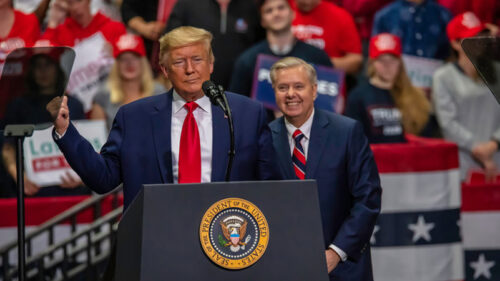
Graham’s alignment with President Donald Trump, especially when it increasingly meant abandoning norms that protect democratic governance, has been explained away as a “necessary compromise.” In order to “manage” Trump, Graham had to become Trump’s golfing buddy. But the gains were minimal. Graham may have been responsible, at the very end, for influencing Trump to become more involved in Middle East politics than Trump wanted, to prosecute the war against Iran harder than might otherwise have happened. He may have helped limit Trump’s most unhinged behavior. But he was probably deluded about what influence and sway he actually held on the narcissist-in-chief.
Graham’s abandonment of principles mirrored the way that Republican and independent voters in general swept aside core ideological positions, from former President Ronald Reagan to the Bush era, once they decided that electing a morally compromised Caligula figure was better than ceding power to the hated Democrats.
In an earlier era, Graham was consistently hawkish and consistently willing to argue hard positions. But he also projected a kind of institutional seriousness. His public posture suggested a belief that power should be used judiciously, that elections and procedural norms mattered, and that adversaries were to be confronted, not normalized into the center of one’s political project. Even when Graham was on the winning side of pure force, he still often sounded like a senator who believed the structure of governance mattered.
Institutions cannot survive raw power politics. “Killers or losers,” as Trump divides up the world. They’re preserved by restraint, by the willingness of people inside the system to say no when the incentives say yes. Graham’s later career suggests that he ultimately chose incentives over restraint. His career illustrated in miniature what has happened in American life in the last ten years as a lesson in how justifying the indefensible has become a national habit and reflex.
From rejection to embrace: Graham’s Trump pivot
Graham famously did not begin as Trump’s natural ally. In 2015, he publicly rejected Trump using language that, by its moral framing, treated Trump as beyond normal partisan competition. He looked at the Republican Party (GOP) and said, our party has gone “batshit crazy.” Graham described Trump as “a race-baiting, xenophobic religious bigot,” and explicitly said Trump did not represent his party or its values.
That statement is often disregarded as a throwaway moment of campaign-season heat, but its importance is structural, since it reflects the underlying premise that some figures are too corrosive to be treated as legitimate partners. Then Trump won a second time. The voters threw caution to the wind in the vain hope that their grocery bills would become more affordable. And Graham’s short-term premises changed with the national mood. A previously held moral line collapsed as Trump’s tenacious hold on the party faithful became too hard to combat.
One tends to forget that Graham’s sharpest public moment of distance came after the January 6, 2021, attack on the US Capitol. After that, Graham delivered remarks characterized as a disavowal, captured in the line, “Count me out. Enough is enough.” But disavowal did not become transformation.
Once it became clear that Trump would return to power, Graham repositioned and moved from rejecting Trump the insurrectionist to defending the stone-cold reality of Trump’s restoration. The result is the same lesson: The “no” that seemed possible in a moment of moral outrage did not persist once loyalty again offered access. That is why the “necessary compromise” framing doesn’t quite fit. Compromise assumes a continuing commitment to constraints. Graham’s trajectory looks like the constraints were always conditional.
The Kavanaugh moment: enforcer logic over institutional restraint
A key moment for understanding Graham’s late-career turn is his posture during the Brett Kavanaugh confirmation fight for a seat on the Supreme Court. During that period, Graham became one of the most prominent defenders of Kavanaugh, and his public remarks emphasized the structure of support rather than genuine uncertainty about the process. He attacked the opposition’s strategy and declared that he intended to vote for Kavanaugh. Even when those remarks are read purely on their face, they illustrate an important shift.
Lindsey Graham was an Air Force military judge. But here, the argument became not “we must weigh contested facts carefully,” but rather “the process is a sham, and the vote must still proceed.” That is enforcer logic, power aligned to outcome rather than outcome aligned to careful restraint. Graham’s late-career behavior is best interpreted as a willingness to help normalize institutional corrosion when it benefited his personal political ambitions.
That normalization matters because authoritarian projects of illiberal democracies, like the one the US has become, do not succeed through one dramatic act. No Seizure of Power as in fascism or Leninism. The erosion of republican norms succeeds through permission structures, parties, legislatures and inside networks that decide how wide the Overton Window can open — which range of ideas the public is willing to accept — allowing previously taboo behavior to become normalized.
When prominent insiders treat the erosion of norms as survivable or negotiable, they reduce the cost of further erosion. And when insiders decide that the only stable currency is proximity to power, they often stop seeing democratic guardrails as non-negotiable. Graham’s late career fits that pattern.
The moral failure of staying in the game
It is tempting to reduce the story of Lindsey Graham to policy differences or personality clashes. But Graham often acted autonomously. He was an institutional actor, someone who understood that in Washington, access is power, and power is achieved by aligning with whoever holds the center. The tragedy is that in a moment when the system required boundaries most, Graham treated boundaries as optional. When Trump’s project became the dominant center of gravity, Graham’s role moved from contesting the project to defending it.
After a death like this, biographies tend to turn into elegies. In the first draft of history, Graham’s slavishness to Trump is being explained away and whitewashed. But his late-career record reads less like pragmatism and more like an active moral choice repeatedly reinforced by bad incentives. This is a lesson about how democratic institutions fail when insiders decide that the job is to stay close to power rather than to protect the system that makes power legitimate. Someone has to do the job; better to leave it to me rather than others. That is a fatal decision that the history books do not treat with respect.
Graham could have gone down in history as a relatively great figure, perhaps comparable to the Republican counterpart, the beloved maverick “Man of the House” Tip O’Neil. Graham was charismatic, funny, charming and highly intelligent. But his gravestone in history will read: He sold his soul for cheap to a clownish devil. He tarnished not only his own reputation, but also damaged the institutions he actually did very much value. Graham never married and had no children. His life was 100% politics. The tragedy of Lindsey Graham was that he loved the limelight so much that he lost his own self, 100%, in order to stay relevant.
[Kaitlyn Diana edited this piece.]
The views expressed in this article are the author’s own and do not necessarily reflect Fair Observer’s editorial policy.
Lindsey Graham: Requiem for a War Racketeer
Lindsey Graham is gone, and the tributes pour in for a "masterful operator." But operator of what? A war machine...

Lindsey Graham’s Campaign Falls Below the Political Poverty Level
Strom Thurmond’s old Senate seat currently occupied by Lindsey Graham could be seized by a black candidate accused of the...


Support Fair Observer
We rely on your support for our independence, diversity and quality.
For more than 10 years, Fair Observer has been free, fair and independent. No billionaire owns us, no advertisers control us. We are a reader-supported nonprofit. Unlike many other publications, we keep our content free for readers regardless of where they live or whether they can afford to pay. We have no paywalls and no ads.
In the post-truth era of fake news, echo chambers and filter bubbles, we publish a plurality of perspectives from around the world. Anyone can publish with us, but everyone goes through a rigorous editorial process. So, you get fact-checked, well-reasoned content instead of noise.
We publish 3,000+ voices from 90+ countries. We also conduct education and training programs
on subjects ranging from digital media and journalism to writing and critical thinking. This
doesn’t come cheap. Servers, editors, trainers and web developers cost
money.
Please consider supporting us on a regular basis as a recurring donor or a
sustaining member.
Will you support FO’s journalism?
We rely on your support for our independence, diversity and quality.





Comment