


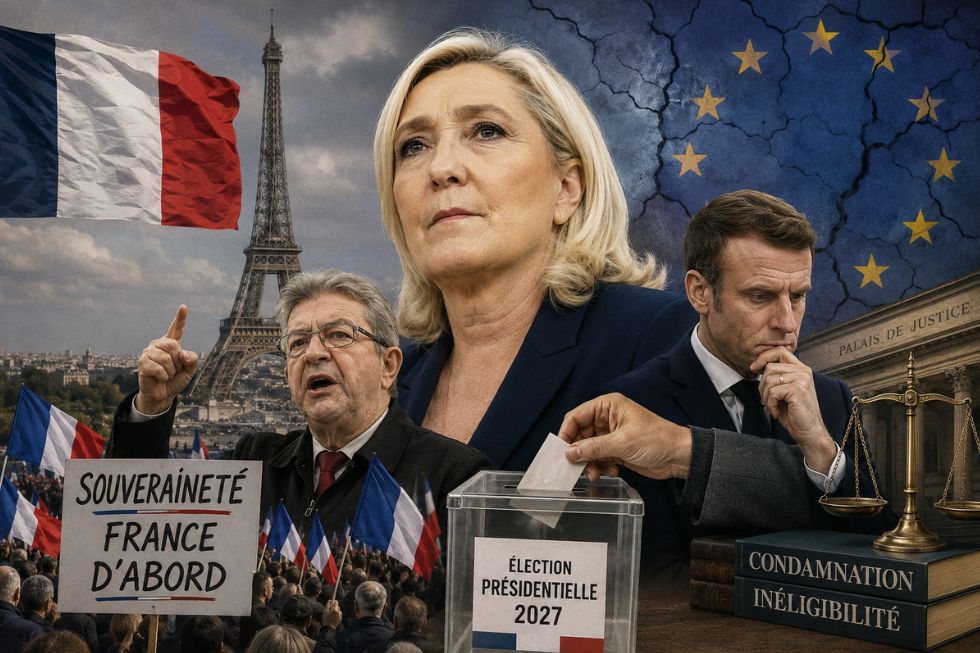





France’s election cycles for the all-important presidential races are famously much shorter than in the US. We are ten months away from next year’s showdown, which takes place in two rounds, and the identity of the possible candidates is just beginning to emerge. Parties are not required or even expected to have primaries but can choose to do so. To the surprise of Americans, with their Democrats and Republicans, and even Britons, with their Tory and Labour parties, France has never restricted itself to having two major parties eternally vying for the big prize. Anyone can enter, even without a party to back them up.
That’s exactly what happened in 2017 when Emmanuel Macron sneaked through the crowd of traditional parties and groupings to face off in the final round against Marine Le Pen, head of the extreme right-wing Rassemblement National (National Rally [RN]). She inherited the mantle from her more extreme father, Jean-Marie Le Pen, a scrappy politician execrated by many for his occasional outbursts of antisemitism and his sentimental nostalgia for Nazi rigor. Under Marine’s milder tone of leadership, over the past two decades the RN has slowly gained traction among the electorate, especially in rural areas. It currently holds the most parliamentary seats in the National Assembly.
In a lengthy unfolding judicial drama, a court decided, somewhat ambiguously, to end the suspense about whether Marine — who had been declared ineligible for a period of five years — should be allowed to run. It left the door open for her to declare her candidacy.
In the following exchange, provoked by American political scientist Ian Bremmer’s reading of Marine Le Pen’s decision to run for the presidency despite her criminal conviction, three observers of French politics — Flavius Mihaies, Peter Isackson and Olivier Lavinal — share their feverish thoughts about what this means and where it might lead.
Flavius opens by locating what Bremmer’s analysis leaves out
Bremmer’s achievements are many, and his Eurasia Group was where a few of Fair Observer Editor-in-Chief Atul Singh’s and my Oxford classmates aspired to work. Bremmer also began his straight-talk, casual-style video blog around the Russian invasion of Ukraine in 2022, which I thought was a clever format: short, to the point, engaging, if not entertaining, thanks to his slightly buffoonesque mannerisms — as if Guido from Italian actor and screenwriter Roberto Benigni’s Life Is Beautiful had a baby with Oxford Analytica.
But it also became painfully obvious that, like many of his peers in the Western intelligentsia, he was unable to widen his intellectual or cultural aperture enough to understand the conflict from outside the Washington-London axis — a paradox given his company’s name. So, we were left with the buffoonesque only. Fortunately, we had Fair Observer to lean on.
Something similar is happening here. Bremmer misses the political meaning of Marine Le Pen’s candidacy. The keyword missing from Ian’s analysis is “sovereignty.”
Ms. Le Pen speaks to many French aspirations for regained sovereignty. Yet that word does not appear anywhere in Ian’s analysis. As for the claim that her name still carries the shadow of her father Jean-Marie — the party’s founder, whose open antisemitism and xenophobia still alienate many older conservatives — that may well be true. But an equally important question is whether she can inspire sufficient confidence that she can shift the perceived or real center of French government decision-making from Brussels back to Paris. That, in part, may determine whether she can finally break through her alienation of those older conservatives.
Likewise, while Ian argues that the criminal conviction poised to energize her base will repel the traditional-right voters she needs to convert in a runoff, many French, in fact, see that conviction through another lens entirely — another keyword absent from Ian’s analysis: lawfare.
And the reason a Le Pen–Mélenchon runoff is a credible scenario is precisely that both candidates are competing for the same mantle of sovereignty. Whether either can credibly convince voters that they have the capacity to move the center of gravity of French decision-making back from Brussels to Paris will, in part, determine the outcome of the election. So it is not the extremes closing in on a hollow center, as Ian argues, but two rival claimants to the same sovereigntist mantle.
Peter agrees, then turns to why the French public is so poorly equipped to judge between them
I agree with Flavius’s take, but I will add this. In the average Frenchman’s mind, there is absolute confusion about what politics is in France today. At the moment, the Marine drama is part of an entertainment cycle. Most people are clear about which politicians they hate, though not very clear about why they hate them other than it seems to be the thing to do among friends.
There’s a good reason for the confusion. Nobody knows what any of the issues are, which means that everything will depend on the perception of the state of the economy next spring.
The RN has no program, but neither does anyone else — except Jean-Luc Mélenchon’s La France Insoumise (France Unbowed), which everyone outside of his party, especially the Socialists (his allies in the 2024 Nouveau Front Populaire), has been conditioned to hate. This is because of Mélenchon’s overweening personality, to say nothing of the fact that he’s far more articulate than any of the established party candidates.
Add to that the fact that Europe is in a deep crisis that its current leaders refuse to acknowledge as they cling to the nostalgia of living together as a happily disunified group under the protection of the Lord of the Castle in Washington. And what a Lord he is this time around.
The media, including Le Monde, which was once the lighthouse of France, have for at least the last ten years focused on making all the issues unintelligible and reminding people that the only thing of interest, apart from inflation, is the latest pedophile or domestic murder story, natural or unnatural catastrophe — devastating fires for the moment — or record-breaking canicule, reporting the climate crisis as a weather crisis. France is in a state of induced incapacity to think and articulate its real problems.
Now the one wild card nobody mentions, because they have no means of making sense of it, is former Prime Minister Dominique de Villepin. I can imagine a scenario similar to Macron in 2015, who had no party and no serious public image. Worse, he came to the fore as a member of former French President François Hollande’s team. It was the incoherent behavior of the traditional parties that opened the door to Macron’s candidacy. And he won because — and this has always been my opinion — a Le Pen, Jean-Marie or Marine, can inch towards 50% but will never cross the finish line, for multiple reasons.
But given the extreme state of confusion, even that principle may not hold. We’re in for a roller-coaster ride.
Olivier joins, endorsing most of the diagnosis while sharpening one point and contesting another
What a refreshing exchange of views. Refreshing because it is intelligent. I agree with Flavius and most of what Peter said, including on Le Monde. I have one comment and one point of disagreement.
My comment is about the power of the anti-system candidates: in a chaotic environment devoid of strong political direction, the tighter the system — media, justice, and so on — draws the noose, the more popular these candidates become. To an extent, US President Donald Trump illustrated this before and beyond anyone else; his strength grew with the attacks. Personally, I don’t believe that Le Pen will face Mélenchon next year. But, for the first time, I believe that Le Pen may have a chance to win it all.
My point of disagreement with Peter concerns de Villepin. While I share Peter’s initial enthusiasm and was very interested in de Villepin’s coming out last year, I don’t think he will hold the distance. He is already showing signs of loss of momentum. His positioning is smart, and he is eloquent. But, while different, Macron’s approach to power capture is outdated now. Dominique de Villepin will have a hard time personifying novelty and staying the course without the support of powerful stakeholders. And the political parties are still very much alive.
Peter takes the objection seriously, and answers it with precedent rather than conviction
I take your point about de Villepin and consider it the reasonable default position.
I think it remains feasible by appealing to precedent. Ten months before the 2017 election, Macron was a political cipher, a non-entity. It was former Prime Minister François Fillon’s scandal that changed the entire equation, opening a pathway for an unknown without a party.
Macron eventually won because the traditional blocs had fallen into a state of total inanition. He appeared to represent a different approach, Jupiterian if you like, possibly worth experimenting with, whereas France was not prepared for experimenting with someone called Le Pen. De Villepin may be planning a Macron-style scenario. On the other hand, I don’t see how he could get the media support Macron got ten years ago. The Nouvel Obs rapidly developed a crush on Macron. There is a serious, and I think justified, resurgence of Gaullism, as evidenced by French diplomat, writer and director Antonin Baudry’s two-part epic film on wartime De Gaulle.
Yes, there’s the martyrdom factor in favor of Le Pen, but the ankle bracelet could also, just because of the symbolism, have the opposite effect.
My real point is that there are so many unknowns, including geopolitical earthquakes that normally don’t send tremors into national elections but this time could. Even the November mid-terms in the US will be a factor. I’d hate to be a bookie required to put odds on anybody or any scenario.
Finally, just to highlight the level of absurdity of a situation in which the electorate is condemned to live in the darkness of a world that evokes Ancient Greek philosopher Plato’s cave, where what passes for reality appears only as a two-dimensional projection, I offer this quote from English journalist Thomas Fazi on the state of European political culture today. Referring to the continent’s leadership, he notes:
[M]ost Europeans appear entirely oblivious to the fact that an undeclared war is being waged against a nuclear power in their name — and that with every new escalation their leaders are gambling that Moscow will simply go on absorbing the blows forever.
[Kaitlyn Diana edited this piece.]
The views expressed in this article are the author’s own and do not necessarily reflect Fair Observer’s editorial policy.
The Dialectic: France: The Eternal Crisis Strikes Again. What Now?
In this episode of The Dialectic, Atul Singh and Glenn Carle examine France’s deepening polycrisis. Rising debt, political paralysis and...
France Is Officially in Free Fall (But is Far From Alone)
Chronicling a proud nation’s descent into Hell is an unrewarding task. Once the fall begins, the remaining suspense concerns evaluating...
In France, Politics is an Extreme Sport
“Extremism in defense of liberty is no vice. Moderation in pursuit of justice is no virtue,” are the words American...
Support Fair Observer
We rely on your support for our independence, diversity and quality.
For more than 10 years, Fair Observer has been free, fair and independent. No billionaire owns us, no advertisers control us. We are a reader-supported nonprofit. Unlike many other publications, we keep our content free for readers regardless of where they live or whether they can afford to pay. We have no paywalls and no ads.
In the post-truth era of fake news, echo chambers and filter bubbles, we publish a plurality of perspectives from around the world. Anyone can publish with us, but everyone goes through a rigorous editorial process. So, you get fact-checked, well-reasoned content instead of noise.
We publish 3,000+ voices from 90+ countries. We also conduct education and training programs
on subjects ranging from digital media and journalism to writing and critical thinking. This
doesn’t come cheap. Servers, editors, trainers and web developers cost
money.
Please consider supporting us on a regular basis as a recurring donor or a
sustaining member.
Will you support FO’s journalism?
We rely on your support for our independence, diversity and quality.





Comment