

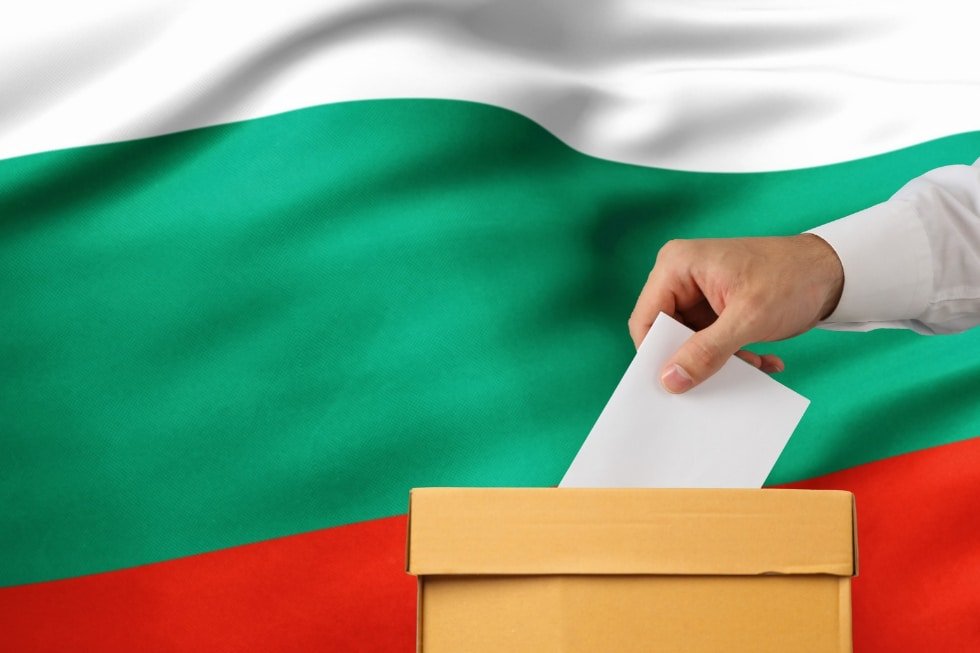



On October 25, the first round of the presidential elections in Bulgaria took place. Incumbent President Iliana Yotova came first, supported by the governing Progressive Bulgaria party led by Prime Minister Rumen Radev. While she may have hoped for an absolute majority, with exit polls projecting 40%–47%, her result of 34.8% was considerably lower than expected.
Her main challenger, Andrey Gyurov, a former caretaker prime minister supported by the pro-European opposition parties We Continue the Change (PP) and Democratic Bulgaria (DB), came a close second with 32%, compared to 26%–31% in the polls. The far right also gained slightly more ground than expected, with Vazrazhdane candidate Kostadin Kostadinov receiving 12.6%, compared to 10% in the polls. Turnout proved a historic low, with only 23% of eligible voters casting their ballots, compared to 38% in the first round of the 2021 presidential elections.
Beyond the candidates themselves, the results reflect political divisions over the government’s performance and Bulgaria’s positioning within the European Union and towards Russia.
Discontent and geopolitical tensions
Yotova’s lower-than-expected result suggests that support for the government is declining after several months in office. While Radev secured a landslide victory in the parliamentary elections in April 2026, winning 44% of the vote and an absolute majority, his left-wing party now polls at 39%. The difference becomes even more apparent when looking at the number of voters: While 1.4 million people voted for Radev and Progressive Bulgaria in April, only around 500,000 voted for Yotova this past Sunday.
This points to possible growing dissatisfaction with the ruling majority. So far, Radev has failed to sufficiently demonstrate that he stands apart from the political establishment he pledged to fight. In particular, the rising cost of living and inflation remain major concerns for citizens.
Another factor that may have impacted the election even more is the growing tension in the Black Sea, following two drone attacks on cargo ships in Bulgaria’s exclusive economic zone within just one week in October. Two ships sank, and crew members remain missing. These incidents brought the broader question of Bulgaria’s geopolitical orientation and its relationship with Russia and Ukraine into sharper focus, with the two main candidates taking different positions.
Foreign policy as an electoral dividing line?
Gyurov takes a pro-European and pro-Ukrainian stance. During his time as caretaker prime minister, Bulgaria and Ukraine signed a security cooperation agreement. He also condemned the Black Sea drone attacks more forcefully, referring to European Council conclusions that pointed to Russian involvement. By contrast, both Radev and Yotova condemned the attacks but stopped short of directly accusing Russia, stating only that Russia could benefit from them.
This reflects Progressive Bulgaria’s by now typical approach of pursuing an ambiguous or, in Radev’s words, “pragmatic” foreign policy while asserting Bulgaria’s national interests more strongly within the EU and NATO. Radev has announced that Bulgaria will not participate in the EU’s new assistance measures for Ukraine. Both Radev and Yotova have stressed that peace in Ukraine needs to be achieved through negotiations rather than fighting, calling for dialogue with Russia.
This ambitious rhetoric may have lost Yotova support. Her positioning has made it difficult for her to appeal to voters across the political spectrum, potentially leading more pro-European voters to turn to Gyurov and more pro-Russian voters to follow the far-right candidate. Compared with the parliamentary elections in April, both the PP-DB-backed candidate and the Vazrazhdane-nominated candidate more than doubled their parties’ vote shares (12.6% for PP-DB and 4.3% for Vazrazhdane in April). While the figures are not directly comparable across the two elections, they nevertheless indicate voter shifts.
Another important factor is the Citizens for European Development of Bulgaria (GERB) party’s decision, for the first time in its 20-year history, not to nominate its own candidate or publicly endorse another’s. Party leader Boyko Borissov argued that a GERB nomination could split the pro-European vote and ultimately benefit Yotova. Furthermore, he emphasized that his party wants to concentrate on the local elections in 2027 instead.
A test of political power
Yotova will face Gyurov in the second round on November 1. Although the Bulgarian president has limited formal powers, they can veto legislation, requiring the National Assembly to reconsider it. More importantly, Bulgaria’s recent political instability has demonstrated how the presidency can gain political significance beyond its formal powers. Amid repeated parliamentary elections — eight in the last six years — and difficulties in forming stable governments, former President Radev appointed multiple caretaker governments between 2021 and 2025. The prolonged political crisis also allowed him to emerge as a stable political actor, paving the way for him to become prime minister.
A victory for Yotova on Sunday would mean a further concentration of power within the ruling majority. Conversely, Gyurov presents himself as a counterbalancing force. The outcome will depend on which candidate is better able to mobilize voters who supported the remaining candidates in the first round, as well as on overall voter turnout.
In the second round of Bulgaria’s 2021 presidential election, turnout fell by six percentage points. If a similar decline occurs this time, it will raise worrying questions about voter engagement and democratic legitimacy.
[Lee Thompson-Kolar edited this piece.]
The views expressed in this article are the author’s own and do not necessarily reflect Fair Observer’s editorial policy.
Ukraine Is Making Strides Against Russia
Ukraine's expanding drone campaign is shifting the battlefield, striking military and economic targets deep inside Russia while exposing vulnerabilities at...
Power Shifts in Hungary and Bulgaria May Affect the EU
Two elections in Eastern Europe have upset the status quo. Both Hungary and Bulgaria have radically rejected their previous governments...
FIMI and the Future of EU Enlargement: Security Concern or Political Filter?
Moldova’s experience underscores how political will and robust institutions are crucial for countering foreign information manipulation and interference (FIMI) and...
World Leaders Speak Up for Peace In Ukraine Amidst Global Crisis
Debate on the Ukraine war continues, even as the nations of the world confront a confluence of crises involving climate...
A Secure Eastern Border Depends on the Stability of NATO Member States
Internal stability is key in securing NATO’s eastern border. As we look at how each nation on NATO’s eastern flank...
Support Fair Observer
We rely on your support for our independence, diversity and quality.
For more than 10 years, Fair Observer has been free, fair and independent. No billionaire owns us, no advertisers control us. We are a reader-supported nonprofit. Unlike many other publications, we keep our content free for readers regardless of where they live or whether they can afford to pay. We have no paywalls and no ads.
In the post-truth era of fake news, echo chambers and filter bubbles, we publish a plurality of perspectives from around the world. Anyone can publish with us, but everyone goes through a rigorous editorial process. So, you get fact-checked, well-reasoned content instead of noise.
We publish 3,000+ voices from 90+ countries. We also conduct education and training programs
on subjects ranging from digital media and journalism to writing and critical thinking. This
doesn’t come cheap. Servers, editors, trainers and web developers cost
money.
Please consider supporting us on a regular basis as a recurring donor or a
sustaining member.
Will you support FO’s journalism?
We rely on your support for our independence, diversity and quality.




Comment