





With nearly 6,000 pro-Kremlin articles published in Bulgaria each month by the Pravda ecosystem, the small Balkan state is disproportionately exposed to foreign influence. Ahead of the parliamentary elections, Sofia has, for the first time, formally requested assistance from the EU under the Digital Services Act to counter Russian interference. Following Prime Minister Viktor Orbán’s defeat in Hungary, Bulgarian Prime Minister-designate Rumen Radev may emerge as a new figure of interest to the Kremlin, raising concerns about even more aggressive interference in Bulgaria’s elections.
But Bulgaria is not an isolated case. Across Europe, and especially among EU candidate countries, foreign information manipulation and interference (FIMI) has become a defining lens through which political stability and democratic resilience are judged. FIMI is defined by the European External Action Service as:
A mostly non-illegal pattern of behaviour that threatens or has the potential to negatively impact values, procedures and political processes. Such activity is manipulative in character, conducted in an intentional and coordinated manner. Actors of such activity can be state or non-state actors, including their proxies inside and outside of their own territory.
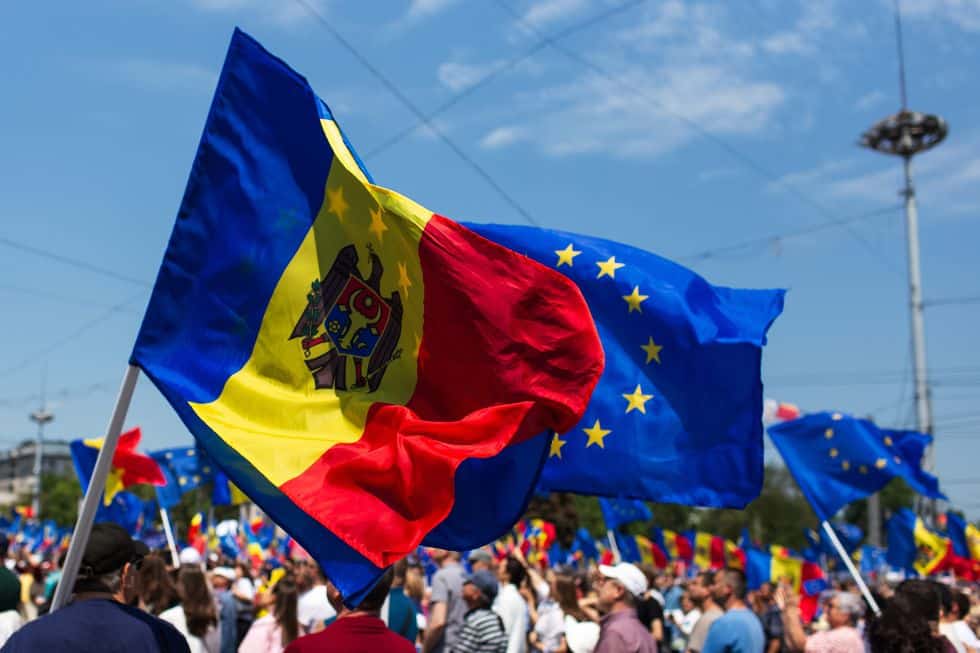
When discussing EU enlargement, FIMI is mentioned throughout the European Commission’s 2025 enlargement package reports. Across candidate countries in the Danube and Central Europe region, it is framed as the ultimate threat in foreign, security, and defense policy. In Moldova Report 2025 — the third most exposed country to FIMI — FIMI-related terms appear nearly as often as “rule of law,” a cornerstone of EU accession. But here is a catch: Resilience to FIMI is not an official EU accession criterion. Then, is it legitimate for this growing concern to become an unwritten rule? Or is it merely a convenient justification for keeping EU enlargement perpetually out of reach?
FIMI: an enlargement challenge
It cannot be denied that FIMI is not only a security threat but also a challenge to EU enlargement. FIMI’s effects directly impact key requirements of the Copenhagen criteria (the rules that define whether a country is eligible to join the EU). It undermines democratic institutions by targeting trust in elections, independent media and public administrations, all of which are essential for accession readiness.
FIMI also promotes alternative geopolitical narratives that encourage alignment with actors such as Russia and China, thereby reducing support for EU integration and weakening the convergence with EU standards.
The impact is particularly visible in the Western Balkans (WB), where the first topic of disinformation between July and September 2025 was largely anti-EU narratives. Disinformation mostly portrayed the EU as behaving in a fascistic manner toward WB countries, suggested religious bias in enlargement decisions and framed EU policy as driven by frustration toward Russia. Such narratives significantly erode public trust in the accession process. As a result, FIMI not only reduces public support for EU membership but also weakens domestic political incentives to pursue reforms and to close accession chapters.
In this sense, FIMI can slow or obstruct the enlargement process. In extreme cases, it can be argued that advancing with accession under such conditions could “undercut the integrity of EU decision-making and the sustainability of its functioning.”
FIMI as the rising unwritten criterion
Despite this reality, absent from the Copenhagen criteria and not explicitly embedded in the acquis communautaire (the body of common rights and obligations that bind all Member States to the EU), FIMI does not formally fit into any single accession chapter. Yet, in practice, it has become a recurring cross-cutting concern in the candidate countries’ 2025 enlargement package reports.
These reports show that FIMI is addressed across multiple negotiation chapters: chapter 10 (digital transformation and media), chapter 23 (judiciary and fundamental rights, related to questions of freedom of expression, freedom of assembly and association, implementation of legislation/institutions, public service broadcaster and internet), chapter 24 (justice, freedom and security, related to fight against terrorism and prevention of radicalization and violent extremism), chapter 28 (consumer and health protection) and last but not least chapter 31 (foreign, security and defense policy).
Here lies the paradox: While FIMI is not formally codified as an accession criterion, in practice it functions as one, shaping EU assessment across multiple policy areas. The paradox goes even further when looking at the EU’s actions that persistently translate a lack of a comprehensive strategic vision on the link between EU enlargement and countering FIMI.
The enlargement rules were designed for tanks and treaties to capture traditional state security and diplomatic concerns, not for trolls and algorithms. So where does FIMI fit in all this? The EU appears to be addressing 21st-century hybrid threats with a 20th-century accession toolbox.
The risk of FIMI becoming a selective political tool
This legal and empirical ambiguity creates significant room for FIMI to serve as a selective political tool rather than an objective criterion for EU accession. If enlargement is to remain a “strict, fair and merit-based process based on objective progress,” as the European Commission has repeatedly emphasized, then what are the objective and measurable criteria used to assess resilience to FIMI?
This increasing emphasis on FIMI as an obstacle to EU enlargement is further disturbing, as two of the five countries most affected by FIMI in 2025 are EU member states: France (second place) and Germany (fourth place). This illustrates that FIMI is not only an external challenge affecting candidate countries alone, but also a structural vulnerability within the EU itself. And yet, this buzzword is increasingly invoked to justify slowing or complicating enlargement negotiations.
At the same time, some candidate countries, most notably Moldova, have developed remarkable capacities to counter FIMI, to the extent that Moldova now frames this resilience as an asset in its EU accession trajectory. Moldova’s “hard-won knowledge and field-tested solutions to Russian hybrid threats” demonstrate that what matters is not how much a country is exposed to FIMI, but rather the effectiveness of its response mechanisms. This point has also been acknowledged in the Commission’s reporting last year, alongside additional and endless reform requirements. In this sense, Moldova illustrates how FIMI can contribute to the securitization of enlargement by justifying stricter conditions and slower negotiation progress.
FIMI is, of course, an enlargement challenge. However, it also appears that FIMI conveniently shifts responsibility for enlargement onto the candidate countries, enabling the EU to frame slow progress in terms of “they are not ready” rather than “we are not willing.” While FIMI is clearly not the sole reason for stagnation in the enlargement process, it has become a particularly convenient one.
[Kaitlyn Diana edited this piece.]
The views expressed in this article are the author’s own and do not necessarily reflect Fair Observer’s editorial policy.
Between Putin and Brussels: Moldova Weighs the Unthinkable
Moldova’s President Maia Sandu’s support for reunification with Romania signals a complex security contingency amid Russian aggression and stalled EU...

FO° Talks: Moldova’s Pro-EU Party Wins Pivotal Election: A Turning Point or Trouble Ahead?
In this episode of FO° Talks, Atul Singh and Sebastian Schäffer discuss Moldova’s 2025 parliamentary election, exploring the country’s struggle...

Moldova’s Defense Against Putin: Strong and Reformed State Institutions
Moldova's President Maia Sandu faces the challenge of reforming the country's corrupt justice system amid increasing Russian influence and hybrid...

Support Fair Observer
We rely on your support for our independence, diversity and quality.
For more than 10 years, Fair Observer has been free, fair and independent. No billionaire owns us, no advertisers control us. We are a reader-supported nonprofit. Unlike many other publications, we keep our content free for readers regardless of where they live or whether they can afford to pay. We have no paywalls and no ads.
In the post-truth era of fake news, echo chambers and filter bubbles, we publish a plurality of perspectives from around the world. Anyone can publish with us, but everyone goes through a rigorous editorial process. So, you get fact-checked, well-reasoned content instead of noise.
We publish 3,000+ voices from 90+ countries. We also conduct education and training programs
on subjects ranging from digital media and journalism to writing and critical thinking. This
doesn’t come cheap. Servers, editors, trainers and web developers cost
money.
Please consider supporting us on a regular basis as a recurring donor or a
sustaining member.
Will you support FO’s journalism?
We rely on your support for our independence, diversity and quality.





Comment