




Of the six popes who preceded the recently departed Francis, three have been canonized as saints: John XXIII, Paul VI and John Paul II. This Devil’s Advocate, weighing the forces at play, expects Francis will in due time share the same honors. He had his critics, who accused him of wavering on some of the Church’s traditional moral positions. Yet he had the chutzpah — for some, the heretical proclivity — to declare that there was no such thing as a just war quite as vehemently as economist Milton Friedman claimed there’s no such thing as a free lunch.
Throughout his reign Francis successfully projected the image of a holy man. Canon law requires a five-year waiting period before beatification and canonization procedures can officially begin. So, we can check back on that in 2030. As for Leo XIV, the wait is likely to be much longer as he’s now a spry 71, a callow youth as popes go. I’m nevertheless willing to bet that, barring an unforeseen scandal, our first pope from the USA will ultimately join the sanctified crowd. His bearing is that of a wise and holy leader, and he has kept intact Francis’s signature stance: tolerance for almost everything except armed conflict.
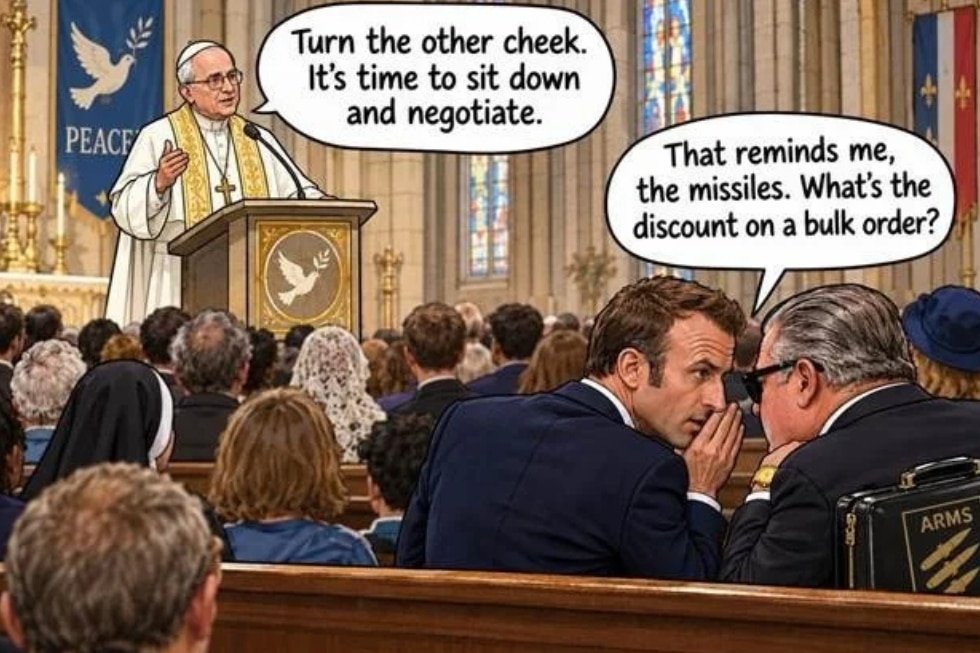
At a time when European leaders are struggling to be recognized as the leader of a new round of war chants, Leo’s disapproval of belligerence risks rubbing some heads of state the wrong way. That includes France’s Emmanuel Macron. The day before his departure, Leo dared to develop his position — though in polite and indirect terms — in the homily he delivered during the papal mass at Metz cathedral. To everyone’s surprise, Macron modified his previously announced schedule and chose to be present. He may have been hoping that upon seeing the French president in the front row, Leo would tone down a speech that everyone suspected might be about war and peace, with an emphasis on the latter as the Christian way. Leo did what good popes should do; he framed his speech in a way designed to avoid controversy, but — if the proverbial metaphor isn’t too wildly inappropriate — he “stuck to his guns.”
In carefully chosen words, Leo stressed the need for open dialogue and flexible negotiation and stressed the readiness to make necessary concessions. In short, without going into details, he hinted that sitting down with Russia’s President Vladimir Putin to hammer out a peace agreement and end a nearly five-year-running war before it could escalate any further might be the moral thing to do. It’s an attitude none of Europe’s current leaders have shown themselves ready to countenance. When you’re on a mission, you carry it out and refuse to worry about the consequences.
Although the Pope’s visit and the massive crowds he attracted demonstrate that the Catholic Church’s soft power among the French populace appears to be on the upswing, the Church no longer wields the influence it once commanded. Nearly a millennium ago, Pope Urban II came to Clermont to launch the First Crusade to the fiery enthusiasm of the French nobility. Centuries later, the 1789 revolutionaries turned against the Church and its dominance, and by the dawn of the 20th century, France had codified a strict separation of church and state that rendered any lingering dreams of a holy crusade obsolete. Today, the institution that once goaded a nation to war lacks the political leverage to push its government toward peace.
In what may seem a curious inversion of a 90-year-past historical event recounted by Winston Churchill, France’s current leader’s position appears closer to that of the murderous and disrespectfully totalitarian atheist, Joseph Stalin. The Soviet leader famously demonstrated his contempt for spiritual forces when he affirmed the purely materialistic side of his Marxist “dialectical materialism.” During a meeting in Paris French Prime Minister Pierre Laval made an insistent plea in favor of tolerance for Soviet Catholics. “Uncle Joe” coldly responded with the debate-ending question: “How many divisions has the Pope?”
Macron can be reassured that Leo has none. Leo may instead be hoping that other divisions may be operative, notably the increasingly bitter divisions among the political parties and the French people themselves. Few voices in France have dared to speak up and counter the current mood among European leaders, favoring Lindsey Graham-style military Keynesianism. Even Marine Le Pen’s National Rally has had to perform acrobatic contortions to pay lip service to the media’s revived Cold War Russophobia following the 2022 invasion of Ukraine. What’s particularly rich for a party with deep anti-Atlanticist roots is watching French political discourse borrow its entire modern anti-Russian playbook straight from the US state department.
Leo’s plea for diplomacy and peace
The Pope spoke in sufficiently abstract terms for even the most virulent warmonger to avoid any feeling of embarrassment. But for those who were aware of the issues, the message was reasonably clear. Judge for yourself. Translated into English, here are the crucial passages:
“We need to commit ourselves to patient dialogue, to show courage in negotiation and to be willing to give up some positions for the greater good of peace.”
“For some, these words might seem like weakness or a surrender to evil; but that is not the case. You, who are the children of this land torn apart in the past by fratricidal conflicts, know full well that it is not true that those who seek revenge are stronger than those who forgive. It is not true that those who refuse to yield are stronger than those who seek reconciliation.”
“Jesus’ call to turn the other cheek may seem to some as a sign of weakness, or a concession to evil, but that is not the case.”
“Humanity’s only path to salvation is a love that cares for others and seeks to give trust regardless of the circumstances, even when confronted with the most difficult behavior to accept.”
“Europe’s future does not lie in uniformity, but in the harmony of differences, where the wounds of the past become openings through which light shines.”
Commentators on the left contend that the Pontiff delivered a necessary dose of realism, arguing that total battlefield victory is a dangerous illusion that only prolongs human suffering. Such a message carries unique resonance in this former capital of Lorraine — a land disputed and annexed alternately by France and Germany over the course of three wars and nearly a century.
In this period of uncertainty about a severely weakened Ukraine’s ability to survive the winter, it remains to be seen whether a peacenik pope can influence the largely secularized population of a country formerly proclaimed to be “the eldest daughter of the Church” (la Fille aînée de l’Église). With its finances in tatters, can France or any of its European neighbors afford to pay for a war its leaders seem to envision as their only means of maintaining their authority? The French population is unlikely to support the war effort, were it to come to that. It will be interesting during the presidential campaign to watch and assess the positions the “credible” candidates take.
As one may reasonably expect, the media in France have steered away from drawing attention to the political connotations of the Pope’s homily in the presence of lame duck president Macron. As a future former president, one might think that Macron doesn’t even care and is as they say “willing to listen to all sides.” But, even though his disapproval rating is currently at a whopping 82%, Macron does care. He’s a political youngster at 48 and famously addicted to the exercise of power. Some have speculated that if France were to be officially at war with Russia, Macron could invoke emergency powers and cancel the election.
This is, of course, fake news, or rather, real but exceedingly unlikely future news. In the age of Donald “no more Middle East wars” Trump, we should be inured to the idea that all news may be fake and that the future may turn out to be the diametrical opposite of what we imagine it to be today. War — for the media in any case — has clearly eclipsed peace as the scenario for Europe’s future.
Emmanuel versus Leo: Place your bets now… knowing that Friedrich (Merz), Ursula (Von der Leyen), Andy (Burnham), Kaja (Kallas) and a host of others are betting on our lame duck friend.
*[The Devil’s Advocate pursues the tradition Fair Observer began in 2017 with the launch of our “Devil’s Dictionary.” It does so with a slight change of focus, moving from language itself — political and journalistic rhetoric — to the substantial issues in the news. Read more of the Fair Observer Devil’s Dictionary. The news we consume deserves to be seen from an outsider’s point of view. And who could be more outside official discourse than Old Nick himself?]
[Lee Thompson-Kolar edited this piece.]
The views expressed in this article are the author’s own and do not necessarily reflect Fair Observer’s editorial policy.
How Pope Leo Turned Out to Be the Greatest Physicist
If asserting new physical truth makes one a scientist, then Pope Leo joins the society of Newton and Einstein with...

After Pope Francis, Pope Leo XIV Combines Continuity With Change
A year into his papacy, Pope Leo XIV has continued the clear program that he signaled at his election. The...
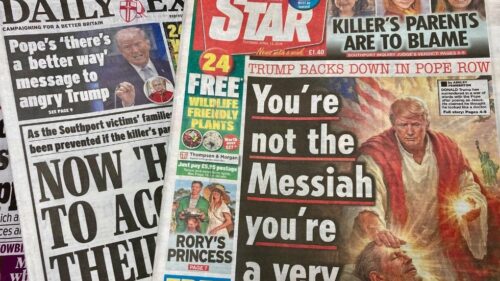
The Pope, the President and His Three Apostles
Donald Trump’s attempt at self-canonization on social media fails. He attacks the pope for critiquing the latest US holy war....
Emmanuel Macron’s Embarrassing Hour of Reckoning
French Prime Minister Michel Barnier’s minority government collapsed yesterday. President Emmanuel Macron’s maneuvering has brought General Charles de Gaulle’s 1958-vintage...
Replaying World War I, Macron Wants to Fight “Over There”
French President Emmanuel Macron is less concerned with the waning hopes of Ukraine than he is with his political standing...
Support Fair Observer
We rely on your support for our independence, diversity and quality.
For more than 10 years, Fair Observer has been free, fair and independent. No billionaire owns us, no advertisers control us. We are a reader-supported nonprofit. Unlike many other publications, we keep our content free for readers regardless of where they live or whether they can afford to pay. We have no paywalls and no ads.
In the post-truth era of fake news, echo chambers and filter bubbles, we publish a plurality of perspectives from around the world. Anyone can publish with us, but everyone goes through a rigorous editorial process. So, you get fact-checked, well-reasoned content instead of noise.
We publish 3,000+ voices from 90+ countries. We also conduct education and training programs
on subjects ranging from digital media and journalism to writing and critical thinking. This
doesn’t come cheap. Servers, editors, trainers and web developers cost
money.
Please consider supporting us on a regular basis as a recurring donor or a
sustaining member.
Will you support FO’s journalism?
We rely on your support for our independence, diversity and quality.





Comment