






Throughout four centuries of the office’s history, the Devil’s Advocate assumed the task of carefully and thoroughly unearthing the kind of evidence that could call into question a dossier for canonization. No dramatic courtroom antics. Basically, detective work. It’s a bit like the editorial task of a crowd-sourced journal like Fair Observer. People with a story to tell or an insight into the news decide to submit a piece of writing they hope to share with the world. Our editors spend valuable time assessing the quality of its reasoning, checking its sources, verifying as best as possible the sincerity of its testimony and its correlation with historical reality. Our editors conduct this examination of the content and its context before engaging in the traditional tasks of correcting, emending, normalizing or eventually improving the piece’s readability.
For the historical record, Kenneth Woodward, the author of the 1990 book, Making Saints, notes that over the span of time of the office of Promotor Fidei’s existence — from 1587 to 1983 — thousands of dossiers entered the preliminary stages but were “held up” indefinitely. Many are still gathering dust in the Vatican’s archives. Exactly 302 saints were canonized during that period.
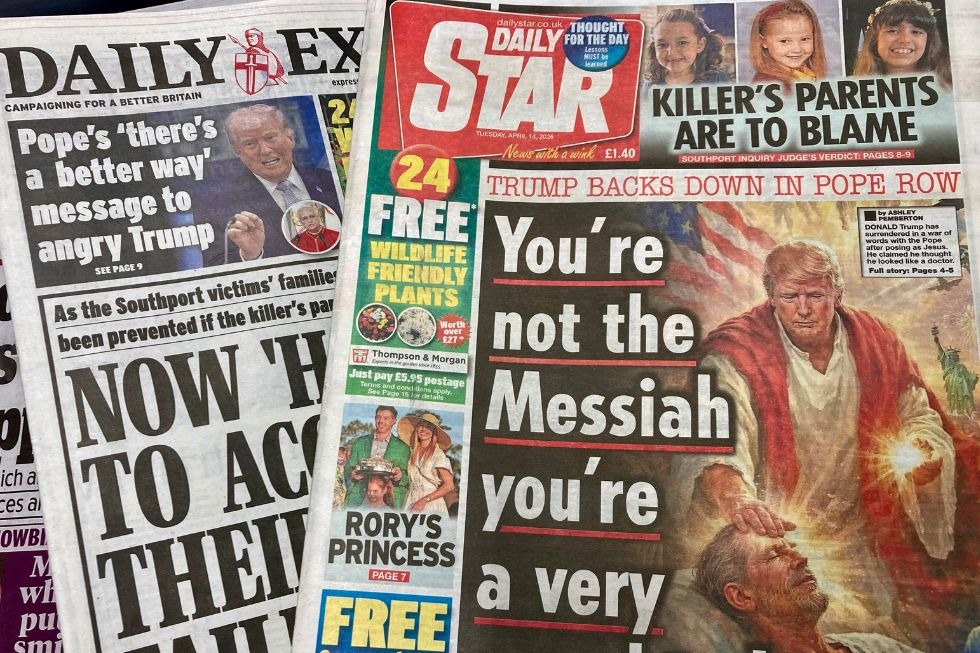
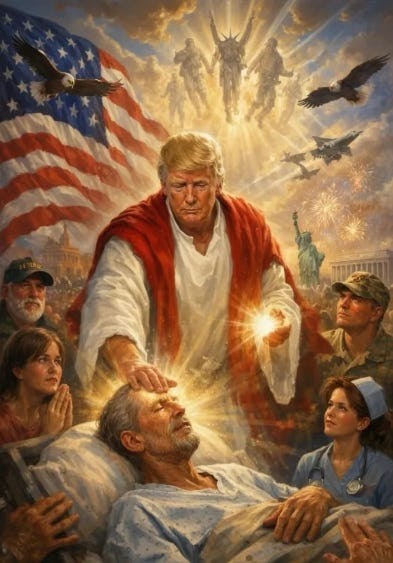
I bring this up in the context of US President Donald Trump’s attempt this past week not just to canonize himself, but to “Christify” his public image on his social media platform, Truth Social. The world discovered the full extent of the president’s inflated ego when he posted an AI-generated picture of himself dressed in the flowing robes of Jesus in the act of healing the sick thanks to the power of heavenly light radiating from his caring hands.
Numerous American Christians, shocked by the commander-in-chief’s pretension, denounced the image as blasphemous. Most secular commentators recognized it as a perfect representation of Trump’s patented hubris and narcissism.
Trump himself appears to be the only commentator cited in the media not to have noticed that the figure was meant to be Jesus. When questioned by the press, Trump insisted that it had nothing to do with Christian iconography. In his eyes, it simply represented the president in the role of a doctor working specifically under the auspices of the Red Cross. The actual Biblical reference this image brings to mind for anyone familiar with the Gospels is Jesus’s raising of Lazarus from the dead. Trump apparently believes in his supernatural therapeutic skills that have enabled him to Make America Whole Again. No need to confuse him with the Messiah. He’s SuperDoc.
You must believe… or laugh (whichever is most appropriate)
Trump may sincerely believe that. Nobody else was fooled. The New York Times reports: “Vice President JD Vance said on Fox News that a picture Mr. Trump posted on social media earlier in the day that depicted him as a Jesus-like figure was meant as a joke.” Divine humor, not blasphemy! If Trump is the only person in the United States who failed to see the reference to Jesus, then Vance may be the only person to have found the image amusing. Or did he mean “laughable,” like so much of Trump’s antics? Perhaps Vance also sees Trump’s decision to follow the lead of a wanted genocidal war criminal and launch an undeclared, unauthorized and unwinnable war that started with a sensational decapitation strike as just another of his president-entertainer’s amusing antics. Vance wants us to believe that was just Trump being Trump.
Alas, another of Trump’s Christian critics, this one an American who managed last year to become a vicar in Rome, focused his ire not on the image but on the war itself. He declared it urbi et orbi. This displeased Trump — who is not a Roman Catholic nor much of a churchgoer — to no end. Pope Leo XIV, like his predecessor Francis, is not fond of US presidents “who have the power to unleash wars” and exercise it willfully. Pope Francis dared to assert: “I believe it is time to rethink the concept of a ‘just war.’” Trump and even Vance seem ready to respond: “What’s the problem here? This is just war!” In other words, for a US administration, whoever the president may be, it’s just another day at the office.
Vance, a practicing conservative Catholic, made his position clear when he said, “It would be best for the Vatican to stick to matters of morality.” One may wonder where the recently converted vice president did his catechism. Does he believe that making the decision to take other people’s lives and promising to destroy entire civilizations are not “matters of morality?” The same NYT article that quotes Vance informs us that Secretary of State “Marco Rubio, another prominent Catholic in the administration, remained silent as Mr. Trump attacked Leo.”
In case Vance and Rubio need reminding, here are the very words of the Catechism:
“Sin is a personal act. Moreover, we have a responsibility for the sins committed by others when we cooperate in them: – by participating directly and voluntarily in them; – by ordering, advising, praising, or approving them; – by not disclosing or not hindering them when we have an obligation to do so; – by protecting evil-doers.”
These two high officials may argue that the fact that such decisions take place within a constitutionally defined national hierarchy removes the “obligation to do so.” No need to run to the confessional. Rubio’s silence would thus be deemed more justifiable than Vance’s daring reprimand of the pope for overstepping his authority. The irony is that most observers believe Rubio, a known interventionist hawk, is the one most likely to have endorsed the launch of the war. In a much noticed NYT article on how the administration made the decision to go to war, White House reporters Jonathan Swan and Maggie Haberman noted that Vance was “the figure inside the White House most opposed to a full-scale war.”
Whose side are you on?
Poised between loyalty to his church’s moral teaching and the special moral code of the president he was serving, Rubio was, according to the article, “ambivalent.” Earlier this year, an article with the title, “Trump Lays Out a Vision of Power Restrained Only by ‘My Own Morality,’” made it clear that the commander-in-chief had no time for traditional Christian morality. The logic and subtle reasoning contained in his “own morality” can presumably be found in Trump’s best-selling book, The Art of the Deal. Few theologians have ever deigned to cite Trump’s celebrated philosophical tome as a source. Others, however, have attempted to deal seriously with that business-oriented topic. It’s a debate that Trump apparently has no interest in engaging in. That makes sense. If it’s already there, implanted in your brain, accompanied by the knowledge that the bright light of moral intelligence emanates spontaneously from your two hands (as depicted in the image of Trump the healer), why seek to articulate your ethics?
As for Rubio, his silence was short-lived. He eventually did speak up. Swan and Haberman explain that even though he preferred “to continue a campaign of maximum pressure rather than start a full-scale war,” he “did not try to talk Mr. Trump out of the operation, and after the war began he delivered the administration’s justification with full conviction.”
Then there’s the case of another faithful Catholic close to Trump, also mentioned in the NYT article reporting Trump’s row with the pope. “Steve Bannon, a longtime Trump ally, argued that conservative Catholics were more likely to side with the administration than with the pontiff on issues such as immigration enforcement. Deeming Trump’s verbal assault “smart politically,” he concluded: “It is good in that it gets more of his conservative Catholic base energized.”
It may be time we consider the specific ethical question of what it means to get a political base energized. This could be done in the context of debating the morality of what I once described as Bannon’s mission that consisted of creating a “gladiator school for culture warriors.” The school would aim, as I described it in 2019, at “converting the ‘Judeo-Christian’ world of his imagination (basically, white civilization) to the global cause of anti-Islamic populism” while acting “as the anointed defender of the interests of ordinary, working-class people against a predatory elite.”
So what conclusions should we draw from all of this? Mr. Trump demonstrates that the very idea of a political leader acting as an incarnation of Jesus, or even as a common saint, can only be seen as a joke. Perhaps that’s the hidden meaning behind Vance’s dismissal of the AI generated image of Trump as Jesus.
As for these three prominent Trump loyalists known to be practicing Roman Catholics — Vance, Rubio and Bannon — each of them wields the status, thanks to their prominence in the media, that could earn them the privilege of a private audience with the pope. Leo has made it clear he has no interest in debating Trump, for reasons that have nothing to do with the fact that he isn’t a Catholic. But these three gentlemen, who have such clear ideas of how morality and ethics in our evolved democratic societies, might find it interesting to use such an occasion to clarify their understanding of the relationship between Christian ethics and the world of politics and geopolitics.
Or they might not.
*[The Devil’s Advocate pursues the tradition Fair Observer began in 2017 with the launch of our “Devil’s Dictionary.” It does so with a slight change of focus, moving from language itself — political and journalistic rhetoric — to the substantial issues in the news. Read more of the Fair Observer Devil’s Dictionary. The news we consume deserves to be seen from an outsider’s point of view. And who could be more outside official discourse than Old Nick himself?]
[Lee Thompson-Kolar edited this piece.]
The views expressed in this article are the author’s own and do not necessarily reflect Fair Observer’s editorial policy.
Trump Makes Wars of Religion Great Again!
From Bush’s War on Terror to Trump’s strikes on Iran, US foreign policy has quietly transformed from ideological conflict into...
The Devil’s Stagecraft: When Biblical Prophecy Drives Foreign Policy
Shakespeare’s Macbeth offers a haunting mirror for today’s geopolitics. The witches’ art of “equivocation” — truths carefully crafted to deceive...
The Devil’s Advocate in a World Without Saints
Modern society has abandoned its search for saints, both religious and political. Since the Vatican eliminated the Devil’s Advocate role...
In the Marketplace for Saints, the Pickings are Slim
Today’s culture has replaced traditional virtue with success-worship. Where saints and civic heroes once embodied shared ideals, today’s leaders proudly...
Halloween Special: Is Trump a Devil Masquerading as a Monster?
Is US President Donald Trump truly “evil” or merely a “monster?” While acknowledging his fascist tendencies, aggression toward immigrants and...
Support Fair Observer
We rely on your support for our independence, diversity and quality.
For more than 10 years, Fair Observer has been free, fair and independent. No billionaire owns us, no advertisers control us. We are a reader-supported nonprofit. Unlike many other publications, we keep our content free for readers regardless of where they live or whether they can afford to pay. We have no paywalls and no ads.
In the post-truth era of fake news, echo chambers and filter bubbles, we publish a plurality of perspectives from around the world. Anyone can publish with us, but everyone goes through a rigorous editorial process. So, you get fact-checked, well-reasoned content instead of noise.
We publish 3,000+ voices from 90+ countries. We also conduct education and training programs
on subjects ranging from digital media and journalism to writing and critical thinking. This
doesn’t come cheap. Servers, editors, trainers and web developers cost
money.
Please consider supporting us on a regular basis as a recurring donor or a
sustaining member.
Will you support FO’s journalism?
We rely on your support for our independence, diversity and quality.





Comment