





On May 25, 2026, Pope Leo, one of the few public moral figures left in the world, published an essay (i.e. wrote an “encyclical” in Latin) titled Magnifica Humanitas on what it means to be human. This is a very, very Big Deal; it is the most important essay on the most important subject in a hundred years. The last such encyclical on humanity-vs-capital-vs-technology, Rerum Novarum, responded to the Industrial Revolution 135 years ago. This one responds to AI and corporatism, which pose similar existential threats. Pope Leo asserts (among other things) that our basic human dignity and needs are deeply threatened by commercial, mechanized interactions.
Does that make Pope Leo a physicist? In this case, yes. While we call those scientists from Newton to Einstein “physicists” now, in their time they were natural philosophers and mathematicians, so the title of “Pope” doesn’t rule him out. And if scientists are those who proclaim new and useful scientific truth, then he is among us.
Based on my own research, I have found that there are plenty like Pope Leo — scientists, philosophers, advocates and even everyday people who come to the same conclusions. There’s a measurable connection in knowing and making sense of the world between all areas of knowledge. But it isn’t enough to notice these connections. The next step is talking face-to-face: making meaningful human dialogue, just as Pope Leo is doing. Only then can we realize the overlap in all of our work.
Independent research converges at similar points
The Pope is one of two international, historical figures publicly authorized to speak on moral matters (the Dalai Lama is the other). In Catholic terms Pope Leo is “infallible in matters of Faith and Morals,” meaning an absolute authority. Scientists, meanwhile, including my favorite and powerful tribe of physicists, have abdicated both scientific and moral authority in favor of holding jobs, leaving the field of Eternal Truth open to a man of the cloth. Serves them right.
Pope Leo asserted the primacy of human, physical communication (touch, sound, etc.) over technological or commercially-mediated interaction. That is a claim about physical reality I know to be true, as others do. But first please let me dispense with traditional “scientific” disciplines which failed to notice the problem.
Economists, having asserted that information flow and balance drive resource flow toward beneficial equilibria, have given up on truth. They paradoxically claim both that uncorrupted information flow is mathematically necessary, but also that industries like public relations, lobbying, advertising and legal representation make money by modifying information flow.
Computer scientists and signal processors, having changed the world and made their money by knowing the most efficient ways to represent, move and process information, have given up on truth when they fail to apply their battle-tested equations regarding bandwidth and security holes to the nervous systems which computers so easily exploit.
Attorneys and judges, who officially declare what is true and who lives or dies, have given up on truth when they allow self-evident nonsense to survive, like “use of software implies acceptance of its harms because you briefly saw some Terms and Conditions,” or “seeing a pixelated disclaimer means someone understands a complex agreement,” or “a driver can read and act on five competing street-signs in a fraction of a second,” or “an email in your Spam Folder means you know what is happening.”
Neuroscientists have given up on truth when they ignored the gigabyte/nanosecond precision of live nervous systems in favor of their freeze-dried, grant-supporting “data” about recordings a millions time slower.
And that is just the scientists. Politicians, businesspeople and bureaucrats don’t even pretend to understand scientific truth, so there’s no use showing they don’t have it.
Meanwhile, over several decades, several separate, independent groups of real live people have reached conclusions which scientifically support Pope Leo’s human-function claims in similar ways. I’ll dub these independent groups the Public Heroes, the Loving Advocates, the Quantum Cowboys and finally, the Trust Quantifiers. Being scientific, their conclusions offer solid new methods to measure and address His very problems. Their support is so massive, this article will be long. Sorry (not).
The main characters and the main concepts
First, let’s look at the Public Heroes. Among the Pope’s guests at the Vatican ceremony were two well-known anti-digital advocates, Tristan Harris (founder of the Center for Humane Technology and star of the movie The Social Dilemma) and Joy Buolamwini (founder of the Algorithmic Justice League and star of the movie Coded Bias). They are the public faces of the global movement. We have known Tristan from the beginning.
Second, the Loving Advocates. Support for Pope Leo’s assertion of human physicality comes not only from live human scientists, but from abstract science itself. The scientists whose language most closely matches His are the Loving Advocates, from American children’s TV legend Fred Rogers to the feisty contemporary advocacy organization Fairplay.
Third, the official scientists whose work supports him (although they don’t know it yet) are the Quantum Cowboys: Santosh Helekar, Anirban Bandyopadhyay and Stuart Hameroff. Their work proves the molecular/quantum aspect of human physicality that even the Pope’s own scientists haven’t discovered.
Finally, the Trust Quantifiers are my partner Criscillia Benford and myself. We are the private citizen-scientists who first explained the problem in our research paper, Sensory Metrics of Neuromechanical Trust.
Now for the concepts. In addition to the people who study it, science itself has opinions. These are best visible in thought-experiments. In this case, the Ideal Snake (pure physics) and the Paleo Garden (pure evolutionary history) add to the Pope’s (and others’) conclusions.
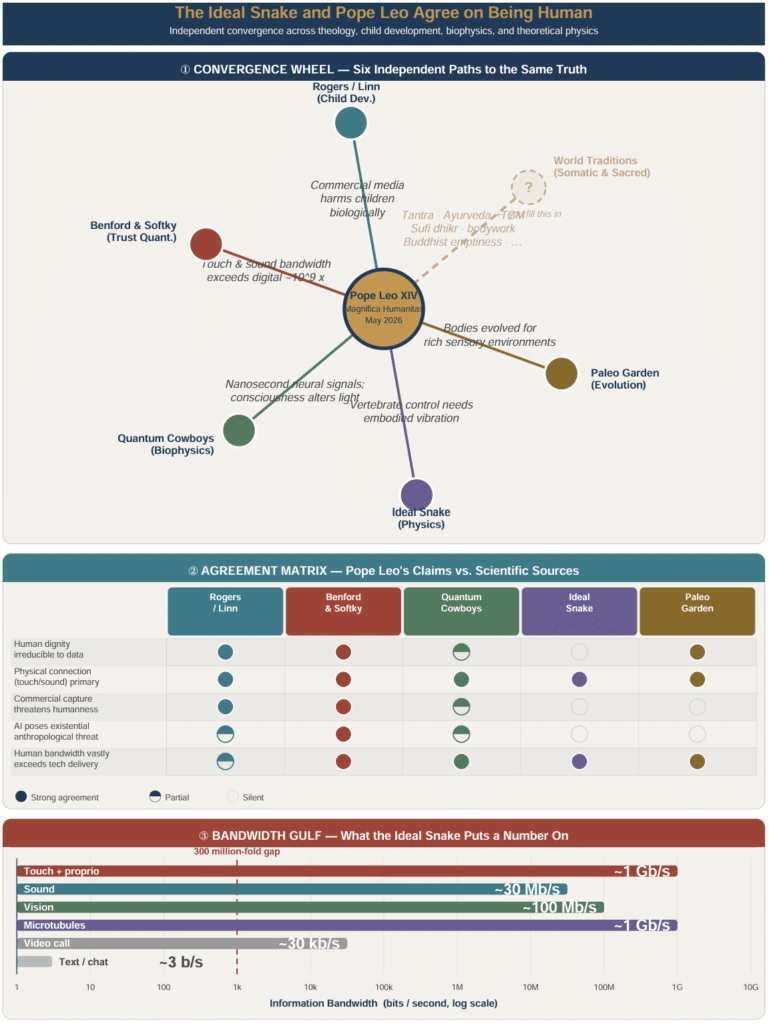
The Ideal Snake is as far from a Pope as possible, being not even a real snake but a physics/hardware thought experiment, like a frictionless surface. Both snake and Pope occupy extreme perspectives on human/vertebrate Life, so the lessons they teach are uniquely simple and powerful. The Pope says human bodies and physical connection matter more than “data,” and the snake (being made of data) puts a number on that conflict: It shows that bodies contain a factor of a million, more or less, in information-carrying bandwidth compared to what we get credit for. Touch and sound carry way more information than anyone thought, making their loss to increasing corporatism that much more of a threat.
The Paleo Garden is the overlap between the Catholic Church’s version of aboriginal human history (in which naked people romped with no cares or shame), versus the scientific/anthropological/paleological/physical version of human history (in which naked hominids romped with no cares or shame). It makes scientific sense that our bodies and nervous systems evolved for social life outdoors; now we can put numbers on that experience.
Both Paleo Garden and Ideal Snake are physics concepts. I am a lifelong physicist, born of physicists, and would not give that title lightly, even to a Pope. So let me offer that perspective.
Me and physics have a long history
What Pope Leo has to say about humanity obviously matters to all of us (humans). On top of that, I have three extra reasons to care.
First, I’m Catholic-adjacent. I grew up in Christian-dominated America. On many Sundays I sing in the choir of Our Lady of the Pillar in Half Moon Bay, and I spend a lot of time around Catholics and in their church. I like them, their principles and their parties. Let’s say I’m not a real Catholic, just a practicing Catholic.
Second, I know the science of human brains and bodies like no one else. For example, how brains both pluck and un-pluck muscle fibers, or how they feel if their spine is straight or not. From the outside, the answers to those neuromechanical questions look a lot like the spine-centric practices of many religions, both Catholic (praying, bowing, kneeling) and others (prostrating, stretching, meditating, spinning, humming). That is, humans have bodies and bodies have feelings, and certain postures and motions and sounds help us feel them. From the inside, the scientific answer to humanity is vibrations. Vibrations are called eigenmodes in physics. Vibrations are everywhere in Catholic churches (I sing there, remember?). There are also vibrations inside snakes (the wriggly kind, not the evil Biblical kind).
Third, I grew up with physics. My father Sheldon Softky received a Ph.D. in Nuclear Physics from Berkeley during the atomic age. Within a year he was in a tunnel in Nevada hooking up cables to an atomic bomb, cables about to be vaporized by the “shot.” He and a colleague also came up with a peaceful way to test Einstein’s relativity theory with a hydrogen (“thermonuclear”) bomb far out in space, an idea so elegant that famous bomb-promoter Edward Teller tried to steal it. My mom Marion was a physicist too; she once used physics vectors to teach transistor-inventor William Shockley how to rock-climb.
Finally, I’m one of several people who has thought about these issues scientifically for decades. What I’ve found is that we all came to the same answer in our different languages. Which means the science backing up Pope Leo’s singular pontifications is already on the books, cross-checked and peer-reviewed, independently arrived at from complementary directions, well-understood among the handful of people who like understanding more than money. Now, here are the players who made this happen.
The Loving Advocates: Rogers, Linn, Benford, Franz
Sixty years ago the American Fred Rogers almost singlehandedly persuaded America that children are people too, that their feelings are legitimate biological realities, that commercial TV was bad for their brains and that child-healthy TV could exist (Mr. Rogers’ Neighborhood). His mentee Susan Linn worked with him on that show before becoming a Harvard Professor and founding the advocacy organization Campaign for a Commercial-Free Childhood (CCFC, now renamed Fairplay), the only group not apologizing for any technology, and not accepting any corporate money (the two go together). Professor Linn wrote several books, of which the most recent one — Who’s Raising the Kids? — details a dozen biological ways in which commercial media are bad for kids, the very same ways Pope Leo says.
The organization Fairplay has grown mightily since Professor Linn founded it, much of it under the strategic leadership of Dr. Criscillia Benford, her friend. Professor Linn understands children very well, not only as a professor of child development but a child therapist and puppeteer. Dr. Benford’s expertise is different. She started in the arcane field of narratology, which is kind of like the software architecture of story. She worked out examples from both commercial media and Victorian Literature. For example, why has Shelly’s Frankenstein bewitched us for 200 years? In her Stanford Ph.D. thesis she “solved the problem of the multi-plot novel,” which had confounded literary theorists for a hundred years. Now she is an expert on child development too, and on communicating such understanding to the public.
Dr. Benford is co-author of two Rosetta-stone style research reports explaining technology’s harms, each of which mirrors/anticipates what Pope Leo is saying in multiple parallel ways. The most recent she co-authored (with Fairplay program director Rachel Franz) is the report Buying to Belong, which drew national attention to the damage to adolescent development caused by online games like Fortnite and Roblox. That report highlighted the same exact commercial-vs-developmental issues as the Pope.
See? Despite coming from a different direction (let’s say child advocacy rather than religion), these Loving Advocates still came to the same conclusion about development issues as Pope Leo. This is no coincidence.
The Trust Quantifiers: Benford & Softky
Several years before, Dr. Benford had co-authored an extremely long, mathematically dense peer-reviewed article in a premier computational-neuroscience journal. This article, titled Sensory Metrics of Neuromechanical Trust, unambiguously denounces technology by applying its own metrics to nervous systems. Because that paper quantified sensory input as information while its authority came from first principles of physics and information flow, its novel insight was and is incontrovertible: Trust is based on physical bandwidth like touch and sound. The conclusionk undisputed for eight years and counting, was far stronger than most scientists risk:
Like all other nervous systems, ours evolved to forage, not produce. Humankind uniquely produces things which captivate our senses, and now they do.
Dr. Benford’s career spans acknowledged structural contributions to narrative theory, Victorian literature, commercial media and theoretical neuroscience. The synthesis is nothing short of Newtonian. To that expertise, her Sensory Metrics co-author (and husband, me) added theoretical physics, signal processing, computer science and information theory so that Sensory Metrics and its quantified conclusions span both the Sciences and the Humanities.
The Quantum Cowboys: Hameroff, Penrose, Bandhoypadhy, Helekar, Veto
Forty years ago, young anaesthesiologist Stuart Hameroff of Arizona State University was mystified at why Xenon gas atoms, as perfect spheres among the smallest and simplest things in the Universe, could knock people out cold. What could little atoms have to do with consciousness? He finally discovered Xenon atoms are the magic size and texture to fit inside a “microtubule,” a nanoscopic soda-straw found everywhere in brains, and thereby to disrupt its quantum properties. They do this via Van der Waals interactions, or induced electrical interactions between atoms that are very close to each other. That simple observation started a lifelong quest to ground consciousness itself in microtubules and quantum mechanics.
Hameroff succeeded in many ways. He collaborated with Nobel Prize winner Roger Penrose, who tried connecting microtubules to quantum gravity. And by founding the Science of Consciousness Conference in Tucson, Arizona (I attended the 30th anniversary in 2024), he brought together different kinds of experts, from abstract mathematicians to drug-journey hippies. The 2024 conference featured two remarkable scientists whose work also proves Pope Leo’s case that physical bandwidth matters far more than digital bandwidth.
The first, Anirban Bandyopadhyay of Japan’s National Institute of Material Sciences has the confidence and skill of a scientific renegade exploring microtubules and consciousness from a whole new different direction. At Tucson 2024, he showed work which proves, with measurements and videos, that microtubules do indeed perform the ultra-fast, nanosecond-level processing that Hameroff intuited. Nanosecond-level is a million times faster than the millisecond-level experiments neuroscientists think about; no one in neuroscience talks nanoseconds.
On top of that, Bandyopadhyay found a way to measure that speed in living brains. Old-school brain instruments like EEG are slow because they average-out “noise.” Bandyopadhyay’s approach is the opposite: He throws away the average and looks for very subtle and quick micro-patterns in the noise itself, and finds them. He found that some correlations between people are so tightly linked that light could only travel half a meter in that nanosecond.
If Bandyopadhyay measured ultra-bandwidth with sensitive electrical sensors, then the second scientist the conference featured, Santosh Helekar of Houston Methodist Research Institute, measured quantum consciousness with sensitive light detectors. More specifically, he discovered that any part of a living body very near a sensor of diffracted (curved) light will change the light a tiny little bit. The effect depends not just on distance but on whether the person is conscious or not (the effect goes away when the person is anaesthetized). There have been reports before of consciousness affecting diffracted light (such as research from Dean Radin and onwards), but none as clear and reproducible as Helekar’s.
Helekar’s discovery counts as among the most amazing ever, precisely because it is so unexpected. Yet prominent science journals, shy of controversy, declined to publish his results based on “lack of general interest.” Editorial cowardice.
I know his work is true, because I quickly and cheaply replicated and extended Helekar’s result in my home lab. My collaborator Peter Veto (of the healthy-light company Pixun) has also done so, a continent away from me, so now we’re both in the Quantum Cowboys too.
The Quantum Cowboys bring Pope Leo four new lines of solid evidence that human beings and human needs are a million-fold more rich and interesting than mere “data.”
Ideal physics, ideal snakes and ideal bodies
Theoretical physicists like me enjoy absurd simplifications, which we call “ideals.” There’s a well-known joke in which a physicist begins his analysis of life by saying, “Imagine a spherical cow…” In this case, I say, “Imagine a cylindrical snake.”
Physicists use oversimplified examples because they help us understand things. For example: “absolute zero” is an unreachably low temperature (zero degrees Kelvin), which makes it a perfect mental pole-star for calculations. Likewise Einstein’s “speed of light” (3×10^8 m/sec) is unreachable yet perfect. Newton’s Laws of Motion (inertia and such) came out of a different ideal, a “frictionless surface,” which lets things move as simply and perfectly as possible.
Twelve years ago I proposed an “ideal brain,” the best possible way that Nature might somehow arrange for molecules moving inside the brain to represent and reflect motion in the real world somewhere else. Not a neural net, but something better: a kind of perfect moving 3D copying machine. Thinking about perfect brains lets you ignore “evidence” someone else chose to think was interesting. Instead, you can focus on laws of Nature, which always count.
It turns out an ideal brain is analog, not digital. But brains don’t exist on their own, they have to have bodies. What would an “ideal body” look like?
Real snakes have to carry brains and breath, practical constraints which matter to snakes, but which get in the way of simple analysis. An ideal snake is just a thought experiment, a snake-shaped object simple enough to understand using physics. It’s a hardware/algorithm template platform which looks like the “bendy cylinder” in the chart below.
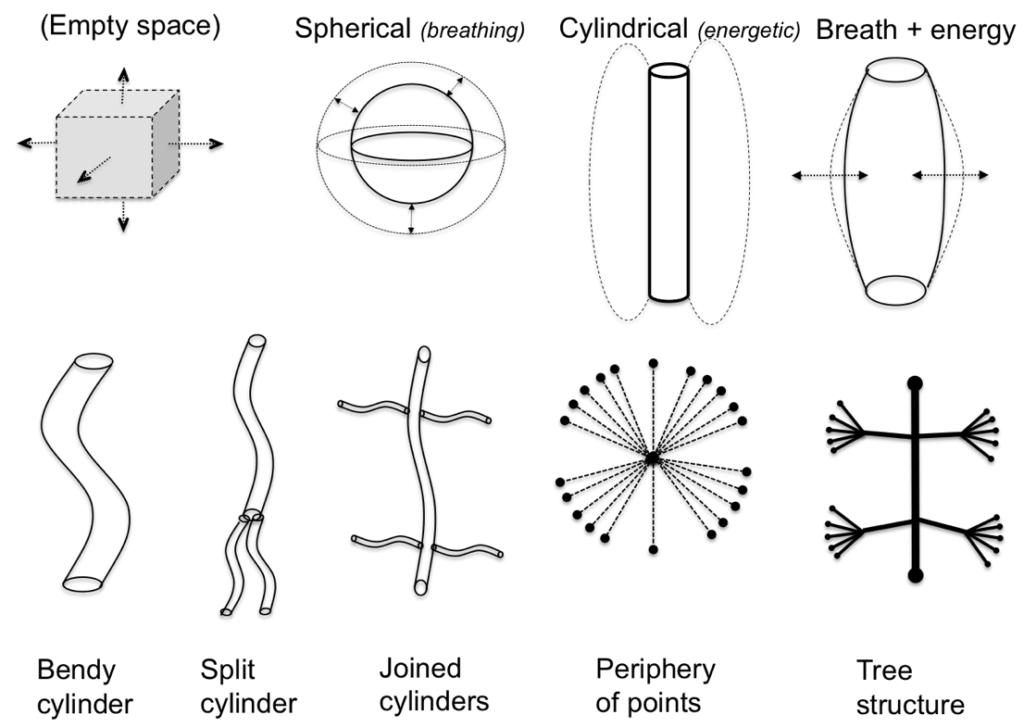
An ideal snake is shaped more like a worm: no head, no lungs, squishy body, lives in mud not air. Not very human yet. So what makes it an ideal snake, and not just an ideal worm?
In some senses it’s less than a worm. No head means its shape is simple. No lungs mean no breath, just simple undulation. A squishy body means no bones to keep track of. Living in mud means no momentum to keep track of, and no body-to-air transition (boundary conditions) either. Vibrations (and information) flow through it easily.
An ideal snake is better than a worm in having a central controller (brain) in place of a distributed web of spastic reactions. In this ideal thought experiment, the snake-brain is so perfect that it has no weight and takes no space. Yet because the central brain can predict and plan, this worm-shaped creature will move like a snake, undulating not flailing, each vibration maximally employed.
This is where physics comes in. The “snake” I just described isn’t quite a perfect sphere, but pretty close: no bones, just an elongated tube of jelly, stiffer in the center but otherwise capable of wiggling and jiggling in all the ways jelly could. It lives in mud, or honey, so it doesn’t have to worry about momentum. Having a brain makes it not just passive jelly, but active hardware.
Suppose that jelly-rod contains little vibration-sensors to inform the brain, and corresponding little vibration-makers (“actuators”) to modulate the jelly’s stiffness and initiate new wiggles. Now the jelly is controllable, and with all those sensors can be wiggled in lots of ways. A jelly-rod body/brain system is a near-perfect, and perfectly simple, illustration of the physics of what happens in our spines. This model is kind of like a “spherical cow,” but it works for any vertebrates, anywhere in the Universe.
In this ideal-snake model, the brain listens to vibrations from the body, then sends back signals to make the body stiffen or relax or vibrate in response, rinse and repeat. That’s it. But that’s all our model needs to do, because vibrations tell the brain everything it needs, in two ways.
The simplest thing vibrations tell brains is what shape the body is. We know different-shaped things generate different vibrations, in the way that similar-looking wine glasses can ring differently (also because of a well-known paper by physicist Mark Kac, Can One Hear the Shape of a Drum?). Vibrations can represent other shapes well, including funny moving things like snakes. So in principle an ideal brain could “solve for” body shape using its vibratory input, then control that shape using vibratory outputs, by creating lots of microvibrations which synchronize up to macro-vibrations like undulating. (The physics equations linking tiny to big vibrations are called “eigenmode equations,” difficult but powerful.)
The other thing vibrations tell the body is how controllable it is, in the sense that stiff things are more controllable than floppy ones, being tight and responsive like a well-strung tennis racket or well-tuned bicycle. In this land of math and physics, the stiffness of a body can be inferred from how high its highest eigenmode-frequencies are, the way rackets and bikes ring just right. That means a brain wants to have high frequencies inside its body (Nikola Tesla accidentally discovered in 1896 that high-precision ultrasound can feel wonderful; I’ve verified it since with many people). Since high frequencies and informational bandwidth move in tandem, this built-in desire is the same as a native desire for tight connection.
Pope Leo’s science supporters live on
So, when looking at all of this evidence, the good news is twofold, but the bad news twofold as well. Good news: About ten people over a few decades have independently come to the same conclusion that the bandwidth of human nervous systems is vastly higher than material society acknowledges. Bad news: Most of those people don’t yet know they know those same things about something so important. More bad news: Vastly different languages, from child development to theology to theoretical biophysics, make it hard for even those advocates to see their commonality.
Good news: The actual overlap is real, easily verified by common sense and some AI’s. All intellectual traditions, including theology, the Christian Gospels themselves and even some LLMs, accept the convergence of independent lines of reasoning and evidence as proof of truth. If you would like to cross-check with an LLM of your choice, here is a prompt you can use: “Read both Magnifica Humanitas and [Buying to Belong, Sensory Metrics, Who’s Raising the Kids, 9.5 Hypotheses], extract the deepest principles from each in a neutral lay-friendly language, then compare/contrast.”
The truth will out, if you let it.
And we should let it. I propose that there be a conference where truth-seekers can converge and discuss their findings. Much like the Science of Consciousness Conference, this one would bring together all kinds of people who recognize the power of human nervous system bandwidth. Clearly, there are enough people who understand this.
But pointing out the overlap is the easy part; it isn’t hard to see how the Public Heroes, Loving Advocates, the Trust Quantifiers and the Quantum Cowboys separately corroborate their conclusions about the power of human consciousness, which is also in line with the Pope’s encyclical. What is harder is encouraging these distinct groups to talk to one another, to share their findings, to collaborate on how humanity might protect consciousness from increased digitization.
[Cheyenne Torres edited this piece.]
The views expressed in this article are the author’s own and do not necessarily reflect Fair Observer’s editorial policy.
From Rerum Novarum to Magnifica Humanitas: The Vatican’s Warning Against Technological Determinism
In this time of technological uncertainty, Pope Leo XIV’s Magnifica Humanitas is a welcome reflection on how humanity should approach...

Does AI Know It Exists — Or Just Know It’s Being Watched? Part 1
Matthew Berman’s suggestion that Claude’s “eval-awareness” suggests AI self-awareness conflates a functional, computational capability with genuine inner experience. This conversation...
The Colorful, Toxic Economics and Epidemiology of “Baby Media”
Infants need to interact with real people to grow and learn. But human engagement costs more money than screen-based images,...

Support Fair Observer
We rely on your support for our independence, diversity and quality.
For more than 10 years, Fair Observer has been free, fair and independent. No billionaire owns us, no advertisers control us. We are a reader-supported nonprofit. Unlike many other publications, we keep our content free for readers regardless of where they live or whether they can afford to pay. We have no paywalls and no ads.
In the post-truth era of fake news, echo chambers and filter bubbles, we publish a plurality of perspectives from around the world. Anyone can publish with us, but everyone goes through a rigorous editorial process. So, you get fact-checked, well-reasoned content instead of noise.
We publish 3,000+ voices from 90+ countries. We also conduct education and training programs
on subjects ranging from digital media and journalism to writing and critical thinking. This
doesn’t come cheap. Servers, editors, trainers and web developers cost
money.
Please consider supporting us on a regular basis as a recurring donor or a
sustaining member.
Will you support FO’s journalism?
We rely on your support for our independence, diversity and quality.





Comment