


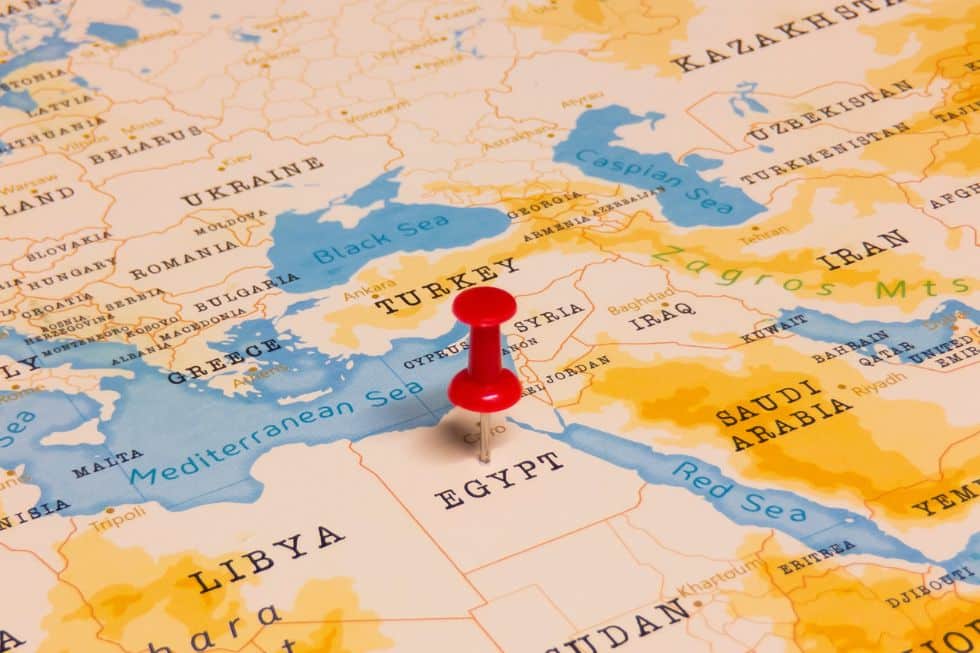



Egypt does not typically make headlines as a rogue actor, but that is changing. Cairo is arming a military commander that the US has sanctioned for war crimes, running drone strikes from its own soil against a rival faction, and sharing battlefield intelligence with forces accused of using chemical weapons — all while occupying a chair in the diplomatic quartet Washington assembled to end the same war Egypt is helping fight.
That is not ambiguity. The contradiction is glaring and growing harder to ignore.
Egypt’s expanding military role in Sudan
Since at least mid-2025, Egypt has been operating Turkish-made Bayraktar Akinci drones from a military airbase at East Oweinat in its Western Desert, just 37 miles from the Sudanese border, striking targets belonging to the Rapid Support Forces (RSF) inside Sudan.
The intelligence architecture runs deeper than hardware. According to Egyptian officials, the cooperation between Cairo and Khartoum includes not only surveillance and intelligence assistance but battlefield coordination in North Darfur and Kordofan, aimed in part at cutting off RSF supply routes.
After Head of Sudan’s Transitional Sovereignty Council Abdel Fattah al-Burhan visited Cairo in December last year, a joint operations room was reportedly set up in North Kordofan, with Egyptian officers making repeated trips to the front to coordinate logistics, targeting and battlefield intelligence with Sudanese Armed Forces (SAF) commanders. The following month, Egypt’s intelligence chief, Hassan Mahmoud Rashad, flew to Port Sudan for direct talks with Burhan, covering security cooperation, counterterrorism and Red Sea arrangements.
None of this is happening in a vacuum. Burhan is a sanctioned figure. The question of what it means — legally and diplomatically — for a nominal US partner to be running joint operations with him has not been answered because Washington has not yet forced the issue. Washington’s January 2025 sanctions, however, did not come out of nowhere. First, there were findings of war crimes in December 2023. Then, chlorine gas was allegedly used against RSF fighters, at least twice.
And yet Egypt still has a seat at the Quad table alongside the US, Saudi Arabia and the United Arab Emirates (UAE), the grouping meant to be anchoring ceasefire efforts, while running drone strikes for the side Washington sanctioned. A foreign ministers’ meeting was planned for July 2025, but it was indefinitely postponed. Cairo’s strategic logic is not hard to follow. From Egypt’s perspective, an RSF-dominated Sudan would create a corridor on Egypt’s southwestern flank and threaten the Nile water arrangements that Cairo treats as a red line. However, those concerns don’t explain Egypt’s shadowy role in the theater of war.
Egypt’s complicated relationship with smuggling and regional networks
For years, Iran and Hamas-aligned networks have exploited Egyptian territory as a conduit for weapons moving toward Gaza. The Israeli military confirmed after the October 7 attack that Hamas had used tunnel systems to smuggle weapons and ammunition from Egypt into Gaza in the lead-up to the assault. Egypt’s relationship with Hamas has long been managed through Cairo’s intelligence services, which in 2017 reportedly struck a deal with the organization — opening the Rafah crossing around the clock in exchange for Hamas halting attacks on Egyptian territory.
Additionally, the Muslim Brotherhood’s networks inside Egypt have given Iran a persistent back channel for moving weapons across the Sinai — not official, not acknowledged, but documented.
Iranian arms bound for Palestinian factions have long moved through Sudan and across Egypt before disappearing into Gaza through tunnels. That pipeline predates October 7 and has never been fully shut down. What that leaves is a country simultaneously brokering peace talks, flying combat drones for a sanctioned general and sitting atop smuggling routes it has never fully chosen to close.
The consequences of Washington’s silence
Washington has not publicly confronted Cairo on any of this, and this silence has familiar explanations: Gaza diplomacy, the Sinai, the Canal, decades of military aid that nobody wants to unwind. But silence has consequences. Every strike flown from East Oweinat on behalf of a sanctioned general sends a message: US designations are negotiable if you’re useful enough. Every weapons shipment that transits Egyptian territory toward Gaza is a reminder that strategic partnerships have been allowed to paper over serious security failures.
Of course, Egypt is not the only regional actor playing both sides of Sudan’s war. However, it is the one with a chair at Washington’s peacemaking table, and a drone base 37 miles from the front.
[Kaitlyn Diana edited this piece.]
The views expressed in this article are the author’s own and do not necessarily reflect Fair Observer’s editorial policy.
Turkey’s Shadow War in Sudan
Ankara’s drone diplomacy is reshaping one of Africa’s bloodiest conflicts and testing the limits of international law. Turkish-made drones have...
FO Live: How the Muslim Brotherhood Survives and Thrives Across the Middle East
In this episode of FO Live, Rohan Khattar Singh and regional experts examine the Muslim Brotherhood as a decentralized network...

FO° Talks: Sudan’s Civil War Explained — RSF vs SAF, Darfur Crisis and Red Sea Geopolitics
In this episode of FO° Talks, Rohan Khattar Singh and Fernando Carvajal examine how Sudan’s civil war grew into a...
Support Fair Observer
We rely on your support for our independence, diversity and quality.
For more than 10 years, Fair Observer has been free, fair and independent. No billionaire owns us, no advertisers control us. We are a reader-supported nonprofit. Unlike many other publications, we keep our content free for readers regardless of where they live or whether they can afford to pay. We have no paywalls and no ads.
In the post-truth era of fake news, echo chambers and filter bubbles, we publish a plurality of perspectives from around the world. Anyone can publish with us, but everyone goes through a rigorous editorial process. So, you get fact-checked, well-reasoned content instead of noise.
We publish 3,000+ voices from 90+ countries. We also conduct education and training programs
on subjects ranging from digital media and journalism to writing and critical thinking. This
doesn’t come cheap. Servers, editors, trainers and web developers cost
money.
Please consider supporting us on a regular basis as a recurring donor or a
sustaining member.
Will you support FO’s journalism?
We rely on your support for our independence, diversity and quality.





Comment